


550W PSU Planning for RTX 5080 Super Builds in SA
550W for RTX 5080 Super needs a full-build check, not a simple yes. Review GPU guidance, CPU draw, transient load, connectors, PSU quality, and upgrade plans before deciding.
Read morePower or video can fail when the USB-C host, cable or selected signal path lacks the required function. The UColor O2 supports one-cable power, audio and video, so troubleshoot each path separately before changing the display.
A USB-C monitor with no picture or power usually has a broken path somewhere between host capability, cable, port selection and display state. USB-C portable monitor troubleshooting works fastest when each layer is tested alone. The UPERFECT UColor O2 is R7,199.
USB-C failure usually means the user's port lacks display output, the cable is unsuitable or the host cannot provide enough power for the 3K OLED panel.
Disconnect docks and adapters, connect the UColor O2 directly with the intended cable, and test another suitable host port one change at a time. The R7,199 monitor supports single-cable USB-C power, audio and video, but the attached computer and lead must supply that route. Restore a basic image before applying 2880x1800, 120Hz or HDR.
Observe whether the screen shows any power state, whether the operating system detects another display and whether audio routing changes. Those clues distinguish a complete connection failure from a video-only or configuration problem.
Avoid changing resolution, cable and power source simultaneously. Record the first action that alters the symptom.
Use Evetech's portable-monitor selection when comparing connection requirements across exact models.
Remove the dock and connect directly. Inspect both plugs, try another tested cable, and use a different host port only after noting the original. A connector that charges another device still may not carry the required external-video route.
If another compatible computer is available, use it as a controlled comparison rather than a permanent conclusion about the first host.
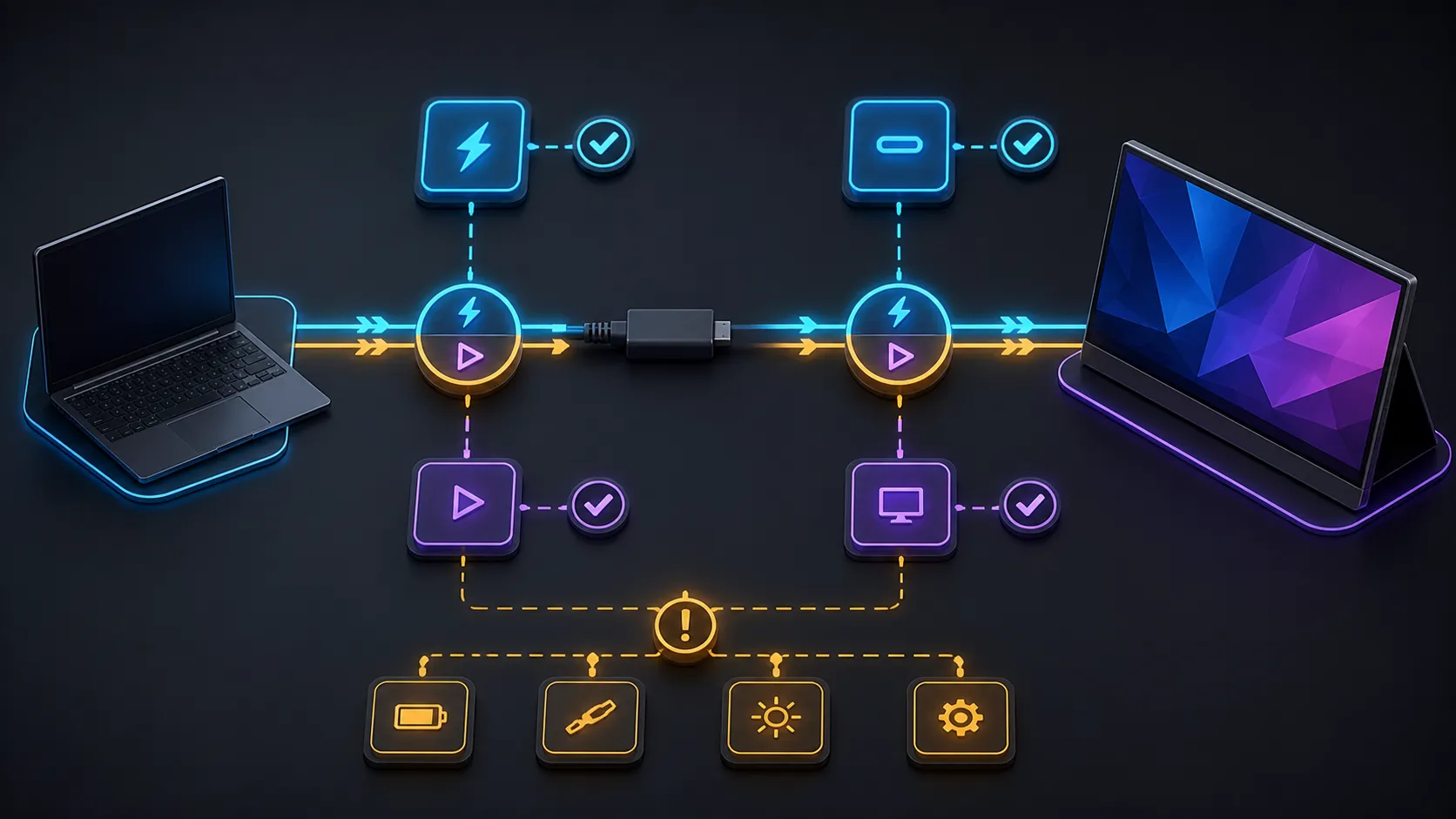
Open operating-system display settings and detect the panel. Start with a conservative, stable picture, then select the UColor O2's native 2880x1800 resolution. Add 120Hz afterward and leave HDR until the connection survives sleep and reconnection.
This order prevents a demanding display state from being mistaken for total hardware failure.
Label the successful port and cable, save the resolution and scale, then repeat the cold connection. Keep a direct baseline for future dock diagnosis. The Evetech PC-monitor category can help when a fixed screen and different connection plan suit the desk better.
If the fault persists, bring the written symptom sequence to support. A reproducible case is easier to resolve than a list of simultaneous changes.
Write each state in order: no power indication, power without host detection, detection without image, image at a basic mode, native resolution, then 120Hz. Mark where the setup first fails. This ladder converts a vague black-screen complaint into one identifiable boundary.
Repeat from a cold start before changing drivers or system files. An intermittent warm connection can lead troubleshooting toward the wrong layer.
Save the host model, operating-system version, port used, cable identity and the exact stage that fails. Photograph the physical path without exposing private information. Support can act more effectively when the issue repeats under a simple sequence.
Avoid stating that the monitor, laptop or lead is defective until the isolated tests justify that conclusion. The purpose of the evidence pack is to narrow the fault, not assign blame early.
Observe whether the monitor loses power when the host changes mode, disconnects from its charger or adds another device. Keep the display path direct and note the exact state that triggers the change. Do not infer a power budget or laptop-runtime result from the symptom.
If another tested route restores stability, preserve it as evidence rather than declaring every USB-C port equivalent. Power behaviour belongs beside video detection in the support record.
Once a stable image returns, test sleep and reconnection before restoring HDR or 120Hz. A repeatable recovery matters more than a one-off desktop appearance.
Start with one known full-featured cable and external power, then test native video before restoring one-cable operation. This isolates signal from power demand. If USB-C remains unavailable, Mini HDMI can prove the display through a separate input. Once the picture appears, select 2880x1800 and 120Hz deliberately; a basic fallback image does not confirm that the complete mode is working.
No. Charging and external video are separate capabilities. Test the exact host port for the required signal path.
It shortens the chain and reveals whether the monitor and host can communicate directly.
No. Establish a stable ordinary picture first, then restore native resolution, 120Hz and HDR in stages.
Include the host, port, cable, detection state and the single change that altered power or video behaviour.
Ready to rebuild the USB-C route from a clean baseline? Compare Evetech monitor connections after documenting the host, cable and display state that your desk requires.
No. Charging and external video are separate capabilities. Test the exact host port for the required signal path.
It shortens the chain and reveals whether the monitor and host can communicate directly.
No. Establish a stable ordinary picture first, then restore native resolution, 120Hz and HDR in stages.
Include the host, port, cable, detection state and the single change that altered power or video behaviour.
550W for RTX 5080 Super needs a full-build check, not a simple yes. Review GPU guidance, CPU draw, transient load, connectors, PSU quality, and upgrade plans before deciding.
Read more
8000Hz polling is overrated for most SA gamers because gains can be tiny next to battery drain and monitor limits. Mbombela players should weigh mouse feel, game support, and system stability before chasing the number.
Read more
Magnetic switches are taking over SA gaming keyboards because actuation can be tuned. For Sandton gamers, rapid trigger, reset control, and profile depth can help, but layout, key feel, and software quality still matter.
Read more
Polokwane oled monitor value questions need cautious SA context because pricing can move with availability, exchange rates, specs, and warranty support. Treat the trend as a planning signal, not a fixed price promise.
Read more
Arc B580 budget builds for Midrand gamers can shift with exchange rates, supply, specs, and model tier. Treat the title as a buying prompt, then compare SA warranty, timing, and build priorities.
Read more
ROG Ally X may beat the LCD Steam Deck for SA gamers who value stronger handheld performance, more memory, and Windows flexibility. Compare battery life, controls, game libraries, and Polokwane support needs before deciding.
Read more
Minisforum's M2 Pro pairs Core Ultra X7, Arc B390 graphics and 32GB onboard memory in 1.8 litres. SA buyers should weigh its fixed memory and $1,439 launch offer against local mini PCs.

Lenovo says Legion Go failures linked to BIOS N3CN42WW are not user error. Affected SA owners should stop retrying the update, preserve proof and open a support case.

Smart monitors can add apps and convenience, but they also add privacy settings and unwanted-software risk. SA buyers should audit the operating system before paying for extras.

A fake 113GB GTA VI ISO reportedly used empty padding around a small malware payload. SA gamers should delete unofficial builds, keep Windows security active and wait for official channels.

ASUS calls the ROG GT-BN98 the first Wi-Fi 8 gaming router. SA buyers should fix coverage and client limits before paying for a future wireless standard.

Apple's M6 Mac mini adds faster AI, graphics and networking in the same compact format. SA buyers should wait for a rand listing before comparing value.

The Vulcan II XP adds hot-swappable switches, sound damping and gaming controls to a full-size wired board. SA buyers should compare feel before features.

Microsoft says Windows on Arm now has over 7,000 verified apps and games. SA buyers should still check each driver, game and work tool before switching.

Xbox Insiders can test disc-to-digital from 31 August 2026. Supported Xbox One and Series X discs gain a digital entitlement, but older discs, regions and title coverage still need exact checks.
ViewSonic's XG2738 pairs QHD QD-OLED with 240Hz and automatic panel care. SA buyers should compare warranty, brightness, ports and burn-in protection against today's R9,999-plus OLED shelf.
NVIDIA's final Windows 10 Game Ready driver is due in October 2026. SA gamers can keep using their GPU, but new game optimisations move on while critical security fixes continue quarterly.

JBL's new Quantum 520, 520X and 120 headsets cover wireless, Xbox-certified and wired use. SA buyers should compare connection, comfort and microphone needs before paying for a new badge.