


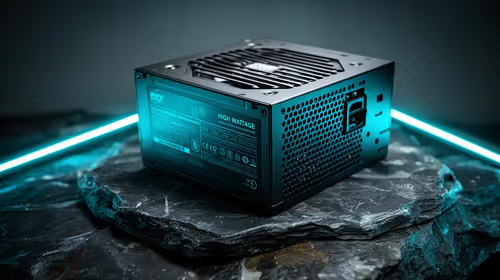
550W PSU Planning for RTX 5080 Super Builds in SA
550W for RTX 5080 Super needs a full-build check, not a simple yes. Review GPU guidance, CPU draw, transient load, connectors, PSU quality, and upgrade plans before deciding.
Read moreSynchronising several RTX Pro GPUs matters when one visual system spans graphics hardware that must remain coordinated. The R19,599 PNY RTX Pro Sync card supports up to eight GPUs and 32 displays, with Mosaic, Genlock and Frame Lock included.

Eight GPUs become relevant when a professional visual environment distributes applications and outputs across several graphics processors that must still behave as one system. The point of synchronizing NVIDIA RTX Pro GPUs is coordination across those boundaries, not a claim that more processors automatically produce a better wall.
Use up to eight NVIDIA professional GPUs when one high-resolution display environment needs more rendering or output capacity than a smaller GPU arrangement can provide.
Synchronise multiple GPUs when the visual workload or output map spans processors and the resulting frames must remain coordinated. PNY RTX Pro Sync is R19,599 and can cover eight NVIDIA RTX Pro GPUs plus 32 displays. Genlock, Frame Lock and Mosaic form its coordination toolkit.
List every application, visual region and output group. Assign each to a proposed processor and look for overloads or unnecessary duplication. This makes the reason for a second, fourth or eighth GPU visible before the parts are bought.
Compare Evetech's workstation graphics card range after the allocation is complete. Eight is an upper boundary; the project should stop at the smallest count that handles its approved workload and connections.
Highlight every place where content moves between outputs owned by different graphics processors. Those boundaries are the natural locations for frame-coordination tests. Frame Lock serves that multi-GPU role, while Genlock aligns equipment to a reference.
The PNY RTX Pro Sync card combines both lock functions at R19,599. It does not turn GPU quantity into a benchmark; the complete application and signal path still needs direct testing.
NVIDIA Mosaic supplies this multi-GPU design with its arranged screen surface. PNY's architecture reaches 32 panels, giving designers a clear display ceiling beside the limit of eight processors. Draw both counts on the same plan.
Select panels from Evetech's PC monitor category according to the audience, resolution needs and physical layout. More GPU capacity cannot compensate for a canvas whose screens or placement do not suit the content.
Use representative motion, transitions and workload while observing every cross-GPU boundary. Record the processors, outputs and synchronization roles active during a passing run. If the installation grows, repeat that sequence at each stage.
Review Evetech's graphics card accessories after the processor map is approved. The sync card's R19,599 price is one line within the full multi-GPU project budget.
Every graphics region should have a technical owner who understands its application, outputs and test content. When the installation spans several processors, this prevents a visible problem at one boundary from becoming everyone's responsibility and nobody's diagnosis.
Create a handover view that shows the eight-or-fewer participating GPUs without requiring someone to read the full design pack. Mark the display groups attached to each processor and the motion paths used during acceptance. A technician can then reproduce the relevant boundary before changing the broader wall.
If the architecture expands, name the owner and test before the new GPU joins the live visual field. This keeps multi-GPU scale manageable rather than treating synchronization as an automatic substitute for operating discipline.
RTX PRO Sync can coordinate that eight-processor architecture through as many as two synchronisation cards. Mosaic then supports a simultaneous field of 32 displays or projectors. The package contains four short and two long sync cables for internal connections. Scaling is justified by the visual workload and output map, while the known GPU ceiling prevents the design from expanding without an architectural boundary.
Coordination is needed when one visual system spans graphics processors and their frames or timing must remain aligned across output boundaries.
No. Eight is the maximum supported quantity. The ideal count comes from the real rendering workload and output allocation.
The PNY card supports up to 32 synchronised screens within the multi-GPU design.
No. Measure the actual application workload and end-to-end visual result; the supported count defines architecture, not a benchmark.
Assign the test to someone who understands the application path and the output groups on both sides of the boundary. That owner should preserve the motion sequence, active allocation and passing result. If another processor joins later, the same person can explain which old and new paths require observation. A second reviewer should confirm the result from the normal audience or operator position before handover. Name a replacement owner so the knowledge survives staff changes.
Keep both names beside the current processor map.
Ready to justify every processor in the wall? Map applications, outputs and cross-GPU boundaries before comparing Evetech's professional graphics and display options.
Coordination is needed when one visual system spans graphics processors and their frames or timing must remain aligned across output boundaries.
No. Eight is the maximum supported quantity. The ideal count comes from the real rendering workload and output allocation.
The PNY card supports up to 32 synchronised screens within the multi-GPU design.
No. Measure the actual application workload and end-to-end visual result; the supported count defines architecture, not a benchmark.
Assign the test to someone who understands the application path and the output groups on both sides of the boundary. That owner should preserve the motion sequence, active allocation and passing result. If another processor joins later, the same person can explain which old and new paths require observation. A second reviewer should confirm the result from the normal audience or operator position before handover. Name a replacement owner so the knowledge survives staff changes. Keep both names beside the current processor map.
550W for RTX 5080 Super needs a full-build check, not a simple yes. Review GPU guidance, CPU draw, transient load, connectors, PSU quality, and upgrade plans before deciding.
Read more
8000Hz polling is overrated for most SA gamers because gains can be tiny next to battery drain and monitor limits. Mbombela players should weigh mouse feel, game support, and system stability before chasing the number.
Read more
Magnetic switches are taking over SA gaming keyboards because actuation can be tuned. For Sandton gamers, rapid trigger, reset control, and profile depth can help, but layout, key feel, and software quality still matter.
Read more
Polokwane oled monitor value questions need cautious SA context because pricing can move with availability, exchange rates, specs, and warranty support. Treat the trend as a planning signal, not a fixed price promise.
Read more
Arc B580 budget builds for Midrand gamers can shift with exchange rates, supply, specs, and model tier. Treat the title as a buying prompt, then compare SA warranty, timing, and build priorities.
Read more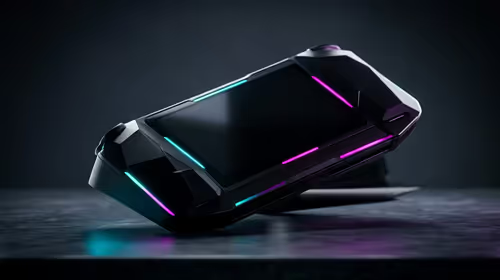
ROG Ally X may beat the LCD Steam Deck for SA gamers who value stronger handheld performance, more memory, and Windows flexibility. Compare battery life, controls, game libraries, and Polokwane support needs before deciding.
Read more
Minisforum's M2 Pro pairs Core Ultra X7, Arc B390 graphics and 32GB onboard memory in 1.8 litres. SA buyers should weigh its fixed memory and $1,439 launch offer against local mini PCs.

Lenovo says Legion Go failures linked to BIOS N3CN42WW are not user error. Affected SA owners should stop retrying the update, preserve proof and open a support case.

Smart monitors can add apps and convenience, but they also add privacy settings and unwanted-software risk. SA buyers should audit the operating system before paying for extras.

A fake 113GB GTA VI ISO reportedly used empty padding around a small malware payload. SA gamers should delete unofficial builds, keep Windows security active and wait for official channels.
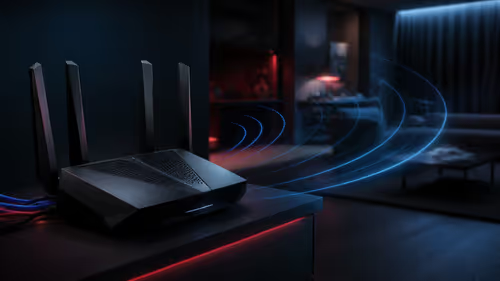
ASUS calls the ROG GT-BN98 the first Wi-Fi 8 gaming router. SA buyers should fix coverage and client limits before paying for a future wireless standard.
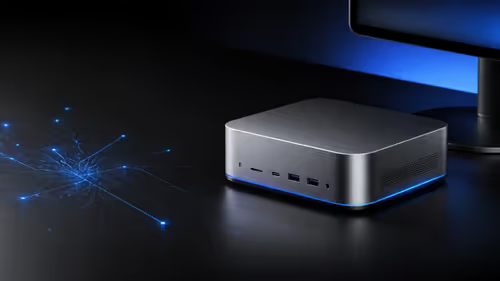
Apple's M6 Mac mini adds faster AI, graphics and networking in the same compact format. SA buyers should wait for a rand listing before comparing value.
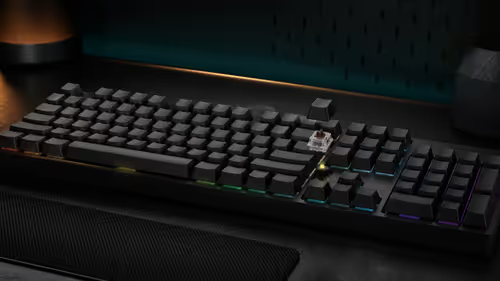
The Vulcan II XP adds hot-swappable switches, sound damping and gaming controls to a full-size wired board. SA buyers should compare feel before features.

Microsoft says Windows on Arm now has over 7,000 verified apps and games. SA buyers should still check each driver, game and work tool before switching.

Xbox Insiders can test disc-to-digital from 31 August 2026. Supported Xbox One and Series X discs gain a digital entitlement, but older discs, regions and title coverage still need exact checks.
ViewSonic's XG2738 pairs QHD QD-OLED with 240Hz and automatic panel care. SA buyers should compare warranty, brightness, ports and burn-in protection against today's R9,999-plus OLED shelf.

NVIDIA's final Windows 10 Game Ready driver is due in October 2026. SA gamers can keep using their GPU, but new game optimisations move on while critical security fixes continue quarterly.

JBL's new Quantum 520, 520X and 120 headsets cover wireless, Xbox-certified and wired use. SA buyers should compare connection, comfort and microphone needs before paying for a new badge.