


550W PSU Planning for RTX 5080 Super Builds in SA
550W for RTX 5080 Super needs a full-build check, not a simple yes. Review GPU guidance, CPU draw, transient load, connectors, PSU quality, and upgrade plans before deciding.
Read moreChoose between workstation and gaming cards by prioritising applications, projects and support needs. The PNY RTX A1000 is a R12,099 workstation option built on Ampere, with 8GB GDDR6 memory, 2304 CUDA cores and a 128-bit interface.

The label on a graphics card should not make the purchase decision. A production workstation and a gaming system can both use powerful GPUs, yet the buyer may value different software support, project behaviour and purchasing evidence. Compare a workstation graphics card vs gaming graphics card through the exact applications and tasks that must work.
The workstation side of this comparison is concrete: the RTX A1000 is a 50W low-profile professional card built for CAD, engineering, 3D and content-creation workloads.
Choose the category that clears the tested application and project, not the label that sounds more specialised. The workstation side is represented by PNY's R12,099 A1000. Its Ampere design contains 2304 CUDA cores. Memory capacity is 8GB GDDR6, joined to a 128-bit interface. An unnamed gaming card cannot be ranked against it.
A designer may care about a stable viewport and a repeatable export. An engineer may need a supported visualisation path. A gamer may prioritise frame behaviour in named titles and settings. These are different test plans, so a category-level argument cannot settle them.
Write the required software, file sizes and output deadlines first. Add the operating environment and any support policy that the team needs. Only then can the hardware comparison answer a business or creative requirement rather than defend a label.
Use the same project, application version and quality settings on every candidate. For a gaming test, keep the title, resolution and preset constant. For professional work, use a representative CAD model, render scene or editing project. Measure the result that affects the user, such as completion time or viewport consistency.
A raw CUDA count should not be compared with a different metric as though they mean the same thing. Memory capacity also needs context: 8GB may fit one working set and constrain another. Architecture and interface width complete the description, but neither guarantees the desired result.
The PNY RTX A1000 configuration is a workstation option costing R12,099. It contains 2304 CUDA cores on Ampere, plus 8GB GDDR6 connected through a 128-bit memory path. Use that complete set as one side of a comparison.
Evetech's workstation graphics card category helps buyers compare other professional options without pretending a single card represents the whole class. An unspecified gaming GPU cannot be ranked honestly, because its model, price, memory and architecture are unknown.
A professional workflow may depend on CPU, system RAM, storage or local AI support as much as the graphics card. If those needs are part of the decision, review Evetech's AI PC options alongside component choices. The best outcome may be a platform change rather than a category switch.
Keep the final recommendation conditional on evidence. If the workstation card clears the team's required tasks at an acceptable cost, it is suitable. If a tested consumer card meets the same needs and support conditions, the buyer can weigh that result without relying on category assumptions.
Two candidates may both pass the application test. In that case, compare physical compatibility, total platform cost, support expectations and the amount of useful headroom shown by the project. The tie should be broken by a documented workstation need, not by loyalty to either category.
If both still meet the same requirement at similar value, either can be defensible. Record why the selected model was easier to integrate or better aligned with expected file growth. A close result does not need an exaggerated winner.
Its professional package includes a single-slot form, PCI Express 4.0 x8 connection and four Mini DisplayPort 1.4a outputs capable of serving four 5K displays. Processing comes from 2,304 CUDA, 18 RT and 72 Tensor cores, supported by 8GB GDDR6 at 192GB/sec. A gaming alternative still needs its own exact specifications and application results; the A1000 side no longer has to remain abstract.
Driver policy and certification may further separate two named candidates.
The required applications and measured workloads should decide. Category names are useful for navigation, but they cannot replace task-specific evidence.
Yes. PNY's RTX A1000 8GB GDDR6 is a workstation graphics card, priced at R12,099 in this comparison.
No. Architecture, memory, application implementation and other hardware affect the outcome, while unlike GPU designs cannot be reduced to one count.
Its workstation label and hardware specifications do not predict a gaming result. Test the relevant title and settings if gaming behaviour matters.
Ready to compare graphics cards by the work they must complete? Use Evetech's professional GPU range to build one side of the shortlist, then test every candidate against the same real project.
The required applications and measured workloads should decide. Category names are useful for navigation, but they cannot replace task-specific evidence.
Yes. PNY's RTX A1000 8GB GDDR6 is a workstation graphics card, priced at R12,099 in this comparison.
No. Architecture, memory, application implementation and other hardware affect the outcome, while unlike GPU designs cannot be reduced to one count.
Its workstation label and hardware specifications do not predict a gaming result. Test the relevant title and settings if gaming behaviour matters.
550W for RTX 5080 Super needs a full-build check, not a simple yes. Review GPU guidance, CPU draw, transient load, connectors, PSU quality, and upgrade plans before deciding.
Read more
8000Hz polling is overrated for most SA gamers because gains can be tiny next to battery drain and monitor limits. Mbombela players should weigh mouse feel, game support, and system stability before chasing the number.
Read more
Magnetic switches are taking over SA gaming keyboards because actuation can be tuned. For Sandton gamers, rapid trigger, reset control, and profile depth can help, but layout, key feel, and software quality still matter.
Read more
Polokwane oled monitor value questions need cautious SA context because pricing can move with availability, exchange rates, specs, and warranty support. Treat the trend as a planning signal, not a fixed price promise.
Read more
Arc B580 budget builds for Midrand gamers can shift with exchange rates, supply, specs, and model tier. Treat the title as a buying prompt, then compare SA warranty, timing, and build priorities.
Read more
ROG Ally X may beat the LCD Steam Deck for SA gamers who value stronger handheld performance, more memory, and Windows flexibility. Compare battery life, controls, game libraries, and Polokwane support needs before deciding.
Read more
Minisforum's M2 Pro pairs Core Ultra X7, Arc B390 graphics and 32GB onboard memory in 1.8 litres. SA buyers should weigh its fixed memory and $1,439 launch offer against local mini PCs.

Lenovo says Legion Go failures linked to BIOS N3CN42WW are not user error. Affected SA owners should stop retrying the update, preserve proof and open a support case.

Smart monitors can add apps and convenience, but they also add privacy settings and unwanted-software risk. SA buyers should audit the operating system before paying for extras.

A fake 113GB GTA VI ISO reportedly used empty padding around a small malware payload. SA gamers should delete unofficial builds, keep Windows security active and wait for official channels.
ASUS calls the ROG GT-BN98 the first Wi-Fi 8 gaming router. SA buyers should fix coverage and client limits before paying for a future wireless standard.
Apple's M6 Mac mini adds faster AI, graphics and networking in the same compact format. SA buyers should wait for a rand listing before comparing value.
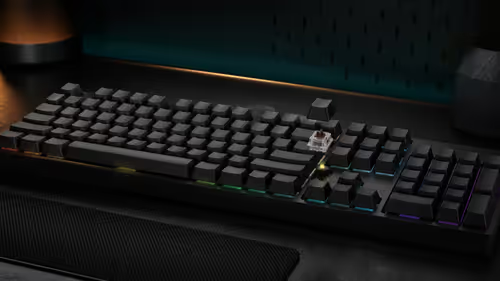
The Vulcan II XP adds hot-swappable switches, sound damping and gaming controls to a full-size wired board. SA buyers should compare feel before features.

Microsoft says Windows on Arm now has over 7,000 verified apps and games. SA buyers should still check each driver, game and work tool before switching.

Xbox Insiders can test disc-to-digital from 31 August 2026. Supported Xbox One and Series X discs gain a digital entitlement, but older discs, regions and title coverage still need exact checks.
ViewSonic's XG2738 pairs QHD QD-OLED with 240Hz and automatic panel care. SA buyers should compare warranty, brightness, ports and burn-in protection against today's R9,999-plus OLED shelf.

NVIDIA's final Windows 10 Game Ready driver is due in October 2026. SA gamers can keep using their GPU, but new game optimisations move on while critical security fixes continue quarterly.

JBL's new Quantum 520, 520X and 120 headsets cover wireless, Xbox-certified and wired use. SA buyers should compare connection, comfort and microphone needs before paying for a new badge.