Quick Answer
Optane caching is a dead-end on X870E — Intel discontinued Optane Memory entirely, and AMD platforms never supported it natively. SA builders on X870E should skip any Optane-based caching scheme and invest that budget into a 2TB Gen 5 NVMe (currently stocked at Evetech from around R2,200) that delivers 10,000 MB/s reads without the complexity.
Why Optane Caching Does Not Apply to X870E
Optane caching relied on Intel's RST (Rapid Storage Technology) and was exclusive to Intel chipsets from the Z370/Z490 era. AMD's X870E chipset, paired with Ryzen 9000-series CPUs, has no RST support. Even if you sourced a second-hand Optane H10 module, no driver stack exists to activate caching on an AM5 platform. The technology reached end-of-life in 2022, meaning no firmware updates, no warranty, and shrinking driver support under Windows 11.
For SA builders who purchased legacy Intel systems with Optane and are now migrating to X870E, the transition path is straightforward: wipe the Optane module from your old system, retrieve your data from the primary SATA drive, and replace both with a single Gen 4 or Gen 5 NVMe on the new board.
What X870E Builders Should Use Instead
X870E motherboards — including the ASUS ROG Crosshair X870E Hero and MSI MEG X870E ACE — provide up to four M.2 slots, with the primary two running PCIe 5.0 x4 at up to 14,000 MB/s. A Samsung 990 Pro 2TB (Gen 4, R2,400 at Evetech) or a WD Black SN850X 2TB (R2,600) covers gaming storage needs without any caching layer. For those who want tiered storage, a large Gen 4 NVMe as the OS drive plus a 4TB SATA SSD for game library is the modern equivalent and far simpler.
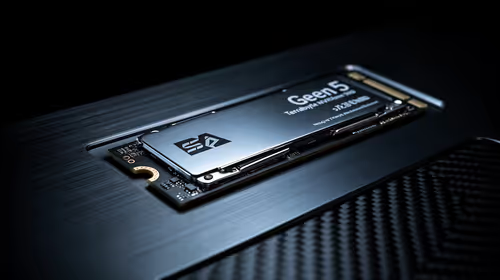
Gen 5 drives like the Crucial T705 2TB push sequential reads past 13,000 MB/s and are suited to 3D rendering, large asset pipelines, and video editing workflows where sustained throughput matters. For pure gaming, Gen 4 already saturates PCIe bandwidth beyond what load times can use.
SA Market Context: Legacy vs. Current Storage
Used Optane modules do appear on local classifieds, but buyers should avoid them. The modules are not compatible with X870E and carry no resale value upside. A 1TB Gen 4 NVMe starts at roughly R1,100 at Evetech currently, making legacy caching schemes economically pointless. Warranty is another consideration: local distributors provide two-to-five year cover on new NVMe drives; second-hand Optane carries none.
Builders repurposing an older Intel Optane-cached SATA HDD should treat that HDD as a secondary archive drive only. The Optane module itself is e-waste at this stage.
FAQ
Does X870E support Optane caching?
No. Optane caching requires Intel RST and was never compatible with any AMD platform. X870E is an AMD chipset and has no Optane support in hardware, firmware, or drivers.
What is the fastest storage option for X870E right now?
PCIe 5.0 NVMe drives via the CPU-direct M.2_1 slot deliver up to 14,000 MB/s sequential read. The Crucial T705 and Seagate FireCuda 540 are stocked at Evetech and represent the current performance ceiling for AM5 builds.
Can I use my old Optane module from an Intel build on X870E?
No — the module is electrically and driver-incompatible with AMD platforms. Treat it as non-functional hardware and invest in a fresh NVMe drive for your X870E build.
entirely on X870E — a 1TB Gen 4 NVMe at around R1,100 delivers faster real-world boot and load times than any legacy caching setup, with full warranty cover and modern driver support.