Quick Answer
In ZAR terms, 80 Plus Gold adds roughly R300 to R600 over a non-certified equivalent and saves you that back in electricity costs over two to three years. Full modularity adds R200 to R400 over semi-modular. ATX 3.0 compliance adds R300 to R500 over an older design but is essential for RTX 40-series and newer GPUs.
What 80 Plus Gold Certification Costs and Saves in SA 💰
An 80 Plus Gold 750W PSU from a reputable brand sits around R1,900 to R2,600 in South Africa. The equivalent model without a Gold rating from the same brand typically undercuts it by R300 to R500. Gold guarantees 87% to 90% efficiency across load ranges, meaning for every 100W your system draws, no more than 13W is wasted as heat. At Johannesburg City Power tariffs, running a 750W system for 2,000 hours per year at Gold versus no certification saves roughly 26kWh annually, or around R40 to R50 per year. Over a five-year PSU life that is R200 to R250, meaning the efficiency premium pays for itself in most usage scenarios with a thermal benefit on top.
Full Modularity vs Semi-Modular in Rand Terms 🔧
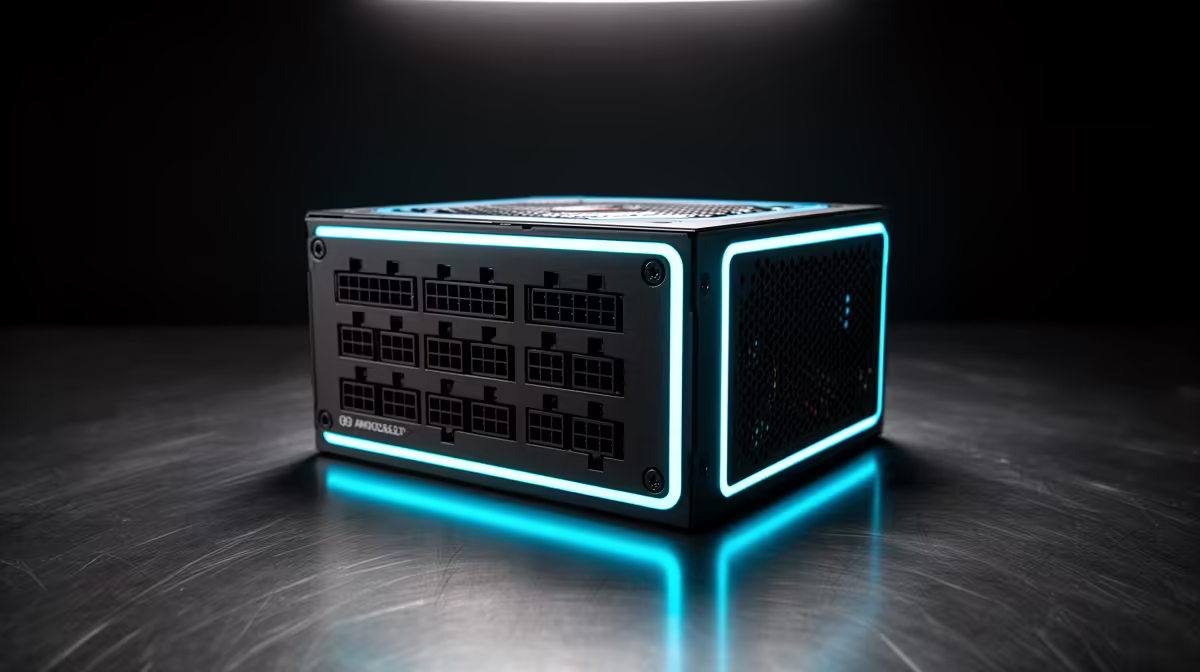
Semi-modular PSUs fix the 24-pin ATX and at least one EPS cable permanently to the unit. For most builds this is not a problem since those cables are always used. The price gap between semi-modular and fully modular within the same product family is typically R200 to R400. That gap buys you the ability to remove the main power cables entirely, making future upgrades, cleaning sessions and full teardowns substantially less frustrating. For builds in glass-panel cases where cable routing is visible, the aesthetic benefit adds subjective value. For builds tucked under a desk where cables are never seen, semi-modular is a rational saving.
ATX 3.0 Value Proposition for GPU Upgrades ⚡
ATX 3.0 compliance typically adds R300 to R500 to a PSU's price compared to an older design at the same wattage and efficiency rating. What you get is the native 16-pin 12V-2x6 connector eliminating adapter cables, transient excursion handling for GPU power spikes up to 200% of rated load, and tighter voltage regulation on all rails. For any builder pairing their system with an RTX 40 or 50-series card now or planning a GPU upgrade within the next two years, that R300 to R500 premium is justified by eliminating known adapter reliability risks and providing cleaner power delivery. Combining all three features, Gold plus full modularity plus ATX 3.0, brings a 1,000W unit into the R4,000 to R5,500 range at Evetech.
Stack Features Intelligently for Your Budget ⚡
If your budget is tight, prioritise Gold efficiency and ATX 3.0 over full modularity. A semi-modular ATX 3.0 Gold unit is a better buy than a fully modular non-ATX 3.0 unit for a current-gen GPU build. Cable management inconvenience is temporary. Connector incompatibility or power delivery instability is a lasting problem.
FAQ
Does paying for 80 Plus Platinum instead of Gold make sense for a gaming rig?
For a standard 6-to-8-hour gaming day, the electricity saving between Gold and Platinum at SA tariff rates is R20 to R40 per year. Platinum is better justified for systems running 12 or more hours daily on compute tasks.
Is there an 80 Plus rating above Platinum worth considering?
80 Plus Titanium is the highest tier, guaranteeing 94% efficiency at 50% load. Units at this rating are rare and expensive, typically adding R1,000 to R2,000 over Platinum equivalents. Reserved for always-on workstations or server adjacent builds where efficiency savings are significant.
Does ATX 3.0 mean I must replace my existing GPU cables?
No, ATX 3.0 PSUs ship with both the new 16-pin 12V-2x6 cable and standard 8-pin PCIe cables. You use whichever cable matches your GPU generation.
Want to understand exactly what you are paying for in your next PSU?
Evetech's power supply range covers every feature combination from entry Gold to fully modular ATX 3.0 Platinum, with transparent specs and local pricing.