Is Your PC Ready for the AI Revolution?
The term "AI PC" is suddenly everywhere, but what does it actually mean for your gaming rig? Is your trusty machine ready for the next wave of AI-powered games and apps, or is it about to be left in the dust? Forget confusing jargon... the real question is, how do you measure your PC's AI muscle? There’s no single magic button, but you can absolutely test your rig's AI capabilities right now. Let's dive in. 🚀
What an AI Performance Test Actually Measures
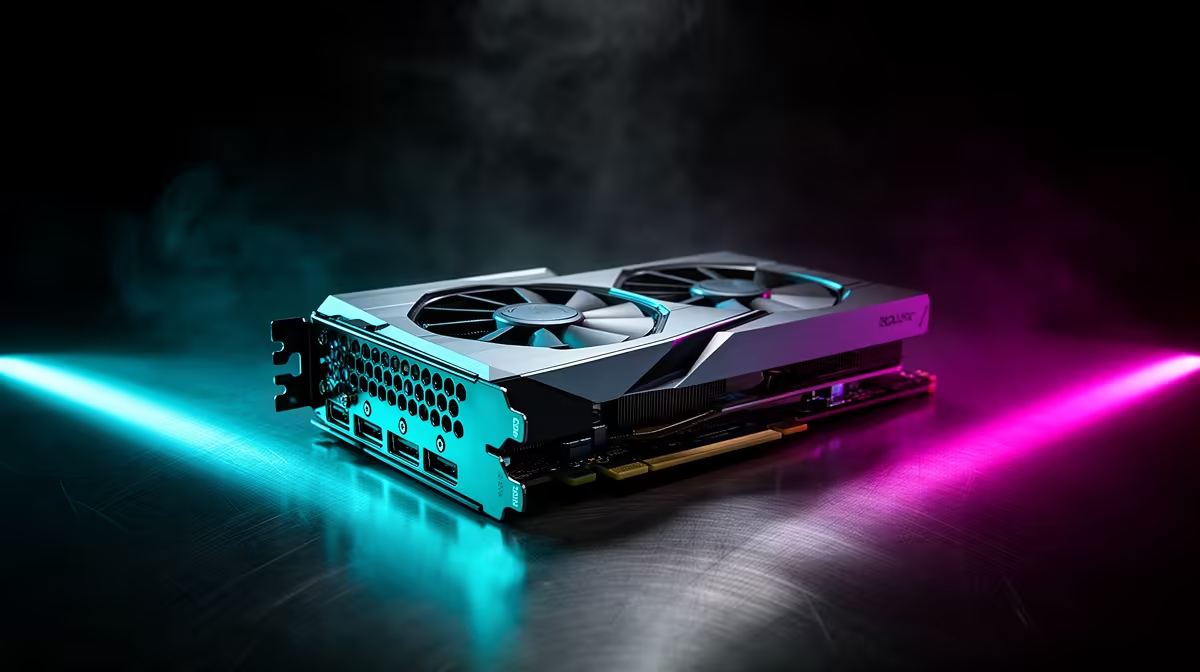
Before running any tests, it helps to know what you’re looking for. When we talk about AI performance on a PC, we’re mostly talking about how quickly your graphics card can handle specific tasks called "inference" operations. Think of it as your GPU's ability to make smart, rapid decisions.
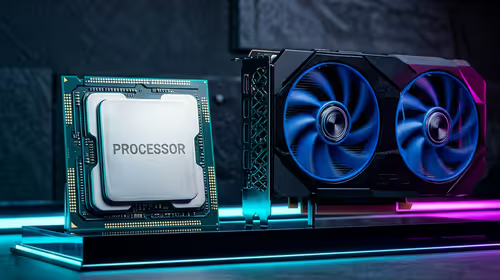
This is powered by specialised hardware inside your GPU:
- NVIDIA's Tensor Cores: Found in RTX cards, these are purpose-built for AI and machine learning, making them incredibly efficient at tasks like DLSS frame generation and ray reconstruction.
- AMD's AI Accelerators: Integrated into modern RDNA architecture, these components boost AI-driven features within games and creative software.
A good AI PC performance calculator or benchmark will push this specific hardware to its limits, giving you a real sense of its power beyond just raw FPS.
How to Test Your Rig's AI Capabilities Today
Ready to see what your machine is made of? Here are three practical ways to gauge its AI horsepower, from simple gaming tests to more advanced benchmarks.
1. The Gamer's AI Test: DLSS & FSR
The easiest way to see your PC's AI in action is to fire up a modern game. Features like NVIDIA DLSS 3.5 and AMD FSR 3 use AI to generate entire frames or intelligently upscale images, massively boosting performance.
- The Test: Pick a demanding title like Cyberpunk 2077 or Alan Wake 2. Run a benchmark or play a specific section with AI features (like Frame Generation) turned off, then run it again with them on the "Performance" or "Ultra Performance" setting.
- What to Look For: The difference in your average frames per second (FPS) is a direct measure of your GPU's AI prowess. A massive jump shows you have a powerful AI-ready machine. This is where modern NVIDIA GeForce gaming PCs truly shine, thanks to their dedicated Tensor Core architecture. ✨
2. The Creative's AI Test: Generative AI
If you’re into digital art or just curious about AI image generation, this is a fantastic real-world test. Using a tool like Stable Diffusion (with an easy-to-use interface like Automatic1111) you can see how fast your PC can create images from a text prompt.
- The Test: Generate a batch of 10 images using a standard prompt and settings (e.g., 512x512 resolution, 20 sampling steps). Time how long it takes.
- What to Look For: The key metric here is "iterations per second" (it/s) or simply how many images you can generate per minute. This is a tough workout that benefits hugely from a strong GPU, and many capable AMD Radeon gaming rigs offer incredible performance-for-rand in these creative tasks.
Check Your VRAM! 🔧
Many local AI models, especially for image or language generation, require a significant amount of video memory (VRAM). 8GB is a decent starting point, but for more complex models, 12GB, 16GB, or even 24GB is recommended. Running out of VRAM is a common bottleneck for AI tasks, so keep an eye on your usage!
3. The Technical Test: Synthetic Benchmarks
For those who want hard numbers to compare, synthetic benchmarks are the way to go. Tools like UL Procyon's AI Inference Benchmark or Geekbench ML run standardised AI workloads on your hardware (CPU, GPU, and NPU) and spit out a score.
This score is the closest you'll get to a universal AI PC performance calculator, making it perfect for comparing your system to others online or for measuring the impact of an upgrade. For professionals who rely on this power daily, investing in dedicated purpose-built workstation PCs ensures you have certified hardware optimised for these demanding AI and machine learning workflows.
The Verdict: Is Your PC AI-Ready?
Testing your PC’s AI capability isn’t about a single pass-or-fail score. It’s about understanding where your hardware excels and where it might fall short as AI becomes more integrated into everything we do. Whether you're a gamer seeking higher framerates or a creator exploring new tools, knowing your rig's AI strength is the first step to staying ahead of the curve.
Ready to Unleash True AI Power?
Whether you're gaming, creating, or experimenting, the future is AI-driven. If your tests show it's time for an upgrade, we've got you covered. Explore our massive range of custom-built PCs and configure the perfect machine to conquer the AI frontier.