

RTX 5070 Ti 16GB for Video Editing and AI Workflows
RTX 5070 Ti 16GB for video editing powers faster renders and AI-assisted workflows, speed up Premiere and Resolve exports, and optimize inference. 🎬🤖
Read moreUnlock peak performance with our AI PC power management guide. Learn to balance intense AI workloads with energy efficiency, reduce heat, and lower your electricity bill. 💡 We'll show you how to optimize settings, choose the right components, and keep your system cool. 🖥️
Staring at your high electricity bill and wondering if your beast of a PC is the main culprit? You're not alone. As we step into the era of AI-powered computing, our machines are getting smarter and more powerful... but also thirstier. Effective AI PC power management isn't just about saving a few rands on your Eskom bill; it's about unlocking peak performance, reducing noise, and extending the life of your components. Let's get your rig running lean and mean. 🚀
The term "AI PC" might sound like marketing fluff, but it represents a real shift. These machines use specialised hardware, like Neural Processing Units (NPUs), to accelerate AI tasks right on your device. This means more power, but also a new challenge: managing that power intelligently.
Proper AI PC power management ensures your system directs its resources where they're needed most. When you're in a heated Warzone lobby, you want every ounce of performance. But when you're just browsing or working, your PC shouldn't be running like a power station. Efficient management leads to lower temperatures, which means less fan noise and reduced thermal throttling—keeping your frame rates smooth and stable when it counts. For professionals, this translates to faster renders and a quieter work environment, especially in demanding powerful workstation PCs.
Before you even think about hardware, you can achieve significant efficiency wins right from your desktop. Mastering these settings is the first step toward optimal power consumption on your AI PC.
Windows gives you direct control over your PC's power profile. You'll find these options in Settings > System > Power & battery.
For most gamers and creators, sticking with the Balanced plan is the best way to manage power efficiently without sacrificing performance. Even the most powerful budget gaming PCs benefit from this simple tweak.
For advanced users, undervolting your CPU or GPU with tools like MSI Afterburner or Intel XTU can be a game-changer. It involves slightly reducing the voltage supplied to the component. The result? The same or even better performance at a lower temperature and power draw. It takes some research, but the efficiency gains are well worth the effort!
Your graphics card is often the single most power-hungry component in your rig. Both NVIDIA and AMD provide powerful tools to manage its appetite.
In the NVIDIA Control Panel, under "Manage 3D settings," you can set the "Power management mode" to "Normal" (the new name for "Optimal Power"). This allows the GPU to clock down when it's not under load. Similarly, the AMD Software: Adrenalin Edition offers extensive tuning options, allowing you to set power limits and custom fan curves on AMD Radeon gaming PCs to find your perfect balance. Fine-tuning these settings is crucial for getting the most out of high-end NVIDIA GeForce gaming PCs without the jet-engine acoustics.
While software tweaks are great, the biggest leaps in power efficiency come from the hardware itself. Modern processors and graphics cards are engineered from the ground up for intelligent power management, making an upgrade a smart long-term investment.
This is where the true value of a modern rig shines. Instead of brute-forcing performance, new components work smarter. This is especially true when you get one of our expertly configured pre-built PC deals, which are balanced for performance and efficiency from the start.
Modern Intel PCs feature a revolutionary hybrid design with two types of cores: powerful Performance-cores (P-cores) for heavy tasks like gaming, and smaller Efficient-cores (E-cores) for background processes. Windows 11's Thread Director intelligently assigns tasks to the right core, delivering incredible multi-tasking performance without wasting a single watt. This same efficiency-first approach is also found in their graphics cards, making Intel Arc gaming PCs a surprisingly power-conscious choice.
Not to be outdone, AMD Ryzen systems offer a brilliant feature called "Eco-Mode." Accessible through the Ryzen Master software or your motherboard's BIOS, it allows you to run your powerful CPU at a lower power target (TDP). For many games and applications, this can slash power consumption and heat output significantly with only a minimal drop in real-world performance.
Ultimately, the best AI PC power management strategy is having a system built with modern, efficient components. It saves you money, gives you a quieter experience, and delivers performance exactly when you need it.
Ready to Upgrade Your Power Efficiency? Taming your PC's power draw is key to a better gaming and creative experience. If your old rig is struggling to keep up efficiently, it might be time for an upgrade. Explore the best gaming PC deals in South Africa and find a machine that's both powerful and smart with its energy.
An AI PC's power consumption varies greatly, from 150W at idle to over 800W during intense AI training. Key factors include the GPU, CPU, and workload intensity.
The best power supply for an AI PC is an 80 Plus Gold or Platinum rated PSU with at least 850W-1000W. This ensures stable power for demanding components like high-end GPUs.
To improve efficiency, enable power-saving modes in your OS, undervolt your CPU/GPU, optimize software settings, and ensure your PC has adequate cooling to prevent throttling.
A stable undervolt can improve sustained AI performance. By reducing heat, it allows the CPU and GPU to maintain higher boost clocks for longer without thermal throttling.
Use tools like NVIDIA's control panel or MSI Afterburner to set custom power limits. This caps consumption, helping manage thermals and power during long AI workload sessions.
Not necessarily. Choose a PSU that matches your component needs with 20-30% headroom. An oversized PSU can be less efficient at lower power loads, wasting energy.
RTX 5070 Ti 16GB for video editing powers faster renders and AI-assisted workflows, speed up Premiere and Resolve exports, and optimize inference. 🎬🤖
Read more
- Assess longevity - Embrace scalable AI - Plan upgrade paths AI upscaling for gaming boosts visuals and FPS while extending GPU life, helping you future-proof your rig with smart upgrades ⚡🎮
Read more
RTX 5060 Ti for AI workflows delivers cost-effective tensor performance to accelerate training, inference, and data prep. Learn tuning tips, memory/driver setup, and benchmark gains to boost daily AI productivity. ⚡️💡
Read more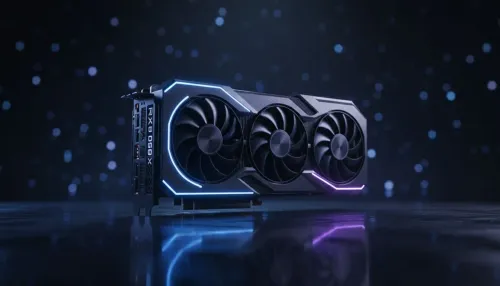
RX 9060 XT for machine learning: Explore whether the RX 9060 XT can handle local AI and ML tasks, plus practical tips, benchmarks, and configuration advice. ✅🔧
Read more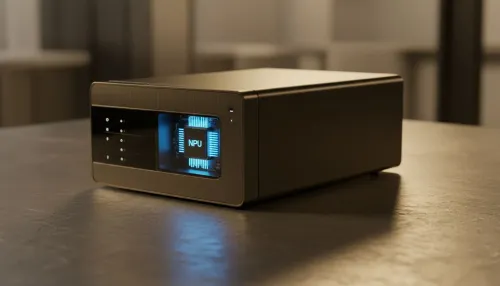
AI NAS combines storage and on-device AI by adding a neural processing unit (NPU). Learn how an AI NAS speeds inference, secures data, and boosts backups. 🤖💾
Read more
Edge computing smart home setups reduce latency, boost privacy, and enable on-device AI for future-proof automation and security. Learn hardware picks and upgrade tips. 🔒🤖
Read more
Discover webcams that automatically adjust light and color for crystal-clear video calls 🎥✨. Boost your streaming quality today!

Discover webcams that blend into your workflow 🎯 Capture moments while you work, stream, or create. Upgrade your setup with smart, multitasking tech!
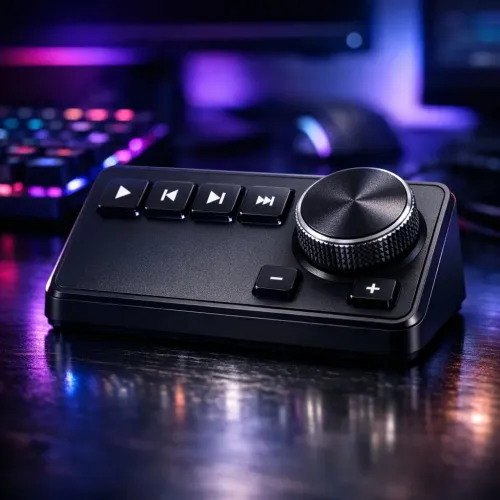
Dedicated media keys give streamers one-touch control to mute, switch scenes, clip highlights, and adjust audio — cutting task time and boosting consistency 🎛️⚡
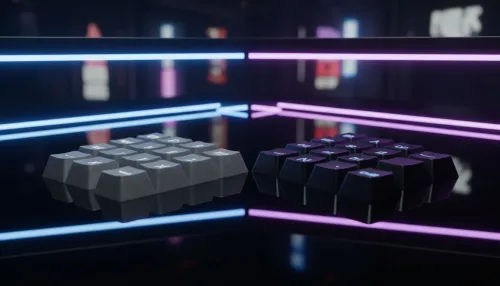
PBT vs ABS keycaps: Clear, local guide for South African gamers—compare feel, sound, durability and where to buy. Find the best material for your budget and playstyle 🎮🇿🇦

- Multi-Function Digital Dial: define benefits - Show gamer setups and macros - Offer buying and setup tips Multi-Function Digital Dial puts programmable control at your fingertips for faster actions and smoother streaming. 🎮⚙️
- Explain benefits; - Show the science; - Compare options; - Recommend picks. Magnetic wrist rest for gaming cuts wrist strain and boosts comfort during long sessions 🕹️✨