Tired of paying for API calls and dealing with network latency just to experiment with AI? For South African developers, the dream is clear: running a powerful Large Language Model (LLM) right on your own machine. It offers ultimate privacy, zero fees, and offline capabilities. But finding the best laptop for a local LLM can feel daunting. You need a specific blend of power that goes beyond typical development tasks. Let's break it down.
Why Run an LLM Locally on a Laptop?
Before we dive into the hardware, let's quickly cover why this is such a powerful move. Running models like Llama 3 or Mistral locally means your data never leaves your device—a huge win for privacy and proprietary code. You escape recurring API costs and can fine-tune models for specific tasks without restriction. The main hurdle? Your laptop needs the right muscle, especially when it comes to the graphics card.
Core Components for Your Local LLM Laptop
Finding the best laptop for a local LLM isn't about the brand... it's about the silicon inside. Three components are critical, but one reigns supreme.
The VRAM King: Your GPU 🚀
The single most important component for running LLMs is the Graphics Processing Unit (GPU) and, more specifically, its video RAM (VRAM). The entire model needs to be loaded into VRAM for fast performance. If it doesn't fit, it has to use system RAM, which is significantly slower.
- 8GB VRAM (e.g., RTX 4060/4070): A great starting point. You can comfortably run quantised 7-billion to 13-billion parameter models.
- 12GB-16GB VRAM (e.g., RTX 4080/4090): The sweet spot. This opens the door to larger, more capable models and even light fine-tuning experiments.
NVIDIA's CUDA technology is the industry standard for AI, making their GPUs the top choice. This same powerful architecture is what drives high-performance NVIDIA GeForce gaming PCs, which offer even more power if you need a dedicated desktop setup.
Pro Tip: Use Quantised Models 🔧
To run larger models on laptops with less VRAM, use quantised versions (like GGUF or AWQ). Quantisation reduces the model's size by using lower-precision data types, often with a minimal impact on performance. This technique can make a 70B parameter model runnable on a high-end laptop, which would otherwise be impossible.
System RAM: Don't Skimp on Memory
While VRAM is king, system RAM is the essential backup. When a model is too large for your VRAM, the system offloads layers to your main RAM. For a smooth experience, 32GB of DDR5 RAM should be your minimum target. If you plan on running larger models or multitasking heavily, 64GB will give you much-needed breathing room.
CPU and Storage: The Supporting Cast ✨
Your CPU and storage are less critical than the GPU, but they still play a vital role. A modern multi-core processor is essential for data preparation and keeping the rest of your system responsive. While your GPU is handling the AI workload, a snappy CPU from a manufacturer like AMD ensures your entire workflow remains fluid. This focus on balanced performance is also reflected in their desktop counterparts, like these powerful AMD Radeon gaming PCs.
Finally, a fast NVMe SSD is non-negotiable. LLM files are huge, often exceeding 10-50GB. An NVMe drive will load these models in seconds, not minutes. Aim for at least 1TB of storage.
Finding the Right AI-Ready Laptop in South Africa
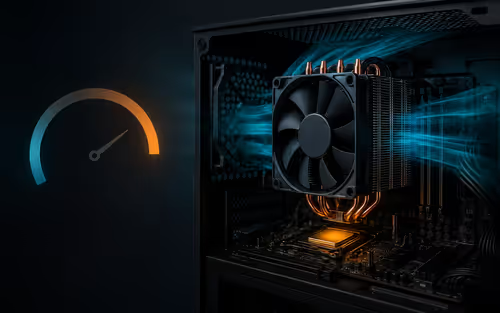
So, what does the ideal laptop for local LLM development look like? You're essentially looking for a high-end gaming laptop. These machines pack the powerful GPUs, abundant RAM, and excellent cooling required for sustained AI workloads. Look for models with an NVIDIA GeForce RTX 4070 or higher, at least 32GB of RAM, and a 1TB NVMe SSD.
For developers working on certified enterprise projects where driver stability and reliability are paramount, stepping up to a dedicated mobile or desktop workstation is a wise investment. These machines are built for 24/7 professional use, and you can explore options among our dedicated workstation PCs for maximum power and support.
Choosing the right machine is the first step to unlocking a new world of AI development, free from constraints.
Ready to Unleash Your Local AI? The best laptop for a local LLM is one that puts raw power, especially VRAM, in your hands. Gaming laptops offer the best performance-per-Rand for developers in South Africa. Explore our massive range of laptop specials and find the perfect machine to build your next big thing.