Building a PC in South Africa for more than just gaming? Welcome to the AI revolution! 🚀 From generating incredible art with Stable Diffusion to running local language models, the hardware demands are shifting. But while everyone talks about GPUs and RAM, a hidden bottleneck can cripple your performance: PCIe lanes. Getting this right is crucial for a powerful AI PC build, and this guide will show you exactly how.
What Exactly Are PCIe Lanes?
Think of PCIe (Peripheral Component Interconnect Express) lanes as the data highways inside your computer. Your CPU is the city centre, and components like your graphics card and SSD are the suburbs. More lanes mean a wider, faster highway, allowing more data to travel between components without causing a traffic jam.
Each new generation, like PCIe 4.0 or 5.0, doubles the speed per lane. But the number of available lanes is determined by your CPU and motherboard, and this is where planning your PCIe lanes for AI PC builds becomes critical.
Why Your AI PC Build Craves More Lanes
AI and machine learning tasks are incredibly data-intensive. They involve moving massive datasets back and forth between your storage, RAM, and most importantly, your GPU.
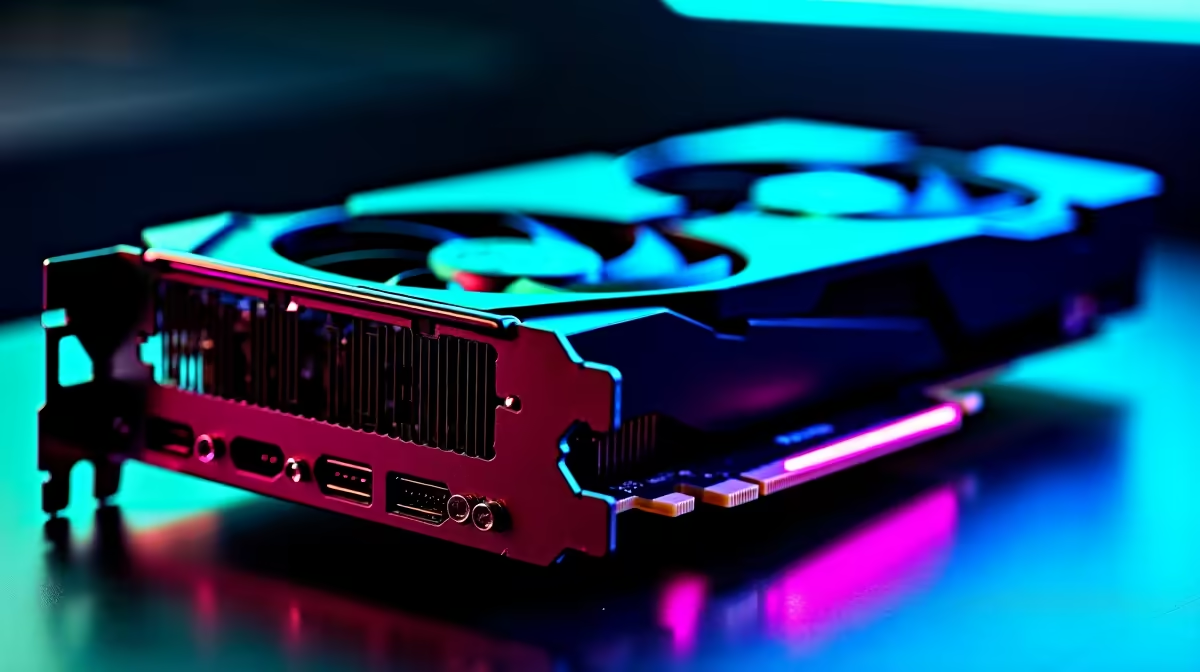
This is where having sufficient PCIe bandwidth is non-negotiable. Your graphics card, the primary workhorse for AI, typically needs a full x16 lane connection to the CPU to operate at peak performance. Starving a high-end GPU of the bandwidth it needs is like putting a speed limiter on a supercar... you're just wasting potential. High-performance NVIDIA GeForce gaming PCs are often configured to ensure the GPU gets the full bandwidth it deserves.
How Many PCIe Lanes Do You Actually Need?
The answer depends entirely on your workflow. Not everyone needs a supercomputer.
The Gamer & AI Dabbler
If you're primarily gaming but also experimenting with AI tools, a standard consumer platform is perfect. A modern Intel Core or AMD Ryzen CPU provides enough lanes (typically 20-24 direct from the CPU) for one GPU at full x16 speed and a super-fast NVMe SSD at x4 speed. This setup covers 90% of users and is the foundation for most high-performance AMD Radeon gaming PCs available in South Africa.
The Serious AI Enthusiast or Professional
This is where the conversation about PCIe lanes for AI PC builds gets serious. If your workflow involves:
- Multiple GPUs for faster model training.
- Multiple high-speed NVMe SSDs in a RAID configuration.
- High-speed networking or capture cards.
...then a consumer platform will become a bottleneck. You'll need to step up to a High-End Desktop (HEDT) platform like AMD's Threadripper or Intel's Xeon series. These CPUs offer a massive number of PCIe lanes (64, 128, or even more), ensuring every single component has a dedicated, uncompromised data highway. ✨
Check Your Motherboard Manual! 🔧
Before you buy, download the motherboard's manual online. Look for the 'Expansion Slots' or 'Specifications' section. It will show you exactly how the PCIe lanes are shared. For example, it might say 'The M.2_2 slot shares bandwidth with the PCIEX16_2 slot'. This is vital info to avoid performance surprises!
Common Pitfalls to Avoid
When planning your build, watch out for these common mistakes:
- Ignoring the Chipset: Your motherboard's chipset (e.g., Z790, X670E) provides additional PCIe lanes, but they all share a limited connection back to the CPU. For tasks that need the absolute lowest latency, like your primary GPU, always use the lanes that connect directly to the CPU.
- Accidental Bifurcation: Some motherboards will automatically split the main x16 GPU slot into two x8 slots if you install an NVMe drive in a specific M.2 slot. While PCIe 4.0 x8 is still very fast, it's not ideal for a top-tier GPU under heavy AI load.
- Forgetting the Future: If you think you might add a second GPU or a 10GbE network card down the line, investing in a platform with more lanes now will save you a costly upgrade later. For these demanding scenarios, exploring pre-configured custom-built Workstation PCs can provide a reliable, performance-tuned solution from day one.
Ultimately, understanding the flow of data in your system is key to building a balanced and powerful machine that won't let you down.
Ready to Build Your AI Powerhouse? Understanding PCIe lanes is the key to unlocking the true potential of your next rig. Don't let a hidden bottleneck slow you down. Explore our massive range of custom-built PCs and find the perfect machine to conquer your creative and AI goals.