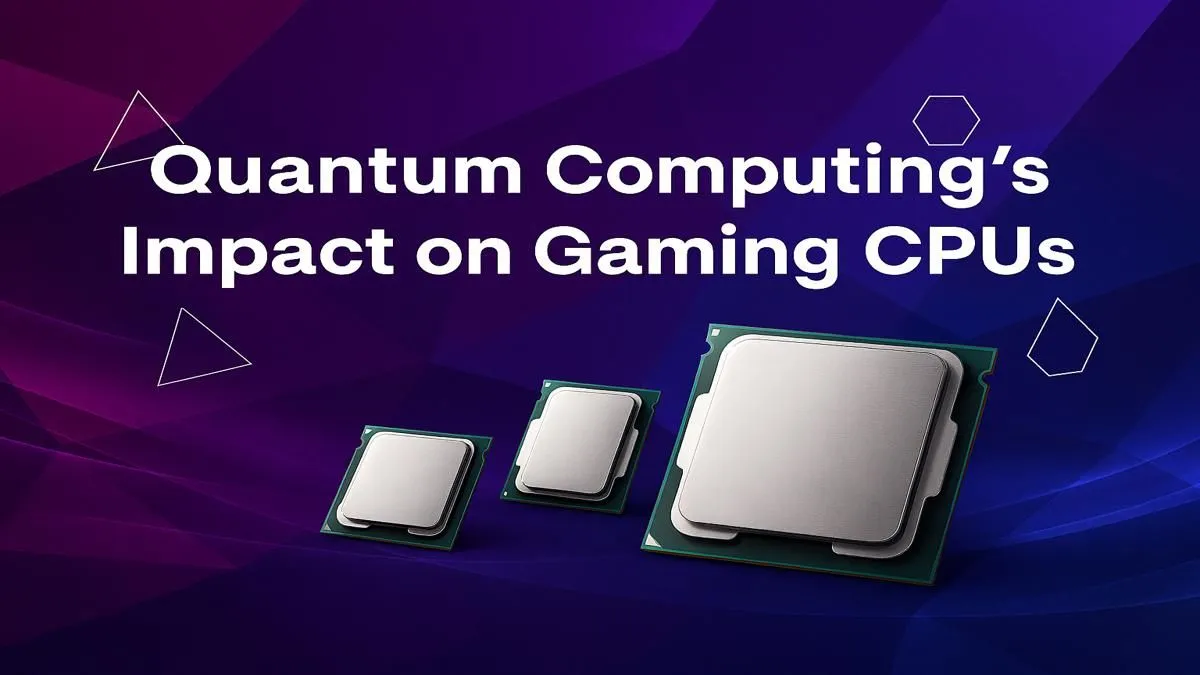
Tired of the endless Intel vs. AMD debate for that perfect frame rate? We get it. Every South African gamer wants the best performance for their rig. But what if the next massive leap isn't just more cores or higher clock speeds? Imagine a processor that could simulate an entire, truly dynamic game world in real-time… that’s the incredible promise of quantum computing for gaming, and it's set to redefine the future of your CPU. ⚛️
How Quantum Computing Could Revolutionise Gaming
Right now, even the most powerful gaming CPUs are based on classical computing. They use bits—ones and zeroes—to make calculations. It's an incredibly effective system that has served us well, but it has limits, especially when it comes to simulating the complex, unpredictable nature of reality.
Quantum computing for gaming throws out the rulebook. Instead of bits, it uses "qubits." Thanks to a wild principle called superposition, a qubit can be a one, a zero, or both at the same time. This allows a quantum processor to explore a vast number of possibilities simultaneously.
What does this mean for your future game library?
- Truly Intelligent NPCs: Forget scripted dialogue. Imagine NPCs with genuine memory, who learn from your actions and develop unique personalities. An entire city of characters could react organically to your choices, creating a story that is truly yours.
- Hyper-Realistic Physics: Water that flows perfectly, weather systems that evolve naturally, and materials that break and bend exactly as they would in the real world. The future of your CPU could involve simulating physics at a molecular level.
- Limitless Procedural Generation: Think No Man's Sky or Minecraft, but on an infinitely more complex scale. Quantum processors could generate entire universes that are not just vast, but also deeply intricate and consistent, from the biggest star down to the smallest rock.
While this future is exciting, the raw power needed for these tasks is far beyond what today's powerful CPU processors can handle alone.
Are We Swapping Our PCs for a Quantum Rig Tomorrow?
Let's get real for a moment. You won't be slotting a quantum processor into your motherboard next year. The challenges are massive. Quantum computers are currently enormous, require near-absolute-zero temperatures to operate, and are incredibly sensitive to environmental interference. They are also astronomically expensive.
For the foreseeable future, the battle for your PC's performance will remain firmly in the hands of the masters of classical computing. Choosing a top-tier Intel CPU for its leading single-core speeds in gaming is a brilliant move for any high-refresh-rate enthusiast.
On the other hand, the multi-core efficiency and value proposition of a powerful AMD CPU make it a champion for gamers who also stream or create content. The choice you make today will power your victories for years to come, long before quantum becomes mainstream. 🚀
Get the Most From Your CPU Today 💡
Don't leave performance on the table! A common mistake is forgetting to enable XMP (for Intel) or EXPO (for AMD) profiles in your PC's BIOS. This simple one-click setting allows your RAM to run at its advertised speed, often giving your CPU a significant performance boost in games and applications without any extra cost.
The Hybrid Future: Your Next CPU's Quantum Co-Processor
The most likely path forward isn't a full replacement, but a hybrid model. Think of it like a graphics card. Your main CPU handles the general tasks, while the GPU takes on the specialised graphics rendering.
In the future, we may see a similar relationship with quantum computing for gaming. A classical CPU will still run your operating system and the core game logic, but it could offload hyper-complex calculations—like advanced AI or environmental simulations—to a small, dedicated quantum co-processor (QPU) on the chip.
This hybrid approach combines the stability and efficiency of classical computing with the incredible parallel processing power of quantum mechanics. It's a future where the CPU as we know it becomes even smarter, delegating tasks to the best possible hardware for the job. It's not about replacing your processor, but enhancing it. ✨
Ready for Power You Can Use Today? The quantum future is fascinating, but epic gaming experiences are happening right now. For the best performance, choice, and value in South Africa, a powerful modern CPU is your ticket to victory. Explore our massive range of CPUs and find the perfect processor to conquer your world.