So, you're diving into the world of AI in South Africa. Maybe you're generating mind-blowing art with Stable Diffusion, training a model to predict the next big JSE trend, or just curious about the tech powering smarter NPCs in your favourite games. But there's a bottleneck you might be ignoring: your storage. The classic SSD vs HDD for AI debate isn't just for tech nerds; it's the difference between blazing-fast progress and frustratingly slow renders. 🚀
Why Your Storage Choice is Critical for AI
Artificial intelligence isn't magic... it's maths. And that maths requires feeding your powerful processor and graphics card massive amounts of data, constantly. Think of it like this: your GPU is a master chef, but it can only cook as fast as you bring it ingredients.
- Hard Disk Drives (HDDs): These are the old-school workhorses. A spinning platter and a mechanical arm read your data. They offer huge amounts of storage for a low price, but they're slow to find and deliver those "ingredients."
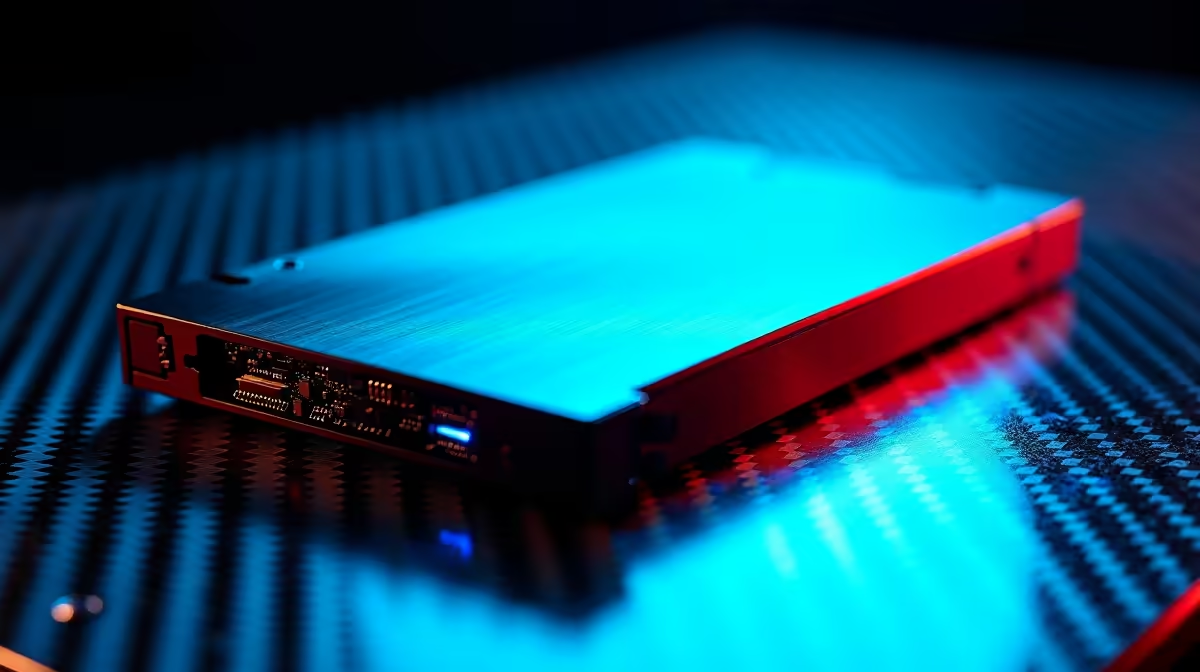
- Solid-State Drives (SSDs): These are modern, silent, and incredibly fast. Using flash memory, they access data almost instantly. They cost more per gigabyte, but the performance leap is enormous.
For AI workloads, where models can read the same dataset thousands of times, this speed difference is everything. A slow drive will leave your expensive components waiting around, wasting both time and electricity.
SSD vs HDD for AI Training: The Speed You Need
When you're training an AI model, your system is in a constant loop of reading data, processing it, and writing the results. This is where the argument for an SSD for AI becomes undeniable.
An NVMe M.2 SSD, the fastest type of consumer drive, can read data more than 10 times faster than a typical HDD. This means your dataset loads in seconds, not minutes. For complex tasks, this ensures your hardware is always working at its peak. A high-end graphics card, like those found in powerful NVIDIA GeForce gaming PCs, is only as good as the data you can feed it. Don't let a slow HDD be the weakest link in your high-performance chain. ⚡
Hybrid Storage Pro Tip 💾
best setup for most South Africans is a hybrid one. Use a fast 1TB or 2TB NVMe SSD for your operating system, AI software, and your active project dataset. Then, add a large, affordable 4TB or 8TB HDD for long-term storage, backups, and archiving old datasets. This gives you the best of both worlds: speed where it counts and capacity where you need it, without breaking the bank.
Is There Still a Place for HDDs in an AI PC?
Absolutely. While an SSD is non-negotiable for your primary drive, HDDs still offer unmatched value for bulk storage. AI datasets can be massive, easily reaching hundreds of gigabytes or even terabytes.
An HDD is the perfect, cost-effective solution for:
- Archiving: Storing raw, unprocessed datasets you don't need to access instantly.
- Backups: Keeping safe copies of your trained models and project files.
- Media Storage: Holding your massive library of games, movies, and music.
Even a beastly machine, like one of our AMD Radeon gaming PCs, can benefit from a secondary high-capacity HDD to complement its primary SSD.
The Verdict: The Best Storage for AI in South Africa
So, when it comes to SSD vs HDD for AI, the winner for active work is clear: the SSD. The performance gains in model training, data preprocessing, and overall system responsiveness are too significant to ignore. An HDD simply can't keep up with the demands of modern AI workloads.
For anyone serious about machine learning, deep learning, or creative AI generation, an NVMe SSD isn't a luxury; it's a foundational component. This is why professional-grade Workstation PCs are specifically configured with multiple high-speed drives to handle the intense data throughput required for demanding computational tasks. Your AI journey in South Africa starts with the right foundation, and that foundation is built on solid-state speed. 🧠
Ready to Unleash Your AI Potential? Choosing the right storage is just the beginning. To truly excel, you need a system built for performance from the ground up. Explore our range of powerful Workstation PCs and configure the perfect machine to bring your AI ambitions to life.