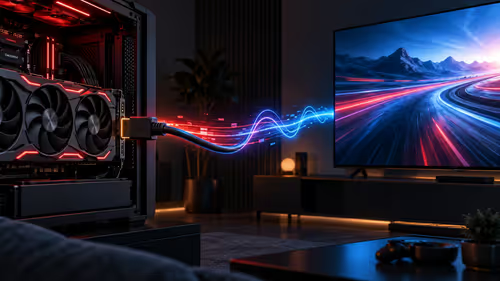
Seen those mind-blowing AI images online and thought, "I want to do that"? From creating epic fantasy characters to photorealistic scenes, Stable Diffusion puts incredible artistic power at your fingertips. The good news is, you don't need a Hollywood-level budget. But you do need the right tool for the job: a capable graphics card. Understanding the specific Stable Diffusion GPU requirements is the first step to turning your text prompts into digital masterpieces, right here in South Africa.
Why Your GPU is the Heart of Your AI Art Studio
Before we dive into specific models, let's quickly cover why your GPU is so critical. Unlike regular gaming where the CPU and RAM play major supporting roles, AI image generation is almost entirely a GPU task. It relies on two key things:
- VRAM (Video RAM): Think of this as your artist's canvas. The more VRAM you have, the larger and more detailed the images you can create without running into memory errors. It's the single most important factor for a smooth experience.
- Processing Power (CUDA/Tensor Cores): This is the speed of your artist. A more powerful core means your images are generated in seconds instead of minutes.
Essentially, the entire AI model gets loaded into your GPU's memory, so choosing from the right graphics cards is non-negotiable.
Decoding the Core Stable Diffusion GPU Requirements
The "best" GPU for you depends on your budget and ambition. Let's break down the Stable Diffusion GPU requirements into three simple tiers.
Minimum Requirements (Just Getting Started 🔧)
If you're on a tight budget and just want to experiment, you can get by with a GPU that has 6GB of VRAM. Cards like the NVIDIA GeForce RTX 3050 or even an older GTX 1660 SUPER can run Stable Diffusion.
However, be prepared for some trade-offs. You'll likely be limited to generating smaller 512x512 pixel images, and generation times will be noticeably slower. You'll also need to use software optimisations to manage the limited VRAM. It's a great way to learn, but you may hit a ceiling quickly.
Recommended Specs (The Sweet Spot ⚡)
For the best balance of price and performance, we strongly recommend a GPU with 10GB to 12GB of VRAM. This tier is where the magic happens for most hobbyists. The undisputed champion in this category has long been the NVIDIA GeForce RTX 3060 12GB model. It provides enough VRAM to handle larger resolutions, complex prompts, and even some light model training.
Newer options in the NVIDIA 40-series also offer fantastic performance. Exploring the current range of NVIDIA GeForce cards will give you plenty of powerful choices. On the other side, AMD Radeon graphics cards like the Radeon RX 7700 XT or RX 7800 XT are also strong contenders, offering competitive performance for their price point in ZAR.
VRAM-Saving Pro Tip ✨
If you're using a GPU with lower VRAM (8GB or less) with the popular AUTOMATIC1111 WebUI, you can enable memory-saving arguments. Edit your webui-user.bat file and add --medvram to the COMMANDLINE_ARGS. This can significantly reduce memory usage, allowing you to create larger images that might otherwise cause errors, albeit with a small performance hit.
Ideal Setup (For Power Users & Professionals 🚀)
If you're serious about AI art, want to train your own models, or simply crave maximum speed, then you'll want 16GB of VRAM or more. This is the pro-tier, where you can generate massive high-resolution images and iterate on ideas almost instantly.
Cards like the NVIDIA GeForce RTX 4070 Ti SUPER (16GB), RTX 4080 SUPER (16GB), and the beastly RTX 4090 (24GB) dominate this space. For commercial or research work, dedicated workstation graphics cards offer certified drivers and even more VRAM, but come at a premium price. This level of hardware ensures your creativity is the only bottleneck.
NVIDIA vs. AMD: The Quick Verdict
While both brands make powerful hardware, the AI community has historically favoured NVIDIA. This is due to its CUDA technology, which is a mature and widely supported platform for machine learning tasks. For a beginner, setting up Stable Diffusion on an NVIDIA card is typically a more straightforward, plug-and-play experience.
AMD is rapidly catching up with its ROCm and DirectML technologies, but you might need to do a little more tinkering to get things running perfectly. For your first AI rig, an NVIDIA GPU is often the path of least resistance.
Ready to Build Your AI Art Machine? The journey into AI art starts with the right hardware. Whether you're upgrading your GPU or building a new rig from scratch, we've got the components to bring your vision to life. Use our Custom PC Builder to spec your perfect AI rig and start creating today.