An AI workstation should be sized from the model that must fit, not from the fastest processor in the shop. For most local machine-learning workstation builds, GPU memory is the first hard ceiling, system RAM protects data preparation, and storage keeps checkpoints and datasets moving.
Quick Answer
Choose the GPU from the model, precision and batch size, then give the system enough RAM and SSD capacity to keep that GPU supplied. CPU core count matters for data loading and preprocessing, but it cannot compensate when the model does not fit in VRAM. In Evetech's July 2026 snapshot, the middle price across a mixed graphics-card range was R13,299 and the gaming-PC median was R26,722; neither figure prices a specified AI workstation.
🧠 Size VRAM from the workload
Model weights, activations, gradients, optimiser state and context all consume memory. Inference needs less than training, quantisation can reduce weight size, and a larger context window increases demand.
Start with the exact framework and model documentation. Add headroom for the operating system, display use and framework overhead. A configuration that barely loads can fail when batch size or context increases.
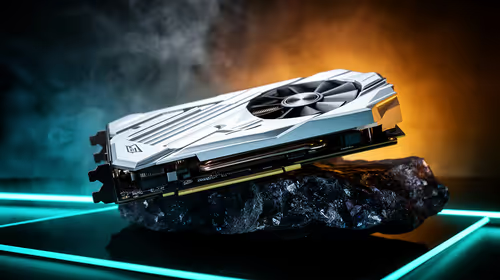
Gaming GPUs can perform serious local AI work when the software supports their architecture and memory capacity. Professional cards may add larger memory, validated drivers or application support, but the correct choice is workload-specific.
Precision changes the calculation dramatically. Full-precision weights require more memory than reduced or quantised formats, while training adds optimiser and activation demands. Use the intended software command or a trusted sizing tool to estimate the complete allocation before choosing a card.
Context length is another hidden multiplier for language models. A model that fits at a short prompt can exceed capacity during long-document work. Test the real context target, not only an empty launch.
💾 Build the data path around the GPU
System RAM holds datasets, preprocessing results and applications around training. Capacity should exceed the active data pipeline without forcing constant paging. Monitor peak committed memory during a representative run.
Use a fast internal SSD for environments, active datasets and checkpoints. Sequential speed helps large transfers, while many small files can expose random access and data-loader limits. Keep backups on separate storage.
CPU choice follows preprocessing, compilation and data-loader requirements. A GPU-bound inference box may need less CPU than a workstation transforming large datasets continuously.
Do not let storage capacity disappear behind speed. Model files, virtual environments, datasets and checkpoints can consume hundreds of gigabytes. Keep the active SSD below its limit and archive reproducible outputs separately.
⚡ Protect power, airflow and reliability
Sustained AI workloads can hold the GPU at high utilisation for hours. Size the PSU for the card, CPU and transient behaviour, with the correct native connectors and quality protections.
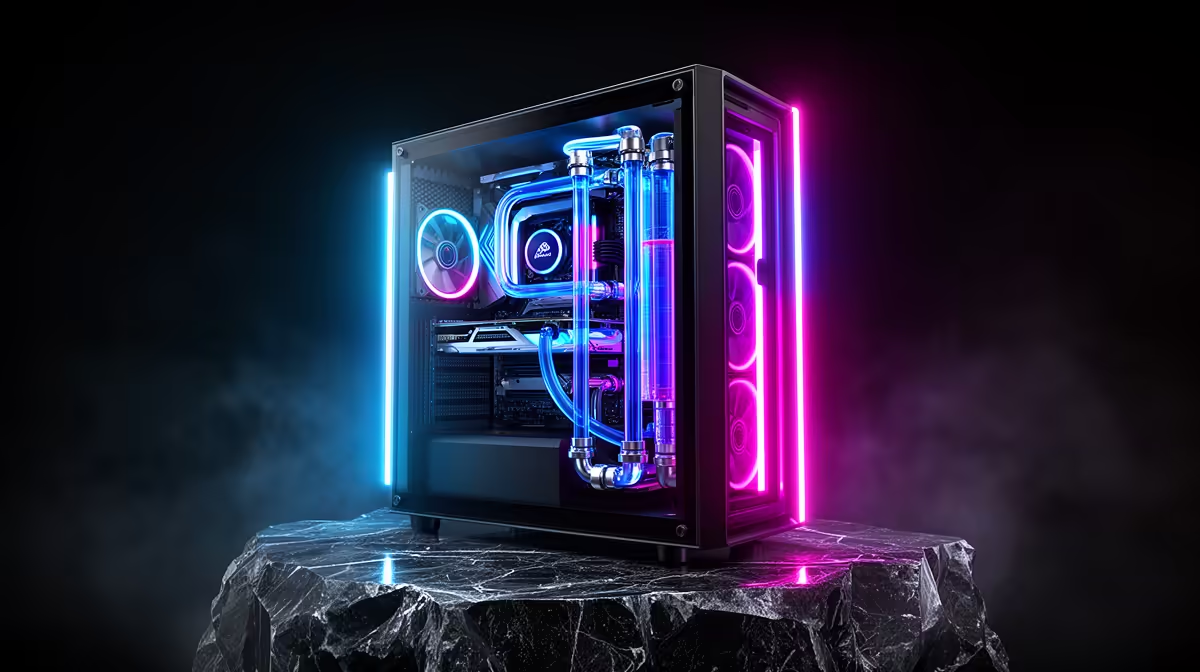
Airflow matters more than elaborate cooling. Give the GPU fresh intake, keep exhaust unobstructed and monitor memory as well as core temperatures where sensors are available. Water cooling is optional, not a requirement for a properly designed single-GPU workstation.
Check case clearance and slot spacing before considering multiple GPUs. Consumer platforms have limited PCIe lanes, power and physical room, while software scaling can be difficult. One larger-memory GPU is often simpler than two smaller cards.
🧪 Validate before expanding
Build one representative environment and measure model load, tokens or samples per second, VRAM use, system RAM, storage throughput and temperatures. These readings identify the next useful upgrade.
Evetech's gaming PC deals and PC best sellers provide complete-system references. Replace the gaming-first balance only where the AI workload proves another priority.
Keep environment files, driver versions and model configurations documented. Reproducibility is part of workstation performance; an unexplained software change can waste more time than a modest hardware gap.
Remote access and security belong in the build plan if the workstation runs unattended. Use authenticated access, protect model and customer data, and configure safe recovery after updates without exposing services directly to the internet.
Frequently Asked Questions
What matters most, CPU or GPU?
GPU capability and VRAM normally dominate accelerated training and inference. CPU importance rises with heavy preprocessing and data loading.
How much system RAM is needed?
Enough for the active dataset pipeline and applications without paging. Measure a representative workload and leave headroom.
Does storage speed affect training?
It can when the data loader cannot feed the GPU. Dataset structure, caching and random access matter beside peak sequential speed.
Can a gaming GPU handle serious work?
Yes, when the framework supports it and its VRAM fits the workload. Professional features remain application-specific.
Is water cooling necessary?
No. Suitable air cooling and case airflow can sustain a well-sized single-GPU workstation.
How much VRAM is enough for local LLMs?
It depends on parameter count, precision, quantisation and context. Calculate from the exact model rather than using one universal number.
Should I prioritise multiple GPUs?
Usually not for a first build. Software support, lane bandwidth, power and memory behaviour make one capable GPU the cleaner starting point.
Ready to turn the model requirement into a parts list? Record VRAM, system-memory and storage peaks first, then compare Evetech PC configurations with the GPU as the measured centre of the workstation.