Quick Answer
Building a Ryzen 7 9800X3D system under R20,000 in South Africa in 2026 requires careful component selection, but it is achievable if you pair the CPU with a mid-range GPU and skip unnecessary extras. The 9800X3D is one of the best gaming CPUs available and justifies the budget allocation even at the cost of a slightly lower-tier GPU.
Why the Ryzen 7 9800X3D Is Worth Centering a Budget Around
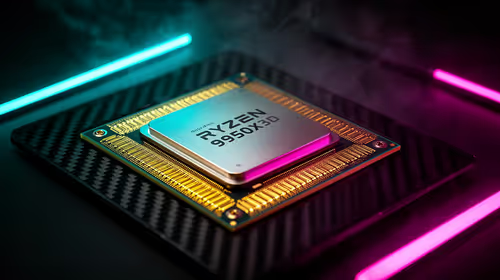
The Ryzen 7 9800X3D carries AMD's 3D V-Cache technology, which stacks additional cache directly on the CPU die. This dramatically reduces the latency of fetching game data, and the practical result is higher average framerates and significantly reduced CPU-side stuttering in games that are sensitive to cache latency.
In gaming benchmarks, the 9800X3D consistently outperforms CPUs with higher clock speeds and more cores in actual game scenarios. Titles like Apex Legends, PUBG, Microsoft Flight Simulator, and open-world RPGs see 15 to 40 percent higher average framerates compared to a standard Ryzen 7 9700X on the same GPU. For South African builders who plan to keep their CPU for four or more years, the 9800X3D is a more future-proof investment than a faster-clocked standard CPU.
The challenge in SA is that the 9800X3D commands a premium over standard Ryzen 9000-series processors. Getting the full system under R20,000 means making smart choices elsewhere.
Component Recommendations to Hit Under R20,000
Motherboard: AMD X670 or B650 chipset. B650 boards are significantly cheaper than X670 while supporting the 9800X3D's PCIe 5.0 and DDR5 requirements. A reputable B650 board in the R2,500 to R3,500 range is entirely capable and leaves more budget for GPU and RAM.
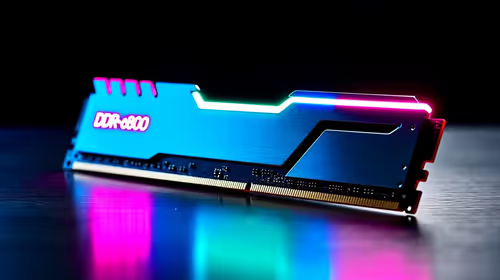
RAM: 32GB DDR5 in a dual-channel kit. The 9800X3D benefits from fast memory, with DDR5-6000 in EXPO profile being the widely recommended sweet spot. Kits at DDR5-6000 32GB are available in the R1,800 to R2,500 range. Do not drop below 32GB on a 9800X3D build, as the CPU's gaming prowess is often paired with multitasking scenarios.
GPU: To stay under R20,000 total, target an RTX 4060 Ti, RTX 4070, or RX 7800 XT. The 9800X3D removes CPU bottlenecking, so even a mid-range GPU performs at or near its theoretical maximum when paired with this CPU. An RTX 4060 Ti paired with the 9800X3D will outperform an RTX 4070 paired with a lower-end CPU in many titles.
Storage: 1TB NVMe PCIe 4.0 SSD. PCIe 5.0 SSDs are available but command a price premium with minimal real-world gaming benefit. PCIe 4.0 SSDs like the Samsung 980 Pro or WD Black SN850X are proven performers and available at accessible ZAR prices.
PSU: A quality 650W or 750W 80+ Gold unit. The 9800X3D has a 120W TDP, and paired with a mid-range GPU the system draw stays well within 650W. Spend on quality rather than wattage here: a reputable brand PSU protects all your components.
Loadshedding Considerations for This Build
The 9800X3D is an efficient processor despite its performance level. The total system power draw with an RTX 4060 Ti is typically 300 to 380W under full gaming load. This means a quality 1000VA UPS provides 10 to 15 minutes of runtime during loadshedding, enough to save progress and shut down safely.
For South African builders running extended gaming sessions, the B650 platform also supports Eco Mode profiles that reduce CPU TDP and power draw with minimal gaming performance impact, extending UPS runtime during unexpected power interruptions.
What Gets Sacrificed to Stay Under R20,000
Honestly, not much that matters for gaming. The trade-offs in a sub-R20,000 9800X3D build are: a mid-range rather than high-end GPU (the biggest performance gap), a B650 rather than X670 board (no practical gaming downside), and potentially a 1TB rather than 2TB SSD (expandable later). The CPU itself, which is the most impactful component in gaming, takes its full position in this build without compromise.
Frequently Asked Questions
Does the Ryzen 7 9800X3D require a specific cooler? The 9800X3D does not include a bundled cooler. AMD recommends a 240mm AIO or high-performance air cooler. A quality 120mm or 140mm single-tower air cooler like the Thermalright Peerless Assassin 120 SE cools the 9800X3D adequately and is available at a fraction of AIO pricing.
Is B650 vs X670 worth the price difference for the 9800X3D? For gaming, no. X670 adds extra PCIe lanes and some overclocking headroom that has no practical impact on 9800X3D gaming performance. Save the price difference for the GPU or RAM. Only consider X670 if you plan to use multiple PCIe 5.0 storage drives or have specific professional workload needs.
Can I upgrade the GPU later in this build? Yes. The B650 platform will support PCIe 5.0 GPUs when they become more accessible, and the 9800X3D will not bottleneck any GPU released in 2026 or the near future. Building around the 9800X3D now and upgrading the GPU in 12 to 18 months is a valid strategy.
How does the 9800X3D compare to the 9700X for gaming? The 9800X3D is consistently 15 to 35 percent faster than the 9700X in gaming, which is a larger gap than any comparable CPU upgrade in recent memory. For gaming-focused builds, the 9800X3D is the clear choice when budget allows.
Ready to Find Your Perfect Match? Find the Ryzen 7 9800X3D and AMD's full CPU lineup at Evetech with competitive ZAR pricing and SA-wide delivery.