


Stuck Pixel Checks for a Mechanical Keyboard Setup
Stuck pixel on a Mechanical Keyboard is likely a display symptom around that setup, not the part itself. Check the monitor, cable, GPU output, drivers, and warranty path first.
Read moreExplore our expert DeepSeek PC build case study and discover the optimal components for peak AI performance. We break down the best GPUs, CPUs, and RAM configurations to help you build a powerful local AI machine without the guesswork. 💻 Unlock incredible speed and efficiency for your machine learning projects today!
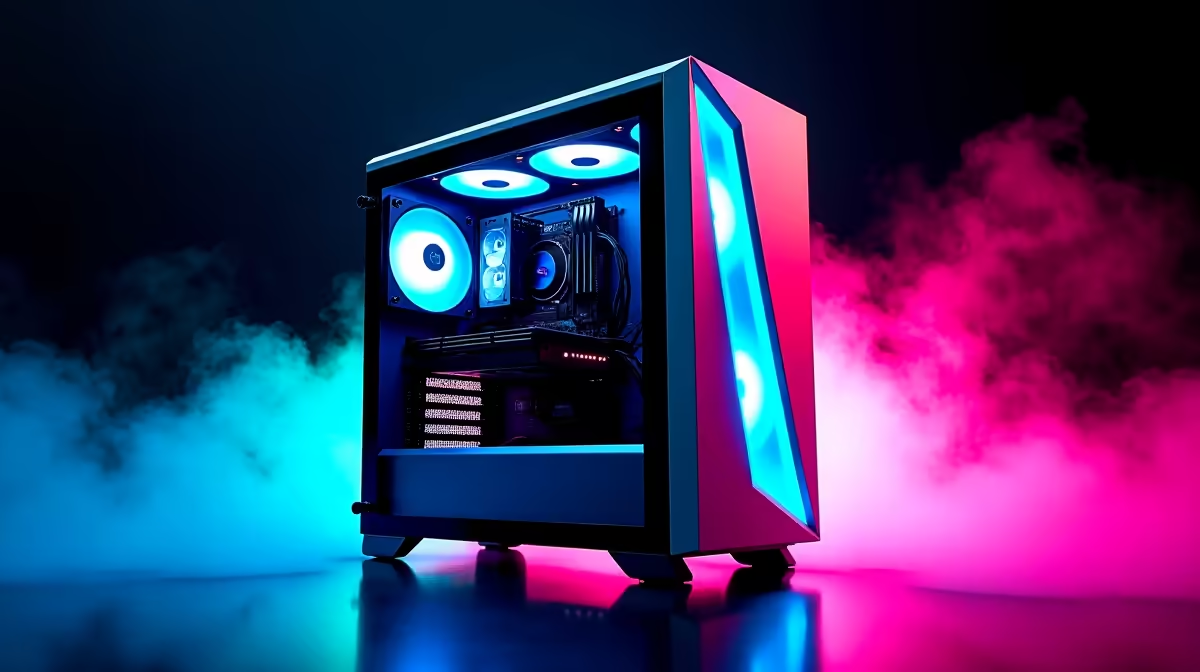
Ever felt your gaming rig stutter when you try to do... more? We're not just talking about running Discord and Helldivers 2. We mean serious, heavy-lifting tasks like training a local AI model, rendering a 4K video, or compiling code. The lines are blurring. What if one machine could dominate both the latest AAA titles and complex workloads? ⚡ This is the thinking behind our DeepSeek PC Build—a high-performance case study in building a rig that works as hard as it plays.
A true DeepSeek PC Build isn't just about cramming the most expensive parts into a case. It's a calculated balancing act. AI and machine learning tasks often crave more CPU cores and massive amounts of VRAM, while high-refresh-rate gaming still heavily relies on raw single-core speed and GPU clock speeds. The goal is to find the sweet spot where neither task feels compromised. This case study explores the components chosen to achieve that powerful harmony.
The CPU is the command centre, and the choice between Team Blue and Team Red is more nuanced than ever. For a build like this, you need to weigh up core counts against clock speeds.
A modern processor from Intel's Core i7 or i9 range offers incredible single-threaded performance, which is fantastic for gaming. Many of the top-tier Intel PC deals are built around this principle. On the other hand, AMD's Ryzen 9 series often packs more cores and threads at a competitive price point, giving it an edge in heavily multi-threaded workloads like compiling code or running virtual machines. Exploring the latest AMD Ryzen PC deals reveals just how potent these CPUs are for productivity.
For our DeepSeek PC Build, we'd lean towards a CPU with a high core count but without sacrificing clock speed... a tough but achievable balance.
For a high-performance PC build, don't skimp on cooling! Whether you choose a high-end air cooler or an All-in-One (AIO) liquid cooler, effective thermal management prevents your CPU from throttling under sustained load. This ensures you get the maximum performance you paid for, especially during long rendering sessions or intense gaming marathons.
Here’s where a DeepSeek PC Build really distinguishes itself. The GPU is no longer just for pushing pixels; it's a parallel processing monster essential for AI.
NVIDIA's CUDA technology gives it a significant advantage in the machine learning space, making GeForce RTX cards a top choice. The Tensor Cores in modern RTX GPUs accelerate AI operations, drastically cutting down training times. This makes browsing the latest NVIDIA GeForce gaming PCs the first stop for anyone serious about AI.
However, we can't ignore the raw gaming performance and value offered by Team Red. The latest AMD Radeon gaming PCs deliver exceptional frame rates, often at a very competitive price in ZAR. And with new players entering the market, it's always worth keeping an eye on how Intel Arc gaming PCs are evolving, especially for content creation workloads like AV1 encoding.
Crafting a specialised, high-performance PC build is incredibly rewarding, but it demands research, time, and a bit of technical know-how. You have to balance budgets, check component compatibility, and handle the build process yourself. It's a journey that bridges the gap between powerful workstation PCs and elite gaming rigs.
For many South Africans, the smarter path is to leverage expert knowledge. Not everyone needs a rig designed for AI development; sometimes, one of our optimised budget gaming PCs offers the perfect performance for your favourite games without breaking the bank.
The beauty of the current market is choice. Whether you're inspired by this DeepSeek PC Build case study or just want a reliable machine for gaming, the perfect system is out there. If you prefer to skip the hassle of building, our wide range of pre-built PC deals are assembled, tested, and backed by a full warranty. They represent the easiest way to get into the game, with options that cover everything from entry-level to the absolute best gaming PC deals available. 🚀
Ready to Build Your Dream Rig... or Have Us Do It for You? Whether this case study has inspired you to build your own beast or you'd rather get a professionally built, warranty-backed system, Evetech has you covered. Explore our massive range of custom and pre-built PCs and find the perfect machine to conquer your world.
The NVIDIA RTX 4090 is the top choice for a DeepSeek PC build. Its massive 24GB of VRAM and powerful CUDA cores significantly accelerate AI model processing and training tasks.
For running large language models like DeepSeek, we recommend a minimum of 64GB of high-speed DDR5 RAM. This ensures smooth performance and prevents system bottlenecks during intensive AI workloads.
Yes. While the GPU does the heavy lifting, a powerful multi-core CPU is crucial for data preprocessing, system responsiveness, and overall workflow efficiency in an AI development PC.
Key DeepSeek hardware requirements include a high-VRAM NVIDIA GPU (RTX 3090/4090), a modern multi-core CPU, at least 64GB of RAM, and fast NVMe SSD storage for quick data access.
VRAM is critical because it stores the AI model's parameters and data. More VRAM allows you to run larger, more complex models and use bigger batch sizes for faster training.
A high-speed NVMe SSD is essential. It drastically reduces data loading times and dataset access speeds, which is a common bottleneck in machine learning workflows.
Stuck pixel on a Mechanical Keyboard is likely a display symptom around that setup, not the part itself. Check the monitor, cable, GPU output, drivers, and warranty path first.
Read more
How to fix stuck pixel Windows 11 USB DAC issues starts with display-only tests. Check HDR, scaling, monitor input, USB cable movement, and safe South African support options before connecting the pixel issue to audio hardware.
Read more
Windows 11 Steam Deck monitor issues often start with display mode, USB-C output, drivers, or dock power. Use this how to fix monitor not detected windows 11 steam deck checklist for SA handheld PC setups.
Read more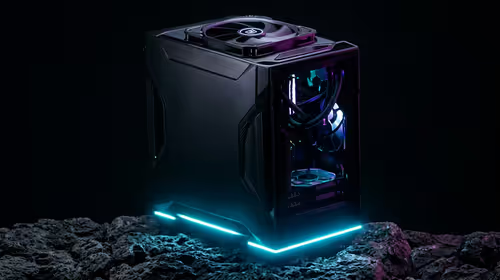
Stalker 2 Heart of Chornobyl PC build planning at R100,000 should stay cautious about parts and settings. Balance GPU, CPU, RAM, storage, cooling, and upgrade room before picking a South African gaming PC.
Read more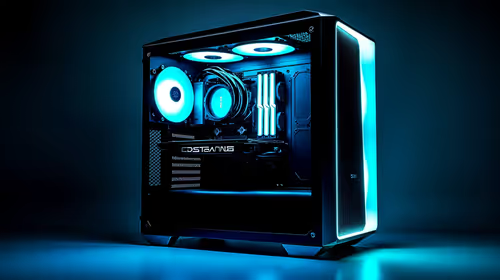
RX 9070 XT build stuttering needs a step-by-step check before replacing parts. Review drivers, settings, thermals, power, background apps, display limits, cables, and game options before changing hardware.
Read more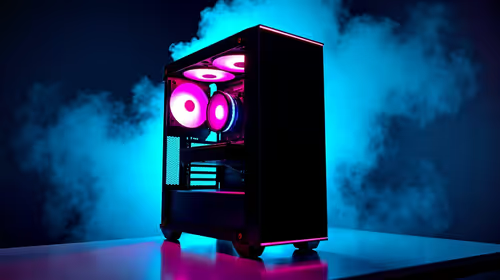
GTA 6 on R15,000 needs careful part balance. This SA build guide frames CPU, GPU, RAM, SSD, cooling, and upgrade trade-offs without promising live prices, stock, or exact FPS.
Read more
NVIDIA lists 550W required system power for the RTX 5060 reference specification, based on a high-end test system. A quality 550W unit can be enough, but CPU draw, transient load, connectors and ageing decide real headroom.
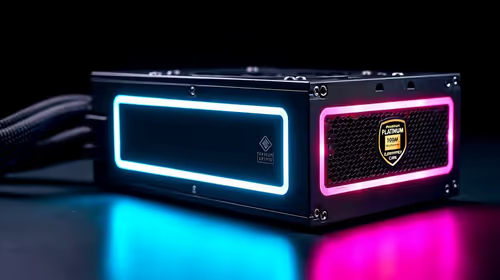
80+ Gold vs 80+ Platinum for couch co-op gaming is about PSU efficiency, heat, fan behaviour, quality, and wattage headroom, not direct FPS. SA buyers should compare the whole build.
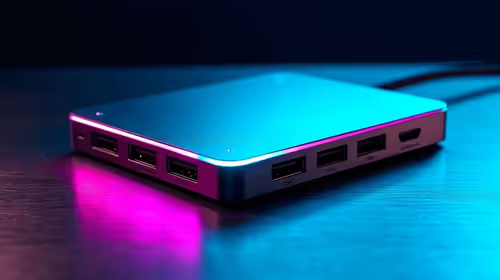
Upgrade your setup with the best USB-C hubs for creators. Discover why high-capacity card readers and dual 4K output are essential for professional South African content production. 🚀💻

B850 motherboard FPS drops needs a methodical troubleshooting pass. Review drivers, thermals, power settings, background apps, cables and game settings before replacing parts in an SA gaming setup.
NVIDIA lists 550W required system power for the RTX 5060 reference specification, based on a high-end test system. A quality 550W unit can be enough, but CPU draw, transient load, connectors and ageing decide real headroom.

OpenRGB's master branch now carries changes labelled for 1.0 final, including translation and platform work, but the official tags page still lists 1.0rc3.1 as the newest packaged release. Stable users should wait for the signed release channel.

A motherboard can remain useful for many years when power, cooling and connectors stay healthy. Replace it for confirmed faults, damaged power delivery or a blocked platform need, not simply because the calendar reaches a fixed age.
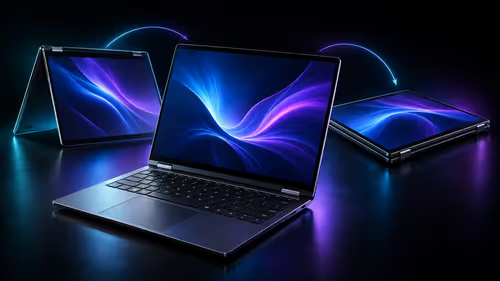
The VAIO T combines a 13.3-inch display with a multi-flip mechanism for laptop, tablet and outward-facing viewing modes. Orders begin in Japan on 18 September; South African availability is unconfirmed.

The smallest ATX case 2026 buyers should choose is the smallest chassis that still fits their exact graphics card, cooler, power supply and airflow plan. ATX support alone does not prove a case has the smallest footprint or volume.
In a 6 bit + FRC vs 8 bit comparison, native 8-bit panels can produce 256 levels per colour channel directly, while 6-bit plus FRC rapidly alternates nearby values to approximate the wider palette. Panel quality still depends on more than bit depth.

The UGREEN LinkStation Pro eGPU dock combines Thunderbolt 5 and OCuLink connections with an integrated 850W ATX 3.1 power supply and up to 140W laptop charging. South African availability is unconfirmed.
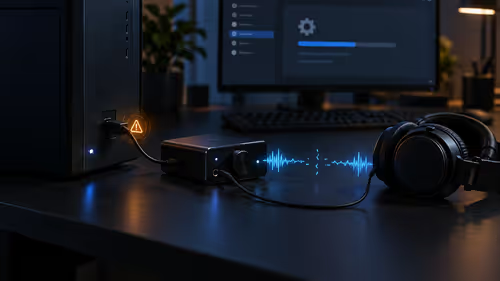
Windows 11 KB5124008 can leave some USB Audio Class 1.0 devices with no sound, Code 10 or failed multichannel output. Microsoft confirms the issue and says switching to two-channel stereo can restore audio for some users.