That dreaded silence. You’ve spent hours meticulously building your new rig, but when you hit the power button... nothing. Or maybe your trusty gaming PC has started crashing randomly. Before you panic, let's talk about diagnosing faulty PC parts. Often, the issue stems from one or two cheap components that just couldn't handle the pressure. We'll show you how to troubleshoot the problem without wanting to throw your machine out the window. 🚀
First Aid for a Failing PC
When your PC refuses to boot or behaves erratically, don't assume the worst just yet. The first step is to play detective. Is the machine getting power at all? Check the cables and the wall socket. If it powers on but doesn't load the operating system, listen for beep codes. These short beeps are a form of Morse code from your motherboard, telling you exactly what's wrong. Your manual will tell you what they mean, but common culprits are RAM or GPU issues.
A visual inspection is also crucial. Open up your case and ensure every cable is securely plugged into your motherboard. Check that your RAM sticks and graphics card are fully seated in their slots. Sometimes, a component just needs to be reseated to fix the problem.
Identifying Common Culprits and Cheap Components
While any part can fail, experience shows that budget-oriented or cheap components are often the first to give up. They might work perfectly fine for a while, but they lack the robust build quality and durability of their premium counterparts, making them more susceptible to failure under load.
The Unreliable Power Source
Your Power Supply Unit (PSU) is the heart of your PC. A cheap, unrated PSU can be a ticking time bomb, causing instability, random shutdowns, and even frying other components when it fails. If your PC shuts off abruptly while gaming, your PSU is a prime suspect. Investing in a reliable power supply with an 80 Plus rating is one of the smartest decisions you can make for your build's longevity.
Memory and Graphics Glitches
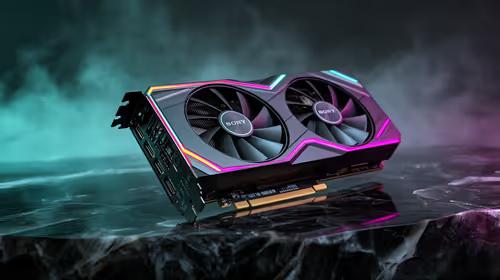
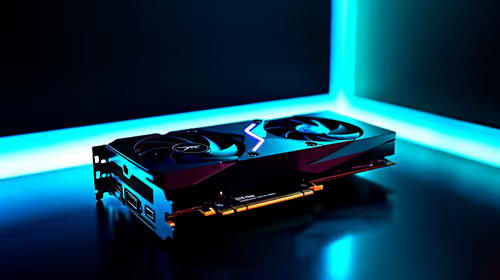
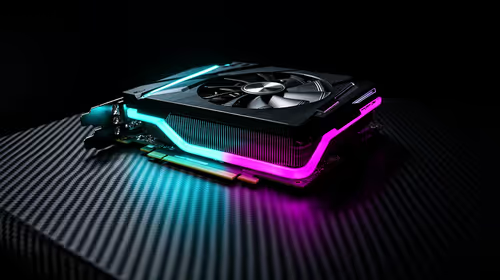
Random Blue Screens of Death (BSODs), application crashes, or failure to boot can often point to faulty RAM. Similarly, if you're seeing weird colours, strange artefacts on screen, or driver crashes during games, your graphics card could be the issue. These are complex parts, and cutting corners here often leads to headaches down the line. A stable system depends on quality gaming RAM and a dependable graphics card that can handle the heat.
The Builder's First Rule 🔧
Before you assume a part is dead, power down completely, unplug the PC, and carefully reseat your components. This means taking out and firmly re-inserting your RAM sticks and graphics card. You'd be amazed how often a slightly loose connection is the real culprit behind seemingly faulty PC parts.
The Heat is On: Cooling and Airflow
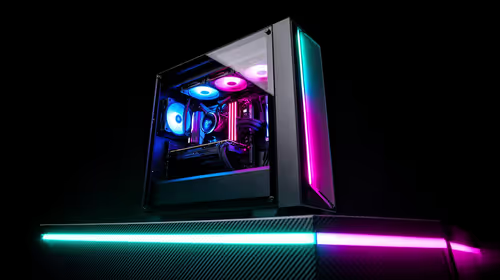
Sometimes, a component isn't faulty... it's just overheating. A stock or undersized CPU cooler can cause your processor to throttle performance or shut down to protect itself. This can easily be mistaken for component failure. Likewise, cramming powerful parts into a cheap, poorly ventilated computer case creates an oven, shortening the lifespan of all your hardware. Good airflow is not a luxury; it's essential. ✨
The Big Decision: Replace or Upgrade?
So you've identified the faulty part. Now what? If it's a single, inexpensive component, a direct replacement is the easiest fix. However, this is also a golden opportunity to upgrade. Replacing a failing entry-level part with another one just resets the clock until the next failure.
Consider if it makes more sense to upgrade a few related components at once. For instance, if your old motherboard has failed, it might be the perfect time to move to a newer platform. Investing in one of our Intel or AMD bundle packs can give you a new motherboard, CPU, and RAM in one go, offering great value and ensuring compatibility. This turns the frustration of a faulty PC part into a massive performance boost.
Ready to Build with Confidence?
Dealing with faulty PC parts is a headache, but investing in quality components from the start is the best prevention. Don't let cheap components compromise your dream build. Explore our massive range of PC components and build a rig that’s built to last.