There's nothing more frustrating than unboxing a shiny new NVMe SSD, slotting it into your motherboard… and getting nothing. Your PC boots up, but the drive is nowhere to be found. For many South African PC builders, this is a real headache. But don't stress! Most of the time, the fix is simple. This guide will walk you through the essential steps to fix NVMe SSD compatibility issues and get your system running at top speed. 🚀
Understanding the Core of NVMe SSD Compatibility Issues
Before you start unplugging things, it helps to understand why these problems happen. It usually comes down to three things: the physical slot, the motherboard's brain (BIOS/UEFI), and how resources are shared.
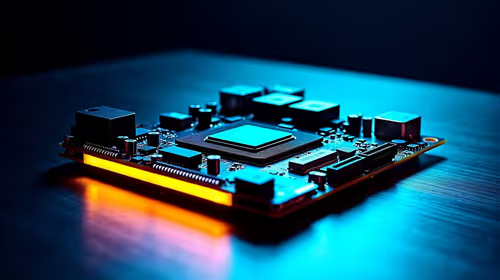
An M.2 slot on your motherboard looks simple, but it can support different technologies. Some are wired for speedy NVMe drives (using PCIe lanes), while others might only support older, slower SATA M.2 drives. Furthermore, putting a lightning-fast Gen4 drive like the Klevv CRAS C925G 1TB into a motherboard that only supports Gen3 will work, but you won't get the maximum advertised speed. It's all about matching the tech.
Your Step-by-Step Guide to Fix NVMe SSD Compatibility Issues
Let's get hands-on. Follow this checklist from simplest to most complex to diagnose and solve the problem. Grab a screwdriver and let's get that drive detected. 🔧
Step 1: Double-Check the Physical Installation
It sounds obvious, but a poor connection is the number one culprit. Power down your PC completely and unplug it from the wall.
- Reseat the Drive: Gently remove the NVMe SSD and plug it back in. Make sure it's inserted fully into the M.2 slot at a slight angle before you push it down.
- Secure the Screw: Ensure the small screw at the end is holding the drive flat and secure. Don't overtighten it, but it shouldn't be loose.
Step 2: Dive into the BIOS/UEFI
If the drive is physically secure, the next stop is your motherboard's BIOS (or UEFI for modern systems). To enter, restart your PC and press the designated key (usually Del, F2, or F12) during boot.
Once inside, look for settings related to storage or onboard devices. You're searching for:
- M.2 Slot Configuration: Make sure the specific M.2 slot you're using is enabled and set to "PCIe" or "NVMe" mode, not "SATA".
- Boot Order: Check if the drive appears in the list of bootable devices. It won't be a boot option until an OS is installed, but it should be visible here if detected.
BIOS Pro Tip ⚙️
Can't find your NVMe drive in the boot list? Look for a setting called "CSM" (Compatibility Support Module) and try disabling it. CSM is a legacy feature for older hardware and can sometimes prevent modern UEFI systems from properly recognising NVMe drives as bootable devices.
Step 3: Consult Your Motherboard Manual
This is the step everyone skips, but it often holds the key. Many motherboards have M.2 slots that "share" resources (PCIe lanes) with SATA ports. Plugging a drive into one can automatically disable the other. Your manual will have a diagram showing exactly which SATA ports are disabled when you use a specific M.2 slot. Reputable brands like those from Klevv South Africa offer incredible performance, but they are still bound by the limits of your motherboard's design.
When the Hardware is Right, but Windows Says No
So, the BIOS sees your drive, but it's missing in "This PC"? This is great news! It means the hardware is working, and you just need to tell Windows what to do with it.
- Right-click the Start button and select "Disk Management".
- A window should pop up asking you to "Initialize Disk". If not, find your new drive in the bottom panel (it will likely be marked "Not Initialized" and have a black bar).
- Choose GPT (GUID Partition Table) as the partition style for modern systems.
- Right-click the "Unallocated" space for the drive and select "New Simple Volume".
- Follow the wizard to assign a drive letter and format it (NTFS is standard for Windows).
Once done, your speedy new NVMe drive will appear in File Explorer, ready for action! ✨ If you've tried everything and the drive still isn't showing up anywhere, you might have a rare faulty unit. At that point, it's best to browse our full range of SSDs to find a replacement that will get you back in the game.
Ready for a Flawless Upgrade? Don't let compatibility woes slow you down. Solving NVMe problems is easier when you start with the right gear. Our experts can help you match the perfect drive to your motherboard. Explore our massive range of high-speed SSDs and give your PC the speed boost it deserves.