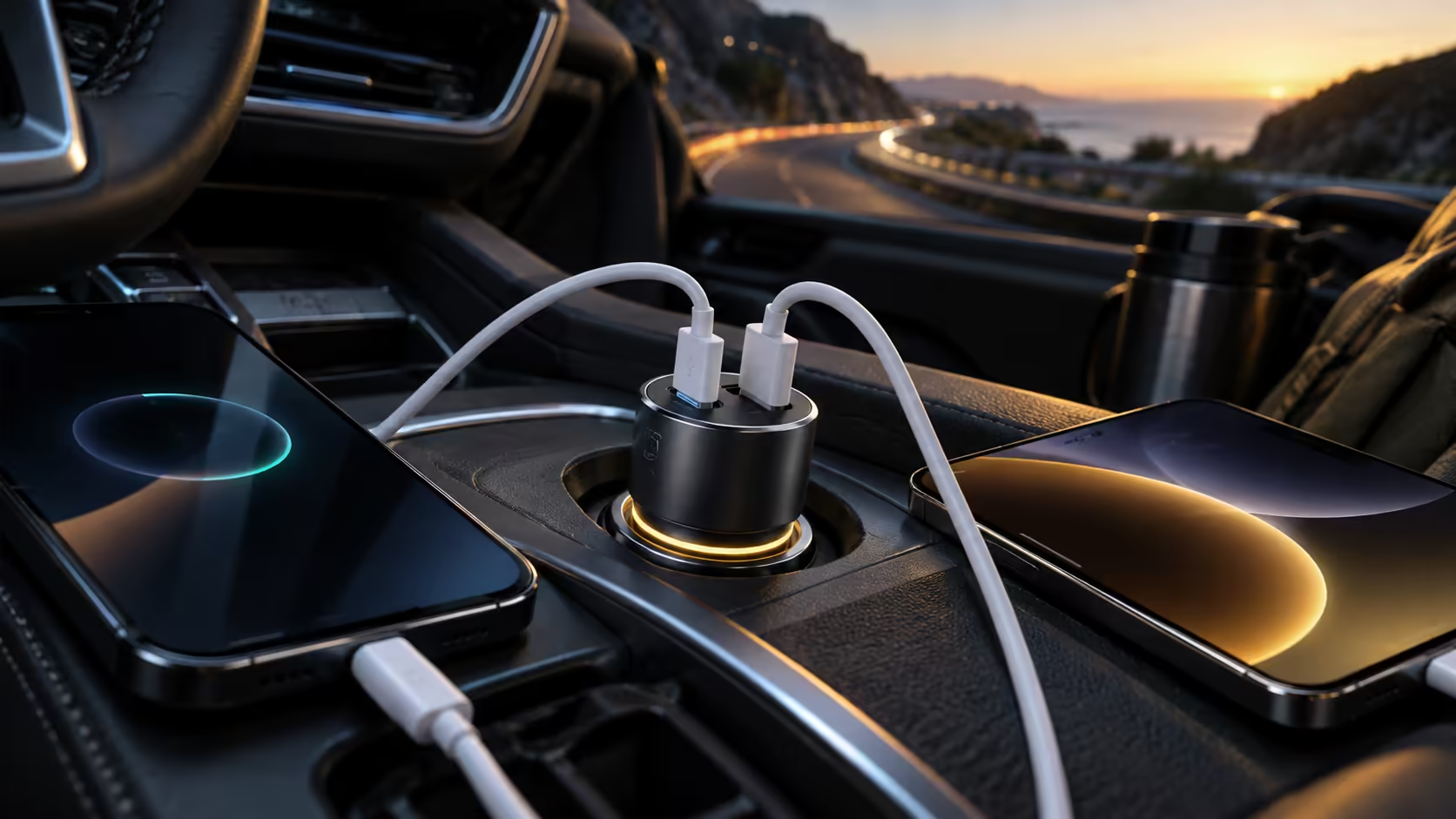
Picking the right USB-C car charger is really four small decisions in sequence, not one big one. Get the order right, phone first and socket last, and the rest of the choice mostly makes itself.
Quick Answer
Start with the phone's own maximum charging wattage, then match a charger that meets or slightly exceeds it, then confirm the cable is rated for that current, and only then worry about the socket and cabin conditions. A phone rated around 25W to 30W gains everything a 30W USB-C PPS port can offer; going further up only matters for a future device. Anker builds that exact port into a R349 two-port unit, with a 22.5W USB-A side and a local warranty behind the whole thing.
📱 Step one: find your phone's real ceiling
Every phone has a stated maximum charging wattage in its own specification sheet, and that number, not the charger's rating, is the actual limit on how fast it will ever charge. A phone capped at 25W gains nothing extra from a 65W or 100W charger beyond simple Power Delivery compatibility, since the phone itself never requests more than its own ceiling regardless of what the source can supply.
Checking this one figure before buying anything avoids the common mistake of chasing a bigger number on the charger's box that the phone was never going to use.
⚡ Step two: match the port, not just the number
Once the phone's ceiling is known, look for a charger whose port meets or slightly exceeds it while running genuine Power Delivery, ideally with PPS. A 30W USB-C PPS port comfortably covers most current phones' real-world ceiling and adds the finer voltage matching that keeps the phone running cooler through the busiest part of a charge.
A second port matters only once someone else in the household regularly rides along too; for a solo driver it is a nice-to-have rather than a requirement, since the shared internal supply only becomes relevant once both ports draw at once.
🔌 Step three: the cable is not an afterthought
A properly rated cable is what actually delivers the negotiated current to the phone. A worn or thin lead, especially one that has lived in a car for years, can cap real-world speed well below what the charger and phone agreed on, showing up as an unexplained slow charge with no obvious cause.
Checking cable condition, or simply replacing an old one when buying a new charger, closes the one gap a charger's own rating alone cannot cover.
🚗 Step four: socket and cabin last
By this point the socket itself rarely changes the decision, since nearly all South African cars share the same standard 12V barrel. Where it does matter is cabin heat: a charger left in direct summer sun works harder to stay within safe temperatures, so checking for stated thermal protection is worth the last few seconds of research. A small USB hub is worth the same thinking for anyone wanting the identical PD behaviour on a desk.
Frequently Asked Questions
Does a higher-wattage charger always charge a phone faster?
Only up to the phone's own ceiling. Beyond that figure, extra wattage on the charger changes nothing for the connected phone.
Should I buy a charger based on my current phone or a future one?
Buying slightly ahead of the current phone's ceiling gives some headroom for the next upgrade, though it rarely needs to go far beyond what current flagships already request.
Is the cable really as important as the charger itself?
Yes. A charger and phone can agree on a fast rate and still be capped by a cable that cannot carry it cleanly, which is a separate failure point from the charger's own capability.
Does the socket type ever actually matter?
Rarely, since the accessory socket is standardised across nearly all vehicles sold locally. Cabin heat and cable condition are far more common practical limits.
What if I cannot find my exact phone's maximum wattage?
Most manufacturer websites list it under the phone's own charging or battery details. Where it genuinely cannot be found, a 30W PD port is a safe general-purpose match for the overwhelming majority of current phones on the market.
Is it worth buying one charger for the whole household rather than one per car?
Only if every vehicle shares the trip pattern; a charger left permanently in one car saves the hassle of moving it, while a shared unit risks being in the wrong vehicle exactly when it is needed.
Does the order of these four steps actually matter, or is it just a checklist?
The order matters because each later step assumes the earlier one is settled. Matching a charger before knowing the phone's ceiling risks buying more wattage than needed; checking the cable before the charger risks buying a lead rated for the wrong current entirely.
Ready to pick a charger that actually matches your phone?
Check your phone's maximum wattage, then browse the car charger range for a matching port.