An extender cannot invent signal where the router has already lost it. Connect a Wi-Fi extender to your router near the source first, confirm that pairing worked, then move it only as far as the original network remains strong. That order is the difference between improving a dead spot and creating another unreliable hop.
Quick Answer
Set up an extender beside the router using WPS or its setup page, then relocate it to an open plug point between the router and the room with weak coverage. In many South African fibre homes, brick walls and concrete slabs are the real obstacle, so test the final position with the same device in the troublesome room rather than trusting a light on the extender.
🔌 Pair it while the router is close
Begin with both devices in the same room. If they support WPS, press the router''s WPS control and then the extender''s button within the interval specified by its manual. Wait for the model''s connection indication rather than unplugging it halfway through. This method is quick, but not every router or household security policy leaves WPS enabled.
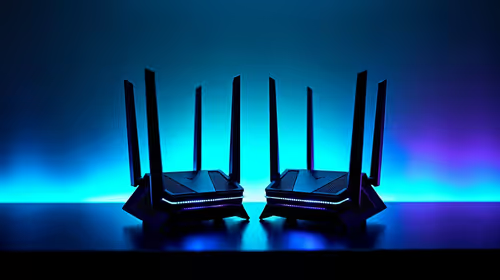
The browser or app route is more deliberate. Join the temporary network made by the extender, open its setup interface and select the correct home Wi-Fi name. Enter the password carefully; confusing the 2.4 GHz and 5 GHz network names is common when a router exposes both. The range of wireless routers can also help identify the features available on a replacement or upgraded central unit when an old router is the bigger limitation.
📶 Find the useful middle, not the farthest plug
After pairing, walk from the router toward the failed room. Stop before the source signal becomes marginal. A hallway, landing or open room often performs better than a socket hidden behind a television, cupboard or metal appliance. The extender still has to hear the router well enough to relay usable data.
South African houses frequently mix thick masonry with longer passages and added rooms, so there is no universal distance. A plug beyond one large wall might be perfect in one home and too far in another. Start closer than your instinct suggests, test, then move one point farther only if the source connection remains solid.
🧩 Give the network a clear identity
An extender may copy the router name or offer a separate one. Matching names can make roaming feel simpler, while a distinct suffix is useful during troubleshooting because you can see exactly which access point the phone or laptop has joined. Either choice works when you understand it and can test it.
Avoid putting the extender at floor level, inside a cupboard or next to equipment that blocks radio signals. Microwave ovens, large metal surfaces and dense clusters of electronics can complicate a connection that looked fine during setup. The available wireless range extender options cover different layouts, so use the unit''s instructions for its lights, app and supported bands.
✅ Test what the room actually needs
Open a speed and stability test in the problem room before changing anything, then repeat it after installation with the same device and a nearby South African test server. Also walk through the activity that caused the complaint: a video call, a streamed lesson, an online game or a large upload. A higher signal icon is not enough if calls still break up.
If the result worsens after moving the extender, it is probably positioned beyond the router''s usable reach. Return it one plug closer and test again. If coverage is poor everywhere, first check the router''s placement, firmware and connection before expecting a relay device to repair every problem.
One final check is easy to miss: reconnect a device that had saved the old network details. Phones and televisions can cling to a weak access point after the new signal is available. Forgetting the connection briefly, or selecting the intended network by hand, can show whether the extender is working while the client device needs a nudge. Do not change several router settings at once; keep each test small enough that you can tell which adjustment improved the result.
Frequently Asked Questions
Should I configure an extender beside the router?
Yes. Close setup gives the devices a strong first connection, making it easier to confirm pairing before placement becomes another variable.
What if my router has no WPS button?
Use the extender''s app or browser-based setup. Join its temporary network, choose the home Wi-Fi network and enter the correct password.
Where should the extender go after setup?
Put it between the router and the weak room, before the original signal drops sharply. An open hallway is often more effective than a hidden socket.
Why does my extender disconnect when I move it?
The new location may be separated by too much brick, concrete or interference. Move it closer to the router and re-test the source connection.
Ready to improve the room that Wi-Fi forgot? Explore range extenders and router options, then place the hardware according to the signal you can measure in your own home.