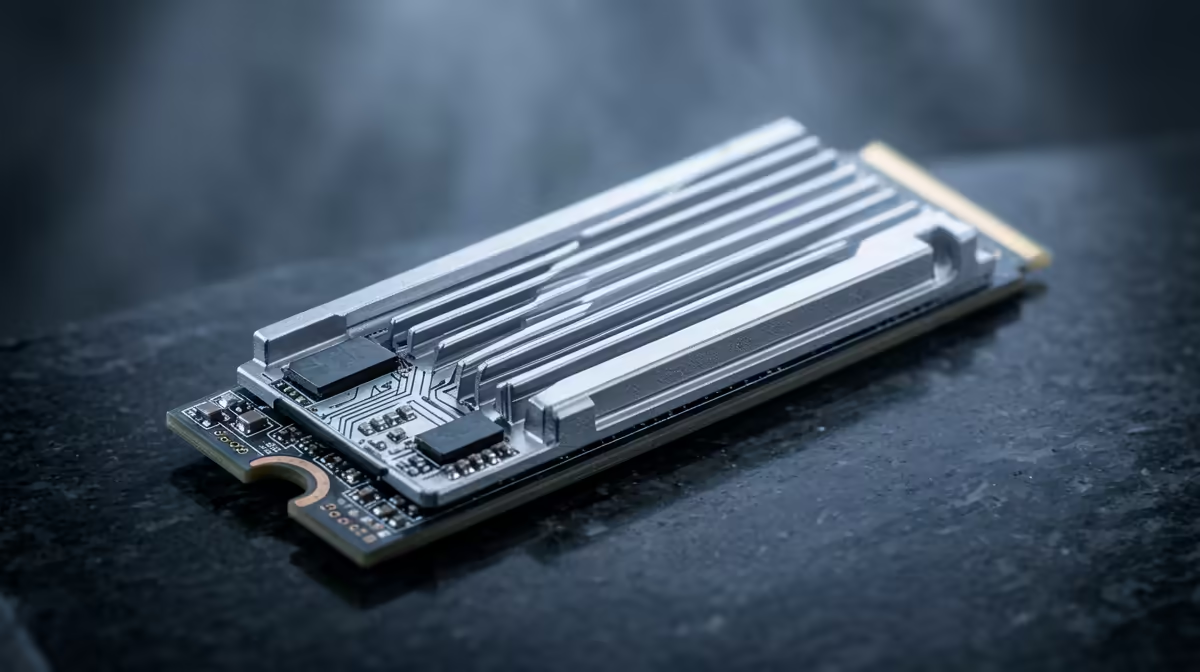
Spotting blurry text after setting up a Gen 5 NVMe SSD build can feel like a return is coming, yet a calm checklist clears the majority of these complaints.
Quick Answer
Blurry text on Windows 11 is almost always a scaling or ClearType issue, not a hardware fault. Set the display to its native resolution, match the recommended scaling, and rerun the ClearType tuner to get crisp text back in minutes. Keep the display at its rated refresh, up to 240 Hz on fast panels, throughout the checks.
Set native resolution and correct scaling
Run a Gen 5 NVMe SSD build at its exact native resolution and pick the recommended Windows 11 scaling value. Non-native resolutions force interpolation that smears every font edge.
Rerun the ClearType tuner
Open the ClearType Text Tuner and step through the samples. Sub-pixel rendering tuned to your panel layout sharpens text far more than people expect, especially on high-PPI displays.
Fix per-app high-DPI overrides
For a blurry single app, open its compatibility settings and enable the high-DPI scaling override. This stops Windows 11 from stretching legacy apps into a fuzzy mess.
Before you assume the part is faulty
Hardware faults are the rare exception, not the rule, with a Gen 5 NVMe SSD build. Most blurry text complaints come down to a default Windows setting, an under-spec cable bought to save a few Rand, or a driver that shipped before your exact panel was supported.
FAQ
Can the same approach apply across my whole setup?
The principles do: confirm native settings, update drivers, verify cabling. Adapt the exact steps to each device, but the order of checks stays the same.
Is it safe to apply pressure to the screen?
Only very lightly and as a last resort, with the screen off and a soft cloth. Too much force damages the panel, so stop the moment you feel any give.
Could blurry text mean my hardware is faulty?
Usually not. The cheap checks above resolve most cases, so only treat it as hardware if every setting, cable and driver step fails to help.
Buy once, buy right for your setup Document the fault on a plain test screen first, so if a warranty claim is needed it is fast and painless.