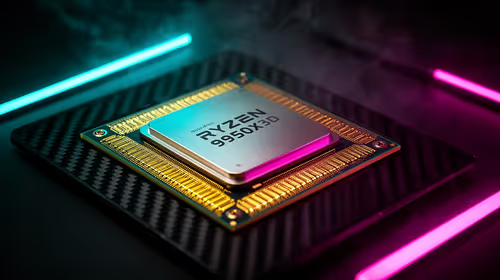
When input lag shows up on a fresh Ryzen 7 9800X3D, the instinct is to blame the new part. In practice the cause sits in drivers, sync settings, or the display path - all things you can rule out in minutes.
Quick Answer
The input lag you feel after this upgrade is almost always V-Sync stacking with an uncapped frame rate. Turn V-Sync off, cap frames around 3-5fps under your panel's refresh, and enable a low-latency mode to bring the delay back under roughly 25ms. For SA setups this is the money question: most of the time the fix is free, and only a clear test result justifies a new part.
Find the Real Cause of Input Lag
To isolate input lag on a Ryzen 7 9800X3D, set one familiar game scene as a baseline and measure the same flick or turn each time. Turn off V-Sync, then enable NVIDIA Reflex (or AMD Anti-Lag) and cap frames 3-5fps below your panel's refresh. If a wired mouse at 1000Hz feels instantly tighter, the original problem was wireless or polling. If nothing changes, move to the display and HDR processing path.
The Ryzen 7 9800X3D Checklist for Smooth Play
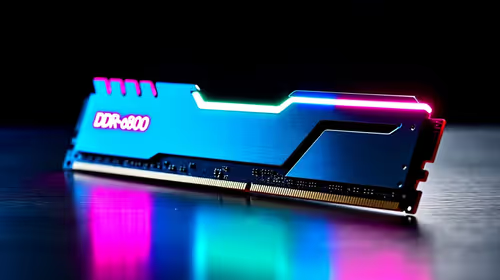
The Ryzen 7 9800X3D relies on a stable platform: a current BIOS, the right power plan, and DDR5 running at 6000 MHz to hold its boost clocks. Update the chipset driver and BIOS, then re-apply your EXPO/XMP memory profile - a half-applied profile is a classic source of stutter. Set the Windows power plan to Balanced or the AMD/Intel high-performance profile so the cores aren't parked at idle clocks mid-game. As a yardstick, with frametimes pinned this CPU keeps 1% lows within a few frames of the average and holds clean frametimes under 16 ms at 60fps, with DDR5-6000 as the proven sweet spot, so use that as your pass/fail line rather than chasing a perfect number.
When a Fix Becomes an Upgrade
Treat the result as a buying guide. A problem that vanishes with a different cable, port, or sync setting costs nothing to fix. A problem that only shifts with more capable hardware tells you exactly what to budget for. That keeps SA spending sensible - you upgrade the ryzen 7 9800x3d or supporting part the test pointed at, instead of guessing and over-buying.
FAQ
How do I know if it's a network problem causing input lag?
Run a wired Ethernet test against your Wi-Fi: if the cable removes the issue, it was the wireless link. Watch ping and packet loss during play - under 30ms ping and well under 1% loss is the target for online gaming.
Does my display cable affect input lag?
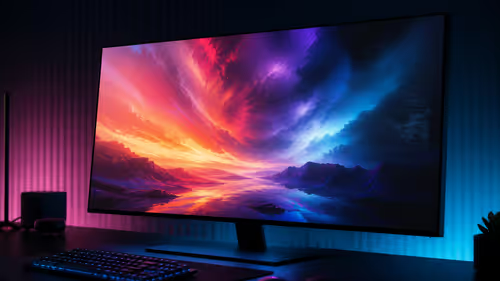
It can. Set the Windows power plan to Balanced or the AMD/Intel high-performance profile so the cores aren't parked at idle clocks mid-game. A cable that can't carry your panel's full refresh quietly caps performance and makes motion feel worse than the hardware should.
Is it worth booking the build in at Evetech for input lag?
Only after the free checks. If a clean driver install, verified memory profile and correct sync settings all fail, a workshop test can confirm a faulty part - but most input lag clears up at the settings stage.
Worked through every free fix and the input lag is still there? That's the point to look at the right part - browse current Ryzen 7 9800X3D stocked at Evetech and match the upgrade to the exact bottleneck your test exposed.