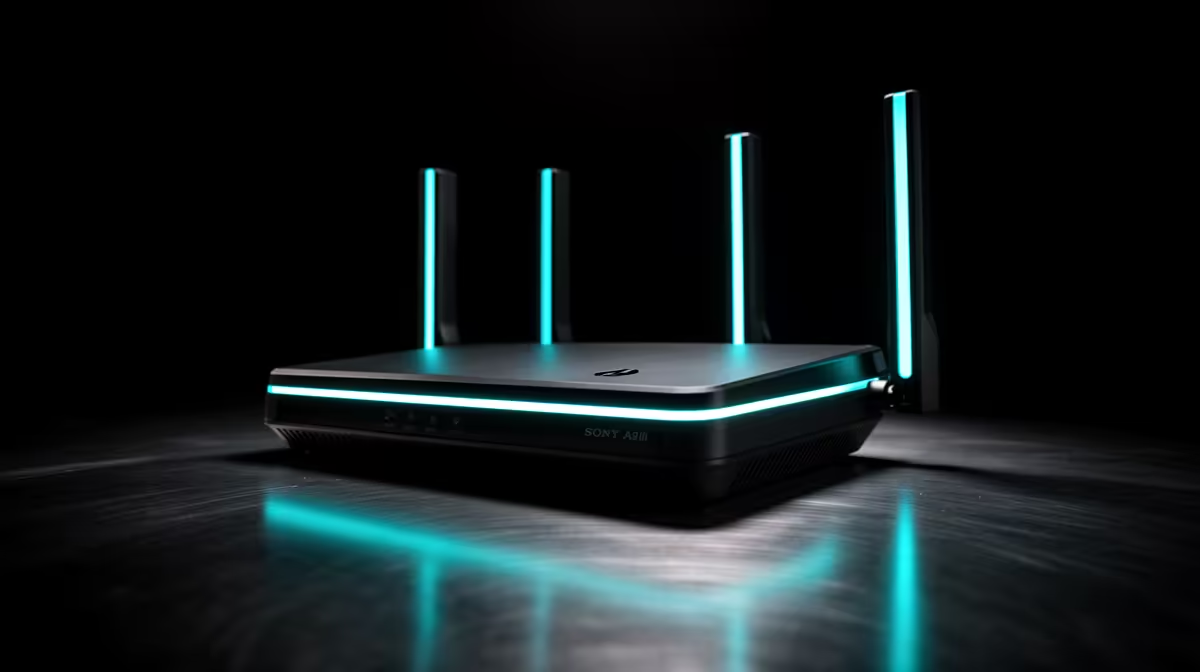
When a Wi-Fi 7 router refuses to climb past 60Hz, treat it as a configuration chain: display mode, cable, monitor menu, then driver, in that order. Worth restating for this exact case, since the details rarely transfer cleanly.
Quick Answer
Open Display settings, then Advanced display, and pick the panel's top rate from the refresh-rate menu. If only 60Hz appears, swap to a DisplayPort 1.4 or HDMI 2.1 cable, enable the high-rate mode in the monitor's own menu, and set the refresh again. A 144Hz panel that trains down usually has a cable or a stale GPU driver behind it. It reads simple, but the order is what makes it work in practice.
Use a cable rated for the refresh you want
Bandwidth is the silent killer of high refresh. A 1440p 165Hz panel needs DisplayPort 1.4 or HDMI 2.1; an older HDMI lead trains down to 60Hz to stay stable. A proper cable runs roughly R450 to R1,200, far cheaper than the GPU or monitor people replace by mistake. Plug into the dedicated GPU ports, never the motherboard, when a card is installed. For a Wi-Fi 7 router in a South African home, that margin is worth protecting.
Reinstall the GPU driver cleanly
A driver that updated badly can drop the mode list to 60Hz only. Remove the current driver with DDU in safe mode, then install the latest stable build for your card. After the reinstall, set the refresh in both Windows and the GPU control panel so the two agree, then reboot and confirm the rate held. Keep this tailored to a Wi-Fi 7 router and the result holds up the first time.
FAQ
Does the cable really affect refresh rate?
Yes, heavily. Refresh rate depends on bandwidth, and an under-spec cable trains down to a safe 60Hz rather than failing outright. For 144Hz and above at 1440p, a DisplayPort 1.4 cable is the safe default and costs around R450 to R900. Once a Wi-Fi 7 router is sorted here, the rest of the diagnosis falls into place.
Should I set the rate in Windows or the GPU control panel?
Set it in both so they agree. Windows Advanced display settings is the master, but the GPU control panel can override per-game, so a mismatch causes flicker or a drop back to 60Hz. Match them, then reboot to confirm. Keep a Wi-Fi 7 router simple here and the fix becomes obvious.
Will a higher refresh rate hurt performance?
A higher refresh rate only shows frames the GPU already produces, so it does not reduce performance; it just removes the artificial 60fps ceiling. If frame rate is the limit, lower a few settings rather than the panel's refresh. With a Wi-Fi 7 router in front of you, work the check before reaching for your wallet.
Get a panel that hits the rate out of the box If your screen tops out below what your GPU can drive, compare Evetech high-refresh monitors so the cable, panel, and card all support the same rate. It reads simple, but the order is what makes it work in practice.