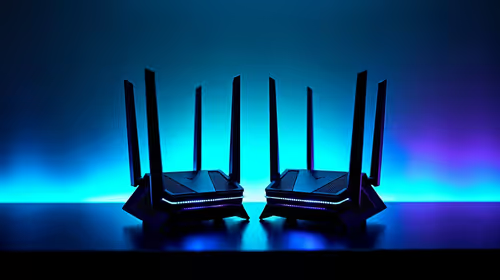
Strong home coverage begins before any Wi-Fi name appears on a phone. How to install Wi-Fi at home is really a small network project: identify where the internet arrives, put the main radio where people need it and use cable where walls defeat radio. That approach is especially useful in South African homes with an ONT fixed in a garage, passage or security cupboard.
Quick Answer
Start with an active fibre, LTE or fixed-wireless service and connect a suitable router to the provider's handoff device or supplied details. Place the main router openly and centrally where possible, lock it down with current security settings, then test every important room before adding coverage hardware. A home-router shelf spans about R249 to R3,599, yet installation quality can make a modest unit more useful than a powerful router hidden in a corner.
🔌 Map the incoming connection first
Ask the provider where its service ends inside the home. Fibre often arrives at an ONT, while LTE or fixed-wireless equipment may need a particular position for a sound signal. Do not move provider equipment blindly: identify the Ethernet handoff, the required login details if any and which device is responsible for the internet connection.
Connect the main router near that handoff for the first test. Once it is online, decide whether it can remain there. An ONT tucked behind a television or beside a metal distribution box is rarely a good place to launch Wi-Fi across a house. A longer Ethernet run can put the radio in a much better room. The network-cable options are useful when the planned router position is away from the incoming line.
📶 Give the main signal a fair chance
Position the router on a shelf or desk, not on the floor and not inside a closed cabinet. Aim for a central, open location with clear paths towards the rooms used for work, school, streaming and gaming. A large double-storey property may need a different plan from a small flat, so walk the space rather than trusting a coverage claim made for open air.
Brick walls, reinforced slabs, long corridors and outdoor rooms can turn a good incoming fibre speed into unreliable room coverage. Before buying extras, check signal and stability in each high-priority spot. The main wireless-router category makes sense when the current unit is underpowered, but repositioning can solve a surprising amount at no extra hardware cost.
For one modest dead corner, a wireless range extender can be practical when it still receives a good signal. For several weak rooms, coordinated mesh nodes or wired access points are usually easier to live with. A repeater placed in the dead zone has too little signal to repeat well; place it between the main router and the place needing help.
✅ Secure the network before everyone joins
Change the router administration password from its factory value and install current firmware using its normal update function. Select modern wireless encryption, use a long Wi-Fi password that guests cannot guess and disable remote administration unless there is a considered reason to keep it. Record the details somewhere secure rather than taping them to the router.
Set up a guest network for visitors if the router supports one. It separates temporary devices from printers, storage and smart-home equipment without making every visitor ask for the main household credential. Check that each family device reconnects properly after the new settings are applied.
Do not confuse Wi-Fi signal with internet performance. Fibre routing, LTE congestion and a busy provider network can affect the connection even when the wireless bars are full. Establish a wired baseline near the primary router, then compare rooms against it to separate radio coverage problems from the incoming service.
🛡 Finish with room-by-room testing
Use the actual phone, laptop, smart TV or console from each room. Check a video call, a sustained download and ordinary browsing, not only one quick speed result. For online games, latency and consistency may matter more than the largest number on a test screen; South African server distance remains a separate factor from Wi-Fi placement.
Label any weak areas and consider the route for Ethernet before buying a second radio. A cable to a study, flatlet or upstairs landing often produces a more predictable result than adding radio hops through dense construction. Leave the router accessible for a reboot and make sure its power lead is not under strain.
Frequently Asked Questions
What must be ready before home Wi-Fi installation?
You need an active internet service, its handoff equipment or connection details, a compatible router and a suitable power point. It also helps to identify the rooms where coverage is most important.
Where is the best place for the main router?
Choose an open, elevated and fairly central position where practical. Ethernet can move the router away from an ONT that was installed in a poor Wi-Fi corner.
How should a new home network be secured?
Replace the administrator credential, apply current firmware, use modern encryption and set a strong wireless password. A separate guest network is useful when visitors do not need access to household devices.
Why do some rooms remain weak despite fast fibre?
Walls, concrete floors, distance and the router's location can weaken radio coverage independently of the incoming line. Test the room itself before deciding the service is slow.
Is an extender, mesh kit or access point best?
An extender can cover one small weak area with a sound upstream signal. Mesh suits coordinated multi-room coverage, while wired access points offer the most reliable backhaul through difficult construction.
How can I test whether the installation worked?
Compare a wired baseline with real-world checks in each important room. Look at stability, latency and ordinary device behaviour as well as raw speed.
Ready to turn the incoming line into useful whole-home Wi-Fi? Select the router, extender or cabling that matches your rooms and the path between them.