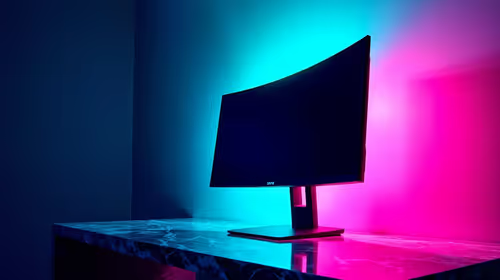
The number on the box is only the starting point for clear movement. A 0.03ms OLED monitor still needs the correct 240Hz mode, restrained processing and steady source frames before fast turns look clean. On the R10,999 ASUS ROG Strix XG27AQDMG, those settings work with a 2560x1440 WOLED panel and dual adaptive-sync support.
Quick Answer
Run the XG27AQDMG at native QHD and 240Hz, disable unnecessary picture processing, then verify frame pacing with FreeSync Premium or G-Sync Compatible. Its 0.03ms response describes rapid pixel transitions, not the total delay of the entire computer, so optimise the game, graphics system and display as one motion chain.
🧭 Set a trustworthy baseline
Reset unusual inherited picture settings before testing. Select 2560x1440 and 240Hz, then display a familiar fast-moving scene. Native QHD avoids scaling softness, while the full refresh mode gives the panel frequent opportunities to present new frames.
Keep the monitor centred and view it from a practical desk distance. Sitting too close can make edge scanning feel busy; sitting too far can hide the finer changes you are trying to judge. The gaming display collection helps compare how size, resolution and refresh combine across different models.
⚡ Separate response from refresh
The 0.03ms figure describes how quickly pixels can change state. The 240Hz rate describes how often a fresh image can be shown. A fast transition reduces visible smearing between updates, but it cannot supply frames that the graphics card has not rendered.
Use a repeatable horizontal pan and watch fine edges, nameplates and high-contrast geometry. Avoid judging motion from an animated menu because its own frame cap may be low. If the scene stays unclear, simplify one graphics setting at a time and retest the exact path.
Buyers comparing rapid transitions with deep black levels can browse the dedicated OLED monitor range without treating response time as the only specification that matters.
🎛️ Remove processing that masks speed
Extra sharpness, noise reduction or heavy image enhancement can change edge appearance and make a clean panel response harder to assess. Begin near neutral values. ROG Gaming A.I can be explored after the basic signal is sound, not used as a substitute for correct refresh and game settings.
Check whether the title uses full-screen, borderless or windowed output. These modes can inherit different desktop behaviour. Confirm 240Hz inside the game, then compare with an on-screen counter or a consistent motion route rather than relying on feel alone.
For buyers considering screen geometry as well as speed, Evetech's curved monitor options show how shape changes peripheral viewing even when the refresh discussion stays similar.
🔄 Stabilise variable frame delivery
Enable FreeSync Premium for an AMD route or G-Sync Compatible for a supported NVIDIA route. Adaptive refresh coordinates updates with completed frames and can reduce tearing while output moves through a range. It does not turn an erratic computer into a constant 240fps system.
Set graphics detail to a level the machine can hold through the busiest scene, then choose a deliberate frame cap if needed. Stable delivery often looks clearer than a higher average interrupted by large swings. Save the resulting display mode and game preset separately so future driver changes are easy to diagnose.
Inspect pacing before blaming the panel
A frame-time graph reveals interruptions that an average frame-rate counter hides. Two runs can share the same average while one contains sharp delays between individual frames. Those pauses interrupt the visual sequence even though the WOLED pixels themselves change quickly.
Close background work that produces obvious spikes, repeat the same route and compare results. If the interruption occurs at the same point every time, the cause may be part of the scene or game workload. If it appears randomly, background activity or unstable settings deserve attention.
Also compare the centre and edges of moving objects. A slow source animation can look stepped on any fast display because it contains too few unique frames. Use high-frame-rate content before deciding that a picture control has failed. Once the source is trustworthy, subtle changes to brightness and dark detail become easier to evaluate without confusing contrast with motion blur.
The most useful final profile is not necessarily the one that produces the highest brief counter. It is the configuration that remains clear through long, representative matches without flicker, tearing or distracting swings in delivery.
Compare motion at three speeds
Use one game replay or test pattern containing a slow pan, medium tracking movement and rapid turn. Watch the same high-contrast edge at native QHD 240Hz. Slow motion reveals judder or processing choices, medium movement tests readable tracking, and the fast turn exposes smearing or unstable frame delivery. Keep sharpness and picture processing restrained during the first pass. The 0.03ms WOLED response should be judged as part of this complete sequence rather than from one fastest clip.
Frequently Asked Questions
What does 0.03ms describe on this OLED monitor?
It is the stated pixel-response figure for the WOLED panel. It concerns transitions on the display, not every stage from mouse input to a rendered frame.
Why is 240Hz still important when response time is 0.03ms?
Fast pixels can settle quickly, while 240Hz allows frequent image updates. The two measurements address different parts of visible motion.
Can picture processing make fast movement look less clear?
Yes. Strong enhancement can alter edges or add work to the display path. Begin with restrained controls before evaluating optional features.
Should I test motion at the panel's QHD resolution?
Yes. Native 2560x1440 provides the proper pixel map and removes scaling as a source of softness during the test.
How can adaptive sync improve a fast OLED display?
It varies refresh timing around the graphics card's completed frames. That helps reduce tearing when rendering does not sit at one fixed rate.
Is the ASUS XG27AQDMG priced for a premium setup?
At R10,999, it sits around a speed-focused QHD WOLED package with 240Hz, dual adaptive sync and OLED protection hardware.
Ready to judge motion with a clean, repeatable test instead of a single headline number? Explore Evetech's high-refresh displays, choose a familiar fast scene and tune the source, sync path and panel in a controlled sequence.