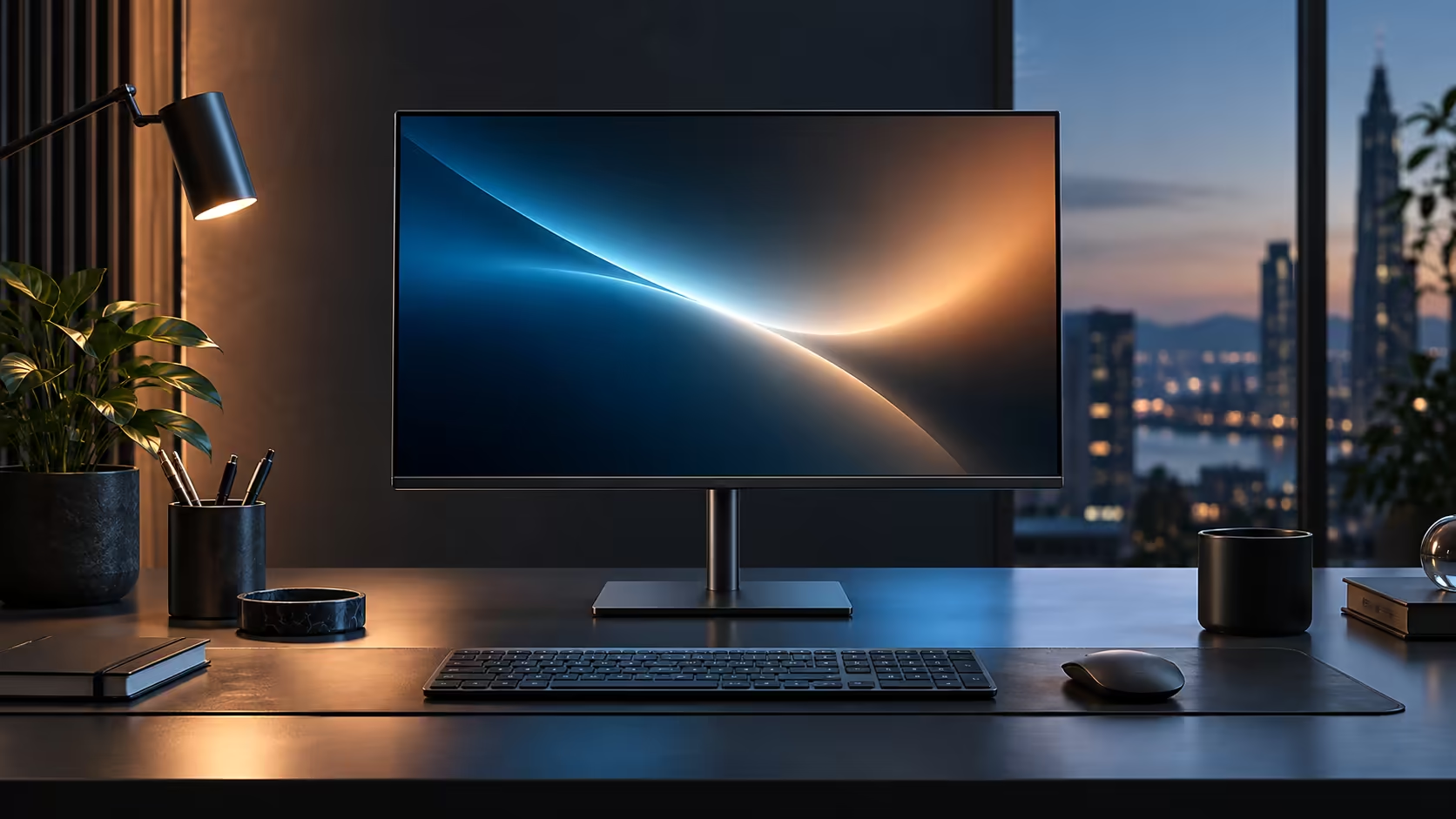
South African remote workers are buying into a specific set of constraints that a generic monitor buying guide rarely addresses directly: shared household fibre, a corporate laptop you may not control, and a desk that has to work without an IT technician on call. Checking a USB-C hub monitor against those specific constraints, using Dell's Pro 24 Plus P2425DE and its R6,099 price tag, avoids a purchase that looks right on paper but fails on the actual desk.
Quick Answer
Check that the laptop's USB-C port carries video, then the charging wattage, then the network port. Add local warranty and a desk deep enough for a 23.8-inch panel and little is left to go wrong. Evetech has the hub monitor at R6,099.
🔌 Confirming your laptop's USB-C port actually carries video
This is the check that prevents the single most disappointing outcome: a monitor that arrives and shows nothing.
Not every USB-C port on every laptop supports outputting video, even on laptops where the port charges perfectly well. Check the laptop manufacturer's official specification sheet for "DisplayPort Alt Mode" or explicit mention of video output over USB-C, since a port description that only mentions charging and data is a warning sign. If you already own any USB-C cable and an external display, a quick test with what you have confirms this before buying anything new.
⚡ Matching charging wattage to your specific machine
Once video is confirmed, wattage decides whether the laptop actually charges properly through the same cable.
Find your laptop's original charger and read the wattage figure moulded into its casing, often 45W or 65W on a thin business laptop, then set that number against the monitor's own 90W Power Delivery rating. A monitor rated at or above your laptop's original wattage keeps it charging normally under typical use; one rated lower still charges under light use but can lose ground slowly during genuinely demanding tasks.
🖧 Checking the network port earns its place on your desk
Not every remote worker needs this, but for the ones who do, it is worth confirming before buying rather than after.
If your household shares one fibre line across several people working, streaming and calling through the day, a monitor's built-in RJ45 port genuinely improves call stability by moving your laptop onto a wired connection. If you work alone near a strong, uncontested router, this feature matters less, though it costs nothing extra either way since it is built into the same unit.
🏠 Local warranty and desk space, the two easily overlooked checks
The last two items on the checklist are less exciting than ports and wattage, but skipping them causes real problems later.
Confirm the monitor is sold with a local South African warranty and support path, rather than being a personal import with no local recourse if something fails. Measure your actual desk depth against the panel size, roughly 55cm for a 23.8-inch screen including its stand, before ordering, since desk space constraints are the most common reason people end up disappointed with an otherwise correct purchase. Compare the full office monitor range, check a docking station as an alternative if your laptop's own USB-C port fails the video test, and browse wired networking accessories for the router side of the setup.
Frequently Asked Questions
What is the single most important thing to check before buying a USB-C hub monitor?
Whether your specific laptop's USB-C port actually carries video, since charging and data alone are not enough to make the one-cable setup work.
Does every remote worker need built-in Ethernet on their monitor?
No. It earns its keep in a busy household where several devices compete for one fibre connection; someone working alone near a strong router gets less out of it.
Is a locally sold monitor always better than an imported one at a similar price?
Generally yes, once VAT, duty, shipping and the local return path for a faulty unit are factored into the real comparison.
Will a hub monitor fit the desk I already have at home?
A comfortable minimum sits around 55cm, measuring back from the desk's front lip to whatever wall or shelf sits behind it, stand footprint included.
What should I do if my laptop's USB-C port fails the video test?
Look at a standalone docking station instead, since some docks can output video over HDMI or DisplayPort even when the laptop's own USB-C port does not carry a picture directly.
Should I check anything before buying if I plan to work from more than one location?
Yes. Confirm your laptop's USB-C port behaves the same way at both locations, since the port itself does not change, but a different monitor or cable at a second desk could still expose a limitation the first desk never revealed.
Does a hub monitor need any South African-specific electrical adapter?
No. It plugs into a standard South African wall socket like any other monitor, and its internal power supply handles the local mains voltage automatically.
Ready to check a hub monitor against your actual setup before buying?
Confirm video support on your laptop's USB-C port first, then work through wattage, network and desk space.