


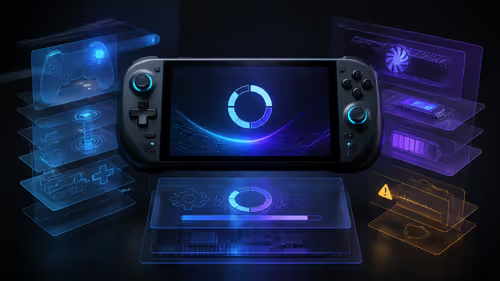
Bazzite Deck 44: The Handheld Update Check
Bazzite Deck 44 replaces core handheld control tools and adds a graphical updater, but some devices temporarily lose features. Users should pin a working deployment before testing it.
Read moreCell C has enabled 5G access through partner radio networks for compatible phones in covered areas. Customers should verify device support and real coverage before changing hardware.

Cell C has switched on 5G access for compatible handsets in areas covered by its roaming radio partners. That is a technical launch, not a promise that every customer now gets the same speed or that a dedicated fixed-wireless product is already available. The sensible first step is to check the phone, address and service before buying new networking hardware.
There is no confirmed extra rand price or dedicated 5G proposition in the launch report. Compatible Cell C handsets can use 5G where partner coverage is available. Customers should verify their exact device and location, then test real performance before spending on a router, booster or replacement phone.
Cell C says the network access is live through radio sites supplied by MTN and Vodacom while Cell C retains its own core network. A compatible handset in a covered area should be able to connect. The company had not yet introduced dedicated 5G marketing propositions when the launch was reported.
That distinction matters because a network capability and a retail offer are not the same thing. The launch does not by itself establish a blanket SIM replacement rule, a new fixed-wireless package or a guaranteed speed. Account provisioning, handset band support, signal conditions and local congestion can all affect the result.
The wireless networking range can help once the need is proven. It should not be treated as evidence that any particular router works with a Cell C service. Hardware compatibility has to be checked against the actual SIM and product terms.
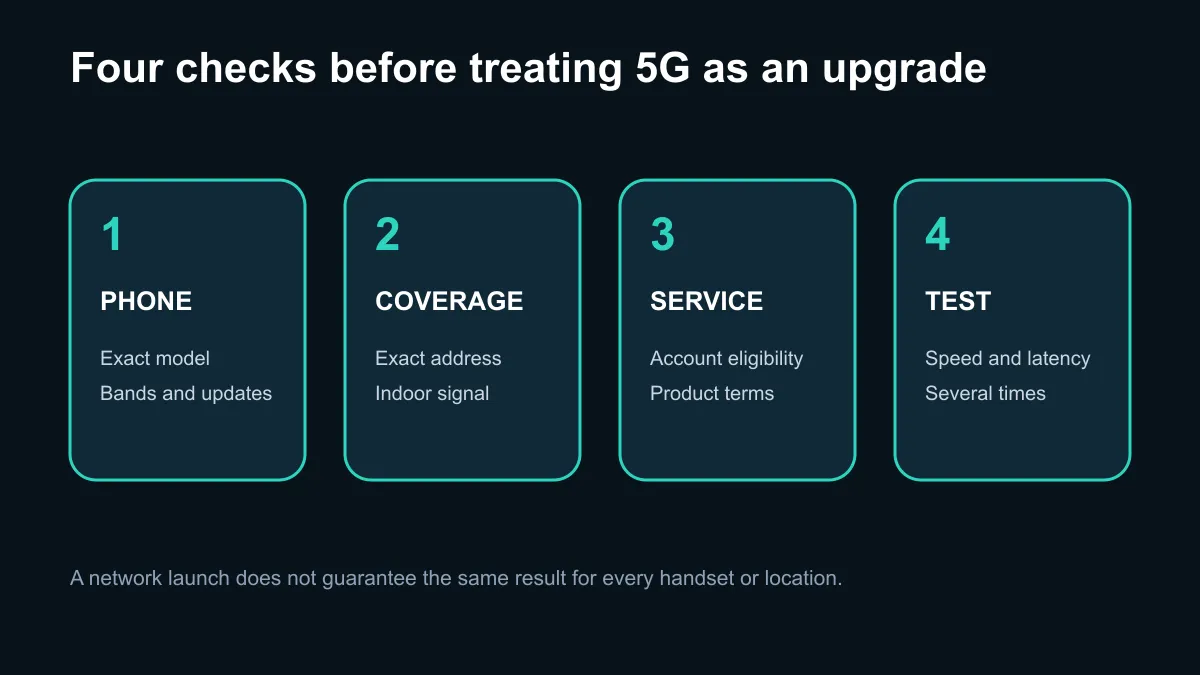
A 5G badge on a handset is not enough. Regional models can support different frequency bands, and software or carrier settings can affect access. Confirm the exact model number, install current updates and make sure the account is eligible before troubleshooting signal.
Use the phone's network status at several times and places rather than judging one speed test. Indoor walls, distance from the site and network load change performance. Compare 4G and 5G in the same location, and look at stability and latency as well as peak download speed.
Do not replace a capable 4G phone solely because a coverage map shows 5G nearby. If calls, messaging and data already meet the need, the practical gain may be small. Upgrade when the phone itself is due for replacement and the chosen model supports the required bands.
Cell C has identified fixed-wireless access as an opportunity, but the reported launch did not include a commercial home 5G product. A mobile-phone SIM, a router SIM and a fixed service can have different rules. Buyers should wait for clear package terms before assuming a handset plan can move into a router.
When a suitable service is confirmed, router placement matters. Put the unit near a strong signal, away from dense obstructions, and test Ethernet as well as Wi-Fi. A fast mobile link can still feel slow when an old router, congested Wi-Fi channel or weak client adapter becomes the bottleneck.
Compare available wireless routers only after identifying the required cellular modem and Wi-Fi standard. Many ordinary Wi-Fi routers do not contain a 5G mobile modem at all.
The launch expands access, which is positive for competition and coverage choice. It does not remove the need for local testing. Keep the existing setup until the new connection proves stable across the activities that matter, including video calls, downloads, gaming and backup use.
Browse the broader networking category for cabling and local network improvements that remain useful regardless of mobile provider. A good wired link and sensible Wi-Fi placement can deliver more reliable gains than replacing every device around a new network badge.
No. Access depends on compatible hardware and coverage from the partner radio networks at the user's location.
The launch report does not establish a universal replacement rule. Check the specific account and handset.
No. Latency, congestion, routing and signal quality matter as much as the radio technology.
Only after Cell C confirms a suitable service and the exact router supports its required mobile bands and SIM terms.
Improving a home connection? Verify service and coverage first, then choose networking hardware for the measured bottleneck.
Yes. Cell C says compatible handsets can use 5G where its partner radio networks provide coverage.
Cell C uses roaming access to MTN and Vodacom radio sites while operating its own core network.
The launch report does not establish a blanket SIM replacement rule. Customers should verify their specific account and device.
The network is live, but Cell C had not yet launched dedicated marketing propositions when the announcement was reported.
No. Speed varies with coverage, signal conditions, congestion, device capability and the service being used.
Only if the service, SIM use and address coverage are confirmed. A handset launch does not itself confirm a fixed-wireless offer.
Bazzite Deck 44 replaces core handheld control tools and adds a graphical updater, but some devices temporarily lose features. Users should pin a working deployment before testing it.
Read more
black friday flight stick strategy guidance for South African gamers keeps the choice practical. Compare fit, features, comfort, support, and total setup needs before treating any option as the right pick.
Read more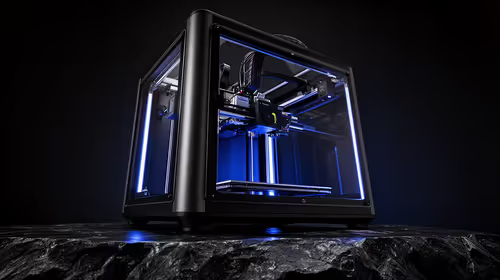
The Bambu Lab H2D delivers a 350x320x325mm build volume, dual independent nozzles, a 350C hotend and a 65C heated chamber for PC, PA and carbon-fibre composites with PVA soluble support. This combination unlocks geometries previously requiring industrial hardware.
Read more
A Copilot+ PC is not a capable local AI coding machine despite its 40+ TOPS NPU, because that silicon is tuned for background assistant workloads and on-device features rather than the GPU compute and unified-memory bandwidth that large coding models depend.
Read more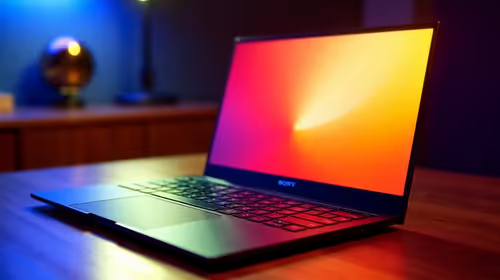
Black Friday is a strong time to buy a creator laptop in South Africa if the deal lifts you into a proper work machine. Use the ProArt P16 at R49,999 as the budget anchor, then plan large file syncs over a R309 broadband line instead of repeated R152 2GB top-ups.
Read more
Windows 11 update KB5121003 is linked to crashes in several multiplayer games on versions 24H2 and 25H2. Check the build, report the fault and avoid risky file or update changes unless the problem is confirmed on your PC.

Sennheiser's Momentum True Wireless 5 adds user-replaceable batteries, 12-hour playback and a $299.95 launch price. There is no confirmed South African date, so compare longevity with live earbuds from R199 to R2,999.

AVerMedia's GC531 and GC535 are professional HDMI capture devices for continuous streaming, with RGB24 capture up to 2K30 and 4K30. South African creators should compare them with live 4K capture cards from R2,099.

From 1 October 2026, WhatsApp Business Platform service replies in South Africa are expected to cost about $0.0076, or 12 cents, per delivered message.

CISA has added Windows IKE flaw CVE-2026-33824 to its actively exploited list. Supported Windows systems need the April 2026 security update or tightly limited IKE exposure.
Windows 11 update KB5121003 is linked to crashes in several multiplayer games on versions 24H2 and 25H2. Check the build, report the fault and avoid risky file or update changes unless the problem is confirmed on your PC.

Comsol's standalone 5G network covers about one million Gauteng homes and starts commercial ISP service in September. Early packages range from R275 to R875 a month, but coverage and fair-use rules still decide the real value.
Sennheiser's Momentum True Wireless 5 adds user-replaceable batteries, 12-hour playback and a $299.95 launch price. There is no confirmed South African date, so compare longevity with live earbuds from R199 to R2,999.
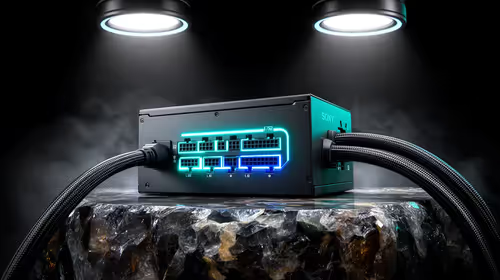
A 650W PSU is a risky ceiling for an RTX 5090 system if you want comfortable safety headroom. SA builders should check total platform draw, PSU age, cable support, case airflow, and upgrade plans before relying on it.
80+ Gold and 80+ Platinum affect 4K video editing through power efficiency and heat. The real-world difference is lower wasted energy, steadier PSU thermals, and quieter long renders for SA creator workstations with hungry CPUs and GPUs.
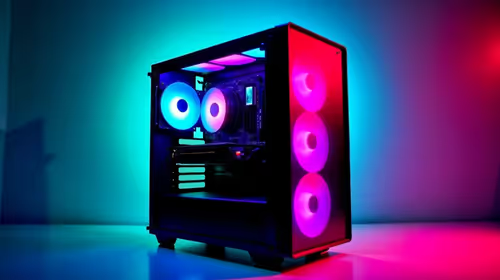
How to fix low FPS Windows 11 Ryzen 7 9800X3D starts with BIOS, chipset, thermals, and graphics settings. Use this SA checklist to confirm the build is boosting correctly before blaming the CPU, GPU, RAM, or display.
AM5 vs AM4 for Strategy and Sim Games comes down to CPU path, motherboard features, memory support, I/O needs, and upgrade timing. SA buyers should match the choice to their setup instead of assuming one option always wins.