Running a capable coding model entirely on your own GPU stops being a luxury the moment you understand the VRAM maths, and Gemma 3 27B is the model that makes a 16GB card punch well above its weight. At its Q4_K_M quantisation the weights land right around 16GB, which means an RTX 5080 can hold Google's largest practical open model in local memory while a heavier 32B model would spill over and crawl.
Quick Answer
Gemma 3 27B at Q4_K_M lands between 15 and 16GB of VRAM, which slots into an RTX 5080's 16GB with very little margin to spare. A 32B coding model would need 20GB or more and overflow that card, so the 27B is the sweet spot for a single 16GB GPU.
Why Q4_K_M is the magic number
Quantisation shrinks each model weight from full precision down to roughly four bits, slashing the memory footprint while keeping most of the quality. For Gemma 3 27B the Q4_K_M build sits near 15 to 16GB depending on whether you run the base or instruction-tuned variant. That puts it just inside a 16GB card, with the catch that the KV cache and your context window also eat VRAM. Keep context sensible and the model stays resident in fast memory rather than offloading layers to system RAM, which is where local inference speed falls off a cliff.
Where the RTX 5080 fits in
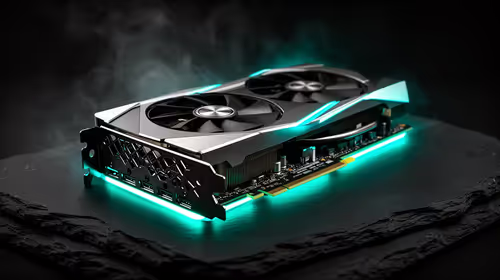
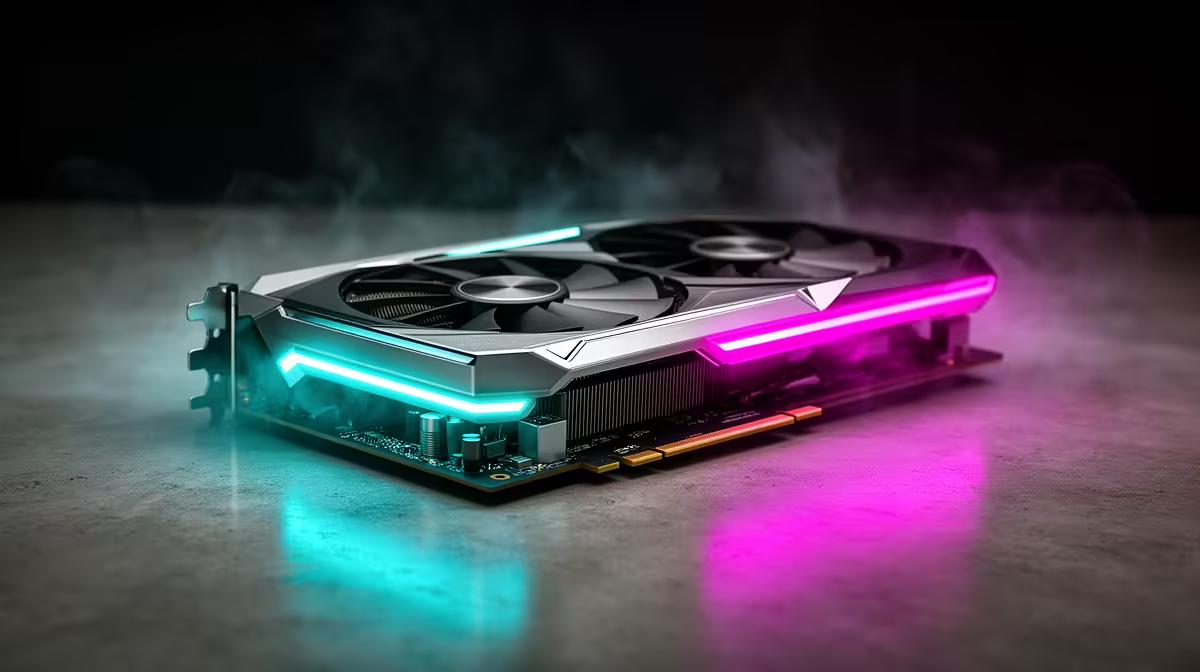
The 16GB of GDDR7 on the RTX 5080 is exactly the headroom Gemma 3 27B was waiting for. You get the Blackwell architecture's strong tensor throughput, so tokens generate quickly once the model is loaded, and you avoid the painful slowdown that comes from splitting a model across GPU and CPU. A 32B alternative would technically run, but only by offloading layers, and the speed hit makes it a poor trade for daily coding work. For builders weighing up a card for this kind of workload, the AI PC range at Evetech pairs Blackwell GPUs with the memory and cooling these sustained loads demand.
What this means for an SA developer
Running locally keeps your code on your own machine, removes any subscription, and means no rands leak out monthly to a cloud API. With RTX 50-series cards available in South Africa you can buy the hardware once, in Rand, and own the whole stack. A 16GB 5080 build sits comfortably in the upper-tier desktop bracket, and it doubles as a serious gaming and rendering machine when you are not running inference. To get a sense of which complete builds local buyers are choosing right now, the best-selling PCs at Evetech make a practical reference before you commit.
Frequently Asked Questions
Will Gemma 3 27B leave room for a long context window on 16GB?
It is tight. The weights alone use most of the 16GB, so a large context will push you toward offloading. Keep context moderate, or use a slightly smaller quant, and the model stays fully on the card.
Is Q4_K_M noticeably worse than full precision?
For coding and general use the quality drop is small and most people never notice it in practice. Q4_K_M is widely treated as the best balance of size and accuracy for local use.
Could I run a 32B model on the RTX 5080 instead?
You can load one, but a 32B at a usable quant needs around 20 to 22GB, so it overflows 16GB and offloads layers. That drops speed sharply, which is why the 27B is the better match.
Do I need anything beyond the GPU?
A modern CPU, fast NVMe storage for the model files and at least 32GB of system RAM make loading and swapping models painless. A modern CPU and fast storage handle the surrounding work, keeping model loading and swapping smooth while the GPU drives inference.
A 16GB Blackwell card turns local AI from a compromise into a daily tool. Explore the AI-ready PCs at Evetech to build a machine that runs Gemma 3 27B comfortably and handles everything else you throw at it.