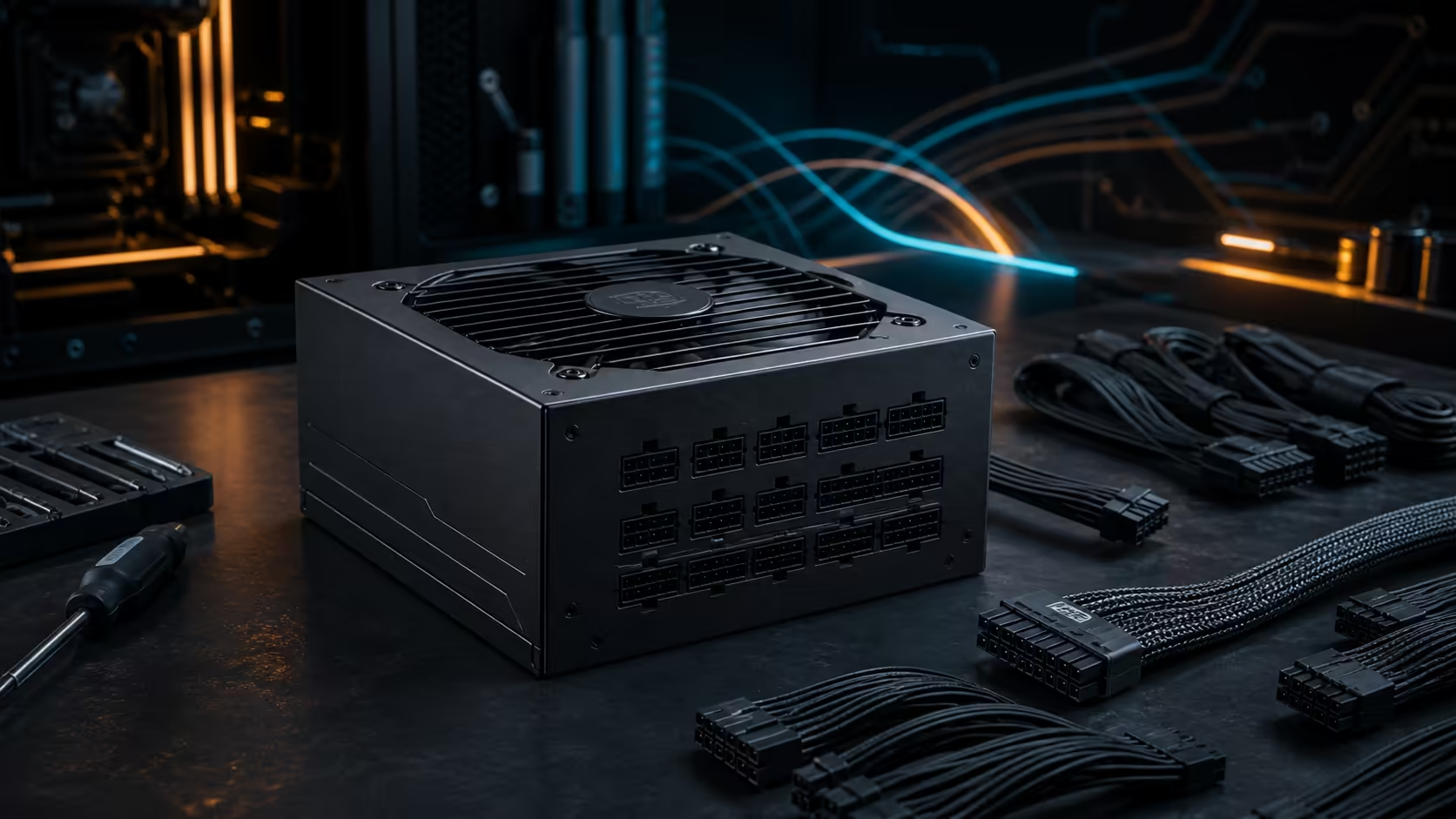
Gamdias has launched a new THOR P2 power-supply family in 850W, 1050W and 1350W versions. All three are pitched as premium units with 80 PLUS Platinum certification, ATX 3.1 and PCIe 5.1 readiness, fully modular cables and native 12V-2x6 support. The important question for a South African build is not whether the largest number looks safest. It is which capacity, connector set and warranty fit the actual parts list.
Quick Answer
An 850W unit is the sensible starting tier for many powerful single-GPU gaming PCs, but the graphics-card maker's recommendation and the chosen processor decide the final answer. Move higher when a flagship GPU, power-hungry CPU, sustained creator workload or future upgrade plan needs the headroom. The new THOR P2 range was not found in the 10 August local catalogue snapshot, so do not assume a South African price or delivery date yet.
What the new THOR P2 range includes
The three announced capacities share the main platform features. They are fully modular, so unused leads can stay in the box. They carry 80 PLUS Platinum efficiency certification, use Japanese electrolytic capacitors and include a 135mm fluid-dynamic-bearing fan with a quiet operating mode. Gamdias lists a 12-year warranty for the new series.
ATX 3.1 and PCIe 5.1 support matter because a modern supply is designed around the short power excursions created by current high-performance hardware. Native 12V-2x6 support also avoids building a premium system around a chain of older adapter leads. None of those labels removes the need to seat the connector fully, avoid a hard bend at the plug and route the cable without side pressure.
Efficiency is another separate decision. Platinum certification describes conversion efficiency at specified loads and input conditions. It does not prove that a unit has the right wattage, cable count, physical length or independent electrical quality for a particular PC. A correctly sized Gold supply can be a better purchase than an oversized Platinum model when the rest of its specification and warranty fit the build.
The local 850W to 1300W shelf
The 10 August check found 20 in-stock power supplies between 850W and 1300W that mentioned ATX 3.1, PCIe 5.1 or a native 12V-2x6 lead. The checked examples began at R1,499 for an 850W ATX 3.1 unit. A current Gamdias 850W Bronze model was R1,699, while an in-stock Gamdias 1300W Gold model was R2,899.
Those products are useful comparison points, but they are not the newly announced THOR P2 models. A similar name, wattage or brand is not proof of the same certification, platform or warranty. Compare the exact model code on the product page and the box before checkout.
Browse the current power-supply range after the GPU and CPU have been selected. A complete graphics-card range helps identify the actual card, while current gaming PC deals show how balanced systems pair power delivery with the rest of the build.
Start with the graphics card, not the PSU badge
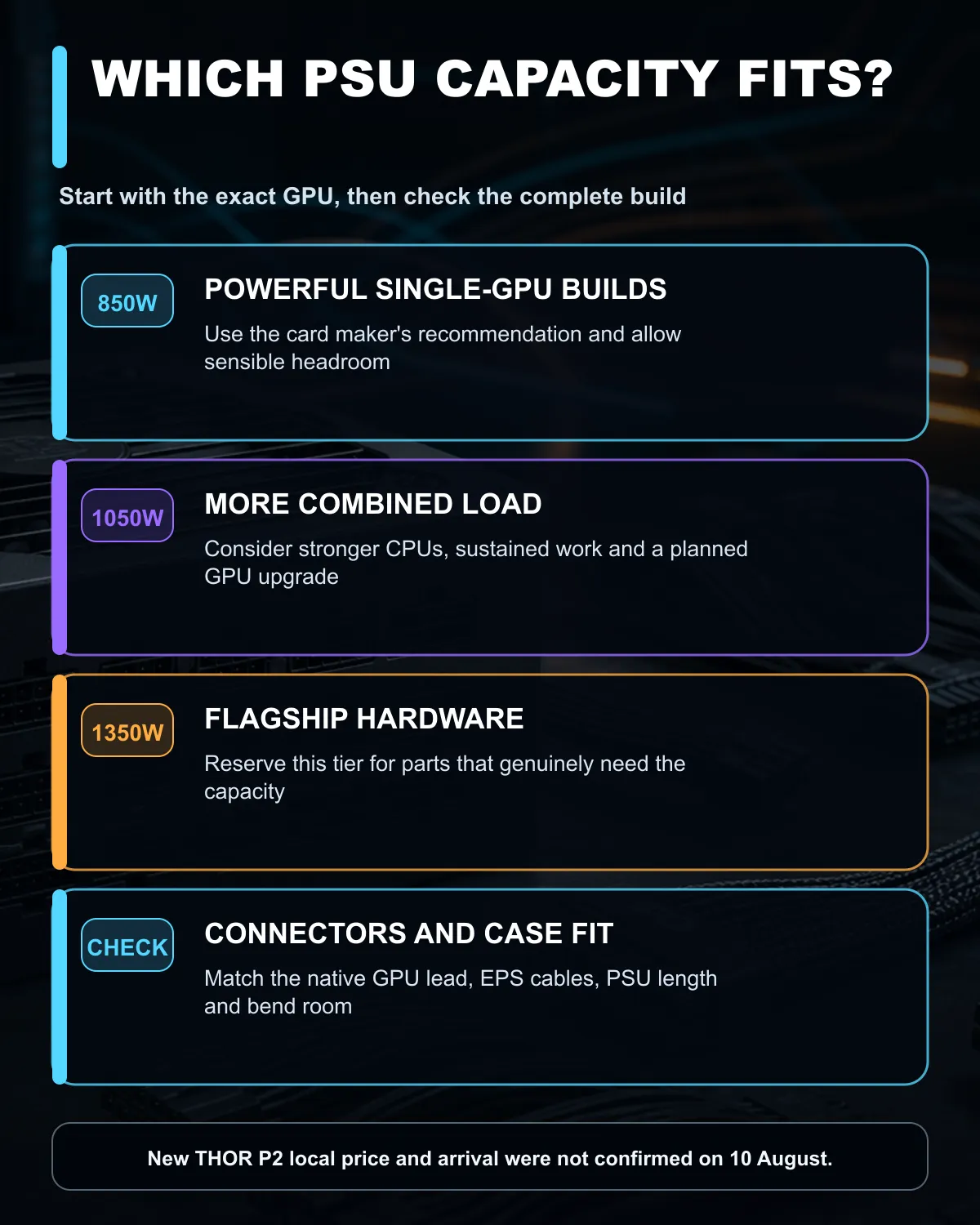
The GPU maker's minimum system-power recommendation is the first checkpoint. It normally assumes a typical surrounding system, so a high-draw processor, many drives, pumps or add-in cards can change the calculation. The card's power-connector requirement matters just as much as the headline wattage.
An 850W supply can be appropriate for a wide range of upper-midrange and high-end gaming builds. A 1050W unit creates more breathing room for a stronger CPU, sustained combined loads or a planned graphics upgrade. A 1350W model belongs in the conversation for flagship hardware and demanding workstations, not because every gaming PC benefits from unused capacity.
Avoid treating this as a universal tier chart. Two graphics cards with similar names can have different board power and connector requirements. Factory-overclocked variants can also change the recommendation. Check the exact card page, not a generic search result for the GPU family.
Check fit, cables and protection
The supply must fit the case with space for its modular plugs and cable bends. A compact case may accept the metal PSU body but leave too little room between the connector panel and a drive cage. Measure that space before choosing a longer premium unit.
Count the CPU EPS leads, conventional PCIe leads, SATA connectors and the native GPU cable. Never combine modular cables from different PSU models, even when the connector appears to fit. The pin arrangement on the power-supply side is not universal, and a mismatched lead can damage hardware.
Protection features and independent testing deserve attention too. Look for over-current, over-voltage, under-voltage, short-circuit, over-power and over-temperature protection. Certification confirms a defined test, while a detailed electrical review can expose voltage regulation, ripple, noise and protection behaviour that a marketing page cannot.
Buy now or wait for the THOR P2?
Buy a current model when the PC is being assembled soon, the exact GPU is chosen and a suitable in-stock supply meets its power, connector, fit and warranty requirements. Waiting for an unpriced product can delay the whole build without improving it.
Wait for the THOR P2 when Platinum efficiency, the 12-year warranty or one of its exact capacities is central to the plan and the rest of the build is not urgent. There is no confirmed local price or arrival date in the checked evidence. Treat overseas launch information as a specification preview, not a South African stock promise.
Frequently Asked Questions
What capacities are in the Gamdias THOR P2 range?
Gamdias announced 850W, 1050W and 1350W models.
Is the new THOR P2 available in South Africa?
The exact new models were not found in the checked Evetech catalogue on 10 August 2026, so local pricing and timing are not confirmed.
Does every gaming PC need a 1000W power supply?
No. Use the exact GPU recommendation, processor draw, connector needs and reasonable upgrade headroom to size the unit.
What was the lowest checked 850W ATX 3.1 price?
The 10 August snapshot included an in-stock 850W ATX 3.1 power supply at R1,499.
Is 80 PLUS Platinum automatically better than Gold?
It indicates a higher certified efficiency tier, but model quality, wattage, protection, cabling, fit and warranty still determine suitability.
Can I reuse modular cables from my old PSU?
Only when the manufacturer explicitly confirms those exact cables are compatible. PSU-side pinouts are not universal.
Building around a new graphics card? Confirm the card's power and connector requirements, measure the case, then compare current ATX 3.1 supplies with enough headroom for the complete system.