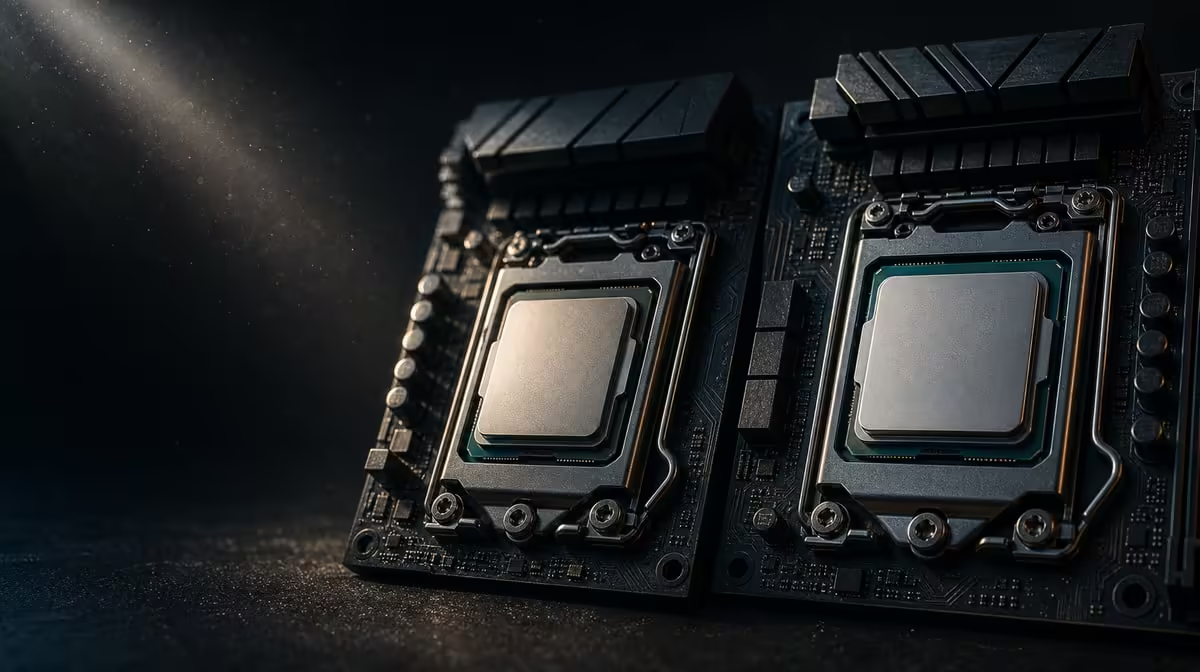
A cache number is not an FPS promise, but it can explain why two processors behave differently even when clock speed is not the whole story. Does 3D V-Cache increase gaming FPS has a conditional answer: extra nearby data capacity can help a cache-sensitive game, while a graphics limit or different engine may reduce the visible gain. The R7,199 Ryzen 7 5800X3D provides 100MB cache for that comparison.
Quick Answer
3D V-Cache can raise FPS when a game repeatedly needs data that the larger on-chip cache can keep close to the CPU. The Ryzen 7 5800X3D combines 100MB cache with eight Zen 3 cores and 16 threads, but not every title benefits by the same amount. Compare representative game tests with the same GPU, settings and scene before assigning value to the R7,199 processor.
🧠 Understand what the larger cache changes
A processor cache is fast storage close to the cores. When useful data is already there, the CPU can avoid some slower trips to system memory. Games with working data that is repeatedly accessed may therefore respond to a larger cache, particularly when the processor is responsible for preparing frames quickly enough to keep the graphics card busy.
The 5800X3D's relevant figure is 100MB cache. It sits alongside eight cores, 16 threads and Zen 3 architecture rather than replacing them. System memory is still required, and its capacity and configuration still matter. Cache helps a particular data path; it is not an alternative to adequate RAM.
Evetech's AMD CPU choices allow that cache-led option to be compared with other processor designs.
🎮 Expect different results across games
One engine may reuse data in a way that suits the larger cache, while another may respond more strongly to frequency, graphics performance or a different resource. Resolution and visual settings also alter the balance. If the GPU is already the limiting part, extra CPU capability can remain largely hidden; a more CPU-sensitive test may reveal it.
The processor's 3.5GHz base and up-to-4.5GHz maximum boost do not settle the cache comparison. Clock speed and cache address different constraints, and the peak boost is not a fixed all-core gaming frequency. A fair test keeps the graphics card, memory, game build, scene and settings constant, then examines both average FPS and frame consistency.
The wider processor range helps place cache, cores and clocks in the same buying decision rather than isolating one headline number.
📊 Read benchmark gains in context
South African buyers should translate a measured gain into their own system before translating it into value. Confirm that the test uses a similar graphics card and resolution, then ask whether the title represents the games actually played. A large result from one scene is evidence for that configuration, not a universal multiplier.
At R7,199, the 5800X3D also needs a compatible AM4 motherboard and BIOS, a separate cooler suitable for its 105W rating, and a discrete GPU for any display output. Evetech's CPU cooler category can be used to price cooling after socket support and case fit are checked.
Frequently Asked Questions
How can a larger CPU cache help a game?
It can keep more reused data close to the processor cores, reducing some slower memory access. The practical benefit depends on the game's engine and workload.
Will every title gain the same amount of FPS?
No. Some games are cache-sensitive, while others are limited by graphics, clocks, settings or engine behaviour. There is no single valid percentage for every title.
Why can resolution change the observed CPU difference?
Higher graphics loads can place more of the limit on the GPU, hiding CPU separation. A less GPU-bound test may expose processor differences more clearly.
What makes a fair cache comparison between processors?
Use the same GPU, memory setup, game version, scene, resolution and settings. Repeat the runs and inspect consistency as well as the average frame rate.
Does the 4.5GHz maximum boost settle the comparison?
No. Up to 4.5GHz is a peak specification, not a fixed gaming speed, and clock frequency does not describe cache behaviour by itself.
Which Ryzen 7 5800X3D specification is relevant here?
Its 100MB cache is central, supported by eight Zen 3 cores and 16 threads. The stated frequency range begins at a 3.5GHz base, with boost reaching a maximum of 4.5GHz.
How should South African buyers interpret benchmark gains?
Match the benchmark to the intended games and complete PC, then compare the measured benefit with the R7,199 CPU price plus required cooling and graphics.
Want to compare large-cache gaming value with the rest of your build?
Explore Evetech's processor choices, then judge the R7,199 5800X3D using tests that match your GPU, resolution and games.