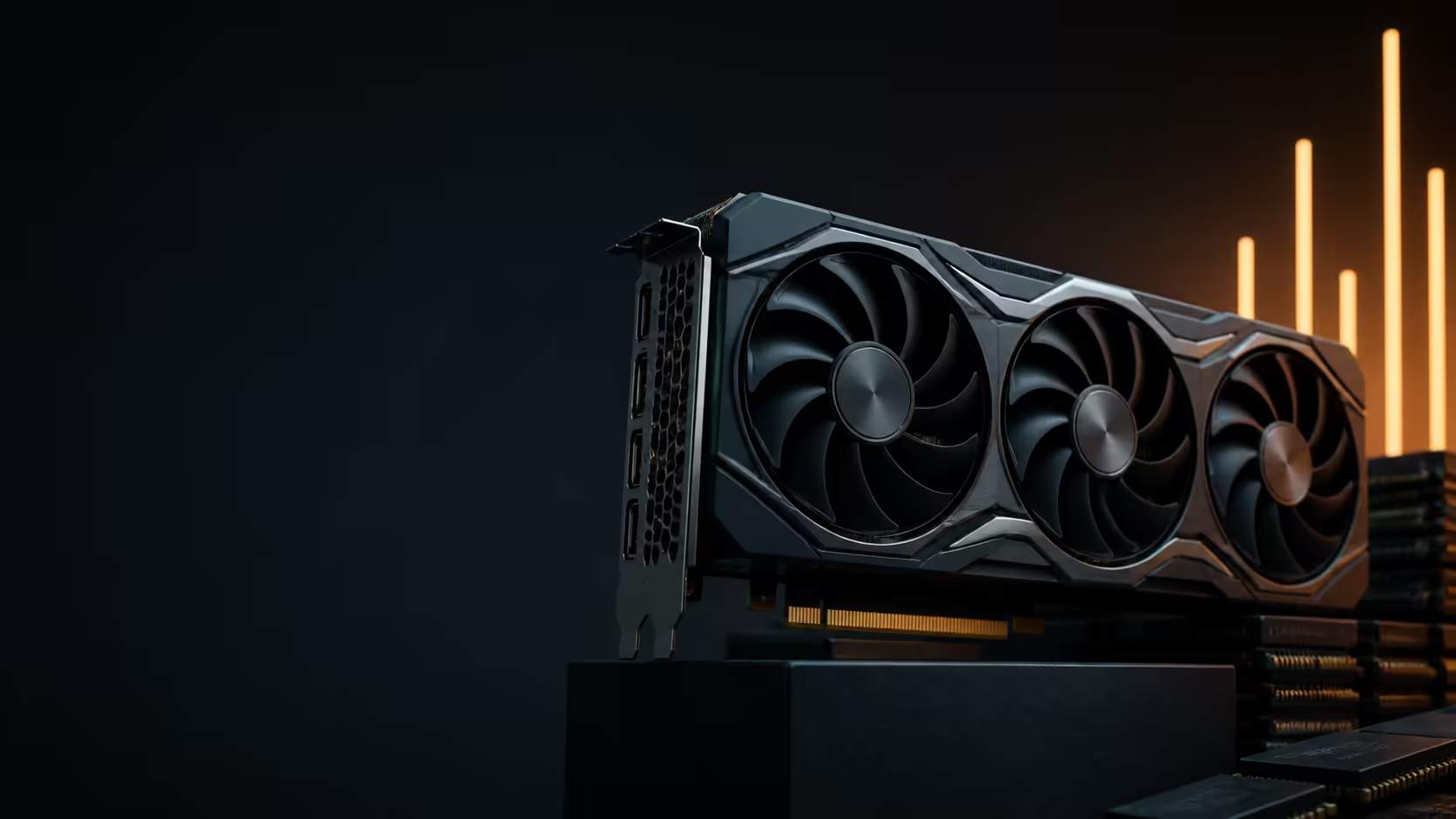
The latest graphics-card price pressure has spread to another major board partner. MSI distributor prices are reported to have risen by more than 20% on parts of its range, while Gigabyte order prices in Japan have moved by roughly 20% to 40% depending on the model. For South African buyers, this is a risk signal rather than a local price announcement.
Quick Answer
There is no evidence that every MSI graphics card in South Africa has just become 20% more expensive. A live Evetech check on 6 August found active graphics cards from R4,399, MSI RTX 5060 models from R8,499 and 16GB cards from R9,999. If the GPU is the last part of a confirmed build, compare the exact card now. If the upgrade is optional, wait for a real local movement instead of buying from fear.
Why this update matters
Graphics-card pricing was already under pressure from expensive graphics memory and constrained supply. The new development is that more board partners and distributors are implementing actual channel changes rather than only warning about future costs.
MSI joins price movements already seen across other brands and markets. A Japanese distributor has also put an effective date on revised Gigabyte order prices, starting from 1 August. That makes the trend harder to dismiss, but it still does not establish how much of any overseas increase will reach local stock.
South African retail prices can behave differently because current inventory may have been purchased earlier, the Rand can move in either direction, and promotions can offset part of a supplier increase. Individual models can also move at different times. A high-end RTX 5090 change does not tell you what an RTX 5060 or Radeon RX 9060 XT will cost locally next week.
Current local prices give the useful baseline
The checked active range started at R4,399 for a Palit GeForce RTX 3050 6GB. Current-generation options appeared higher up the list: an ASUS Radeon RX 9060 8GB at R7,899 and several RTX 5060 8GB cards between R7,999 and R9,199.
MSI models are especially useful for tracking this story. The MSI RTX 5060 Shadow 2X OC was R8,499, the RTX 5060 Ventus 2X OC was R8,999, and MSI RTX 5060 Ti 8GB models started at R9,499 in the snapshot. Those figures record the South African shelf before assuming a new overseas price has filtered through.
Buyers who need more memory also had choices. An XFX Radeon RX 9060 XT 16GB was R9,999, while a Palit RTX 5060 Ti 16GB was R12,999. Browse all graphics cards and compare the full model name, because cooler, clock, VRAM capacity and warranty can separate cards that share the same GPU family.
Do not let the brand headline choose the GPU
The best card is still the one that matches the games, monitor and power budget. Start with resolution and target frame rate. A 1080p esports build has different needs from a 1440p high-refresh machine or a 4K system using ray tracing.
Next, check VRAM and the features you will actually use. A cheaper 8GB card may be perfectly reasonable for a focused 1080p build. A 16GB model can offer more headroom for heavier textures, creation workloads and longer ownership, but capacity alone does not guarantee better performance.
Then compare the complete price. A larger GPU may require a stronger power supply, more case clearance or better airflow. Those supporting changes can erase an attractive card-only deal. The graphics-card specials are most useful after those requirements are known.
When buying now makes sense
Buy now when the current card cannot meet a real game or work requirement, the rest of the system is ready, and a suitable model fits the total budget. A known local price and available stock are more valuable than trying to time an overseas channel change precisely.
Wait when the present GPU still meets your needs, when the monitor upgrade is not decided, or when you would need to borrow money to move early. Price pressure is not a command to overbuy. A later promotion, used-market option or change in local stock can still produce a better result.
If MSI is your preferred brand, compare current MSI graphics cards with equivalent cards from other board partners. The underlying GPU matters more than the badge. Cooler noise, size, power limit, support and final Rand price should decide between two versions of the same chip.
Frequently Asked Questions
Did MSI GPU prices rise by 20% in South Africa?
That is not established. The reported movement applies to overseas distributor pricing, while the local snapshot shows current Evetech listings.
What was the cheapest graphics card checked?
The active range started at R4,399 for a Palit GeForce RTX 3050 6GB.
What did an MSI RTX 5060 cost?
The lowest checked MSI RTX 5060 was the Shadow 2X OC at R8,499.
Should I choose 8GB or 16GB?
Match VRAM to resolution, games, workloads and expected ownership. Capacity is important, but the GPU's overall performance still matters.
Could South African GPU prices fall instead?
Yes. Exchange rates, older inventory, promotions and local demand can move individual products differently from overseas channels.
Ready to choose the right graphics card? Compare current RTX and Radeon options at Evetech by resolution, VRAM, case clearance and total system cost before the market headline chooses for you.