



AMD Q2 Results: What Ryzen Demand Means for SA Buyers
AMD's Q2 results show weaker gaming revenue but stronger Ryzen-led client sales. South African buyers should judge today's CPU value by platform cost, not the headline alone.
Read moreMemory supply is expected to stay tight into 2027. South African builders with a near-term project should price the correct RAM now instead of waiting for an assumed drop.

The memory supply outlook for 2027 has become another reason to plan a PC build carefully. Reports of long-term allocation deals and continued pressure from AI infrastructure do not prove that South African RAM prices will jump tomorrow. They do weaken the case for delaying a confirmed build simply because memory is expected to become cheaper soon.
Global DRAM supply is expected to remain tight into 2027, but there is no confirmed matching South African price increase yet. A live Evetech check on 5 August found 16GB DDR4 modules from R2,699, a single 32GB DDR5 module from R7,299, and a 32GB 2x16GB DDR5 kit from R7,999. If your platform and build date are already fixed, compare the correct kit now instead of betting the project on a rapid price fall.
The latest reports describe a memory market in which large customers are securing future capacity while manufacturers direct more production towards high-value server and AI products. Independent market analysis also expects AI-driven demand growth to outpace new DRAM supply during 2027. That combination can keep the seller's side of the market firm even as factories expand.
This is a supply warning, not a local price forecast. Consumer DDR4 and DDR5 modules pass through several steps before reaching a South African shelf. Existing distributor inventory, exchange rates, shipping, product mix and demand all matter. A global constraint can take time to reach local pricing, and some individual kits may still move down while the wider market stays tight.
The practical lesson is narrower: do not assume that waiting automatically produces a cheaper memory purchase. Buyers should decide from the current full-platform cost and their actual build date.
The live category read found seven active DDR4 memory options, ranging from R1,599 for an 8GB module to R3,499 for a 16GB dual-module kit. Several single 16GB DDR4 modules sat between R2,699 and R2,999. That leaves a workable path for an older compatible desktop that needs more capacity without replacing the full platform.
The DDR5 memory range was broader, with 39 live products in the checked category. For a practical 32GB target, a single 32GB 5600MHz module started at R7,299. The lowest checked matched 2x16GB kit was R7,999, followed by several 6000MHz and 6400MHz kits from R8,199 to R8,699.
Those numbers are a dated snapshot, not a promise that every listing will remain available. They show that buyers still have choices today and that capacity, speed, module count and platform support can change the price by much more than a small market movement.
RAM is only useful when it matches the motherboard and processor. An AM4 build normally needs DDR4, while most AM5 desktop boards use DDR5. Buying a discounted kit before fixing the platform can create an expensive compatibility mistake.
For DDR5, check the motherboard memory support list, the processor's practical memory target and the kit's profile support. A 2x16GB kit is often the straightforward 32GB choice because it provides a tested pair and dual-channel operation. A single 32GB module can make sense when a later capacity expansion matters more, but performance depends on the platform and module arrangement.
Use the current memory best sellers as a comparison point, then confirm the exact kit code rather than buying on capacity alone. Two products can both say 32GB while differing in speed, latency, height and supported profiles.
Buy now when the build is happening within the next one to three months, the motherboard is chosen, and the current kit fits both the specification and total budget. The supply outlook gives no strong reason to hold a ready build for an assumed bargain.
Wait when the platform is undecided, when the current machine already has enough memory, or when a major motherboard and processor change is still several months away. Future compatibility matters more than trying to beat a possible price movement.
For an existing system, confirm whether memory pressure is real. If normal use does not approach installed capacity, adding RAM may not improve performance. If games, creation tools or heavy multitasking repeatedly push the system into storage paging, a correctly matched capacity upgrade can help immediately.
The headline is not a command to panic-buy. It is a reason to remove wishful price assumptions from the build plan and compare the real Rand cost while suitable stock exists.
No. The checked Evetech categories had seven live DDR4 listings and 39 live DDR5 listings on 5 August.
A single 32GB DDR5 module started at R7,299. The lowest checked 2x16GB DDR5 kit was R7,999.
Not as a simple memory swap. DDR5 normally requires a compatible motherboard and processor platform, so price the full change.
It can be, depending on the games and background workloads. Move to 32GB when measured use, stuttering or the rest of the build justifies it.
No. It increases risk but does not determine a specific local movement or date.
Ready to lock in the right memory kit? Compare current DDR4 and DDR5 options at Evetech, then match capacity, speed and module layout to the motherboard you will actually use.
No. The 5 August check found 7 live DDR4 listings and 39 live DDR5 listings in the checked Evetech categories.
The lowest checked 2x16GB DDR5 kit was R7,999, while a single 32GB DDR5 module started at R7,299.
If the build is confirmed, pricing the correct kit now is sensible. Do not buy until the motherboard and processor platform are fixed.
Yes. Seven live DDR4 listings were found, including 16GB modules from R2,699 in the 5 August check.
No definite local increase is established. Global tightness is a risk signal, while exchange rates and local inventory affect shelf prices.
Not automatically. A matched two-module kit normally gives dual-channel operation, while one module can leave a simpler capacity upgrade path.
AMD's Q2 results show weaker gaming revenue but stronger Ryzen-led client sales. South African buyers should judge today's CPU value by platform cost, not the headline alone.
Read more
Steam's July 2026 survey puts 16GB VRAM and 8-core CPUs at the top of their categories. South African buyers can reach both from about R12,998 before the rest of the build.
Read more
Fresh reports warn of 20% to 40% GPU order increases in Japan, but no matching South African rise is confirmed. The checked local 16GB shelf still starts at R9,999.
Read more
Black Friday Gaming PC Wait can help if your PC need is flexible. On a R8,000 SA budget, compare deal risk, component balance, warranty, and timing before waiting.
Is the vertical mouse vs horizontal mouse needs a workload-first comparison. For SA buyers, judge real performance, platform fit, warranty path, power needs, and upgrade timing before choosing either side.
An alternative to the RTX 5090 for 1080p gaming should match your screen, not chase excess headroom. Compare SA-friendly GPU classes, monitor needs, and upgrade priorities before choosing a balanced card for your rig. Keep heat and fit in view.
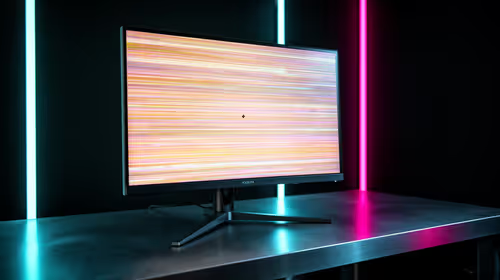
Windows 11 gaming PC dead pixel checks start with a pixel test and display isolation. This how to fix dead pixel windows 11 gaming pc guide helps SA gamers test cables, settings, monitor behaviour, and warranty-safe next steps.
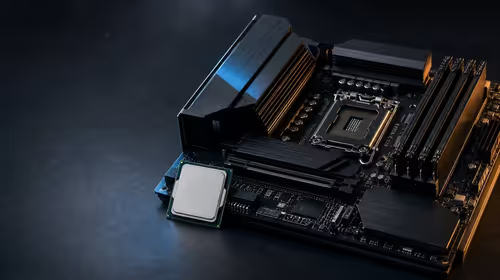
This high-end AMD kit combines the platform parts that define CPU performance, memory and cooling, while the remaining PC still needs support hardware. Its 9950X3D sits on the Dark Hero board, with 48GB KLEVV memory and an LQ360 completing the package.
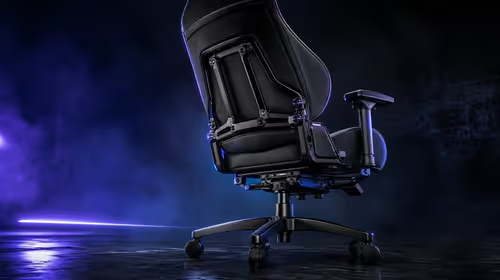
A gaming chair frame transfers seated and movement forces through the structure, making it more consequential than surface styling. The HERO uses a robust steel frame and is designed for users up to 150kg, though those facts cannot establish an exact lifespan.
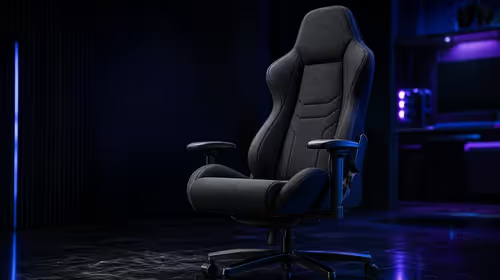
Gaming chair material affects more than appearance: upholstery shapes feel while foam manages pressure beneath it. The HERO TX combines premium TX fabric with cold-foam, then uses enlarged 4D armrests and a memory headrest to refine upper-body contact.
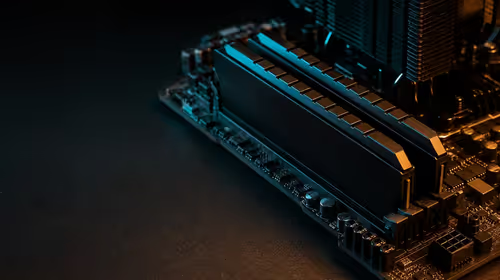
Faster memory can increase data bandwidth for workloads that respond to it, while sufficient capacity prevents concurrent tasks from exhausting the available pool. This kit's 48GB DDR5-7200 configuration targets both needs for gaming, streaming and creative work.

Memory supply is expected to stay tight into 2027. South African builders with a near-term project should price the correct RAM now instead of waiting for an assumed drop.
AMD's Q2 results show weaker gaming revenue but stronger Ryzen-led client sales. South African buyers should judge today's CPU value by platform cost, not the headline alone.
Steam's July 2026 survey puts 16GB VRAM and 8-core CPUs at the top of their categories. South African buyers can reach both from about R12,998 before the rest of the build.
Fresh reports warn of 20% to 40% GPU order increases in Japan, but no matching South African rise is confirmed. The checked local 16GB shelf still starts at R9,999.