Fresh GPU price hike warnings are moving across Asian markets, with reports of new Gigabyte order prices rising by 20% to 40% in Japan. That is a warning signal for South African buyers, not proof of a local increase. The useful response is to record today's Rand price, choose a target card and buy only when the whole build is ready.
Quick Answer
No 20% to 40% South African GPU increase has been confirmed. The checked Evetech shelf still had in-stock 16GB graphics cards from R9,999 on 5 August 2026. Buy now if the card meets a current need and the rest of the build is funded; wait if you are reacting only to overseas headlines.
🌏 What the overseas reports actually say
A Japanese distributor reportedly warned customers that new Gigabyte graphics card orders would carry increases of roughly 20% to 40% from August. Separate reporting from South Korea pointed to increases of up to 30% on parts of the RTX 50 range. A broader current-generation price review also found weak discounting and persistent pressure on popular cards.
These are related signals, but they are not a South African price notice. Regional distributor contracts, taxes, currency movements, shipping, old stock and new stock can produce very different timing. A percentage reported in Japan cannot be copied onto a Rand shelf price.
The reports still matter because graphics cards are globally traded products. If replacement stock lands at a higher cost, local prices can eventually move. The word eventually is doing important work: existing inventory may have been bought under different terms, and local demand can change how quickly a new cost reaches the shelf.
🇿🇦 The live South African snapshot
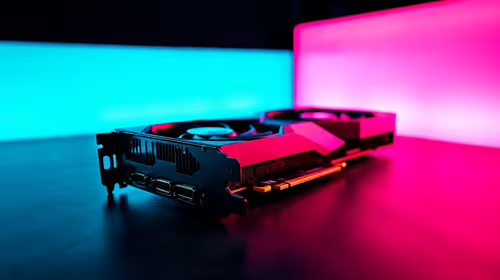
The 5 August catalog check found 17 in-stock 16GB cards across the main Nvidia and AMD categories. On the full graphics card shelf, the lowest checked 16GB option was an XFX Radeon RX 9060 XT at R9,999. Another RX 9060 XT was R10,499, while the lowest checked RTX 5060 Ti 16GB was R12,999.
Higher performance tiers widened quickly. RX 9070 XT 16GB models started at R13,999 in the check. RTX 5070 Ti 16GB models started at R19,999, and RTX 5080 16GB models started at R26,999.
Buyers who already prefer one GPU family can compare the current Nvidia graphics card range and AMD Radeon range separately. The checked prices are a dated snapshot, not a promise that every model will hold the same price.
🧭 A calm buy-or-wait rule
Buy now when three conditions are true: your present GPU is preventing a game or workload from meeting its target, you know the exact performance tier required, and the rest of the system can support it. That last check includes the power supply, case clearance, processor balance and monitor resolution.
Wait when the purchase would sit unused, when you have not chosen a resolution and frame-rate target, or when fear of a future increase is the only reason to spend. A rushed R20,000 purchase is not protected simply because another market reported a percentage increase.
For buyers choosing between nearby cards, use the current Rand gap rather than the overseas percentage. If the step from an 8GB card to a 16GB model is small enough for the games and lifespan you want, the extra memory may be sensible. If the jump forces cuts to the power supply, processor or monitor, the build has become less balanced.
✅ Protect the decision without panic buying
Take a screenshot or note of the exact model, price and date when you begin comparing. Graphics card names are close enough that a cheaper listing can be a different memory capacity, cooler or clock profile. Compare like for like.
Set a maximum Rand budget for the entire upgrade, not only the GPU. If the preferred card rises beyond that ceiling, move down one performance tier or delay the build. Do not recover the difference by buying an inadequate power supply.
Finally, check availability again at checkout. The live read used for this article showed every quoted card as in stock with Evetech, but stock status can change. The honest conclusion today is measured: overseas pressure is real, a matching local increase is not confirmed, and the current shelf gives buyers a clear price to judge.
Frequently Asked Questions
Are South African GPU prices going up by 40%?
That has not been confirmed. The 20% to 40% warning applies to reported new orders in Japan.
What is the cheapest checked 16GB GPU?
The live 5 August check found an RX 9060 XT 16GB at R9,999.
What is the cheapest checked Nvidia 16GB option?
The lowest checked Nvidia model was an RTX 5060 Ti 16GB at R12,999.
Should I wait for the next GPU generation?
Only if your present system still meets your needs. Waiting has no guaranteed price benefit while current-generation costs remain under pressure.
How do exchange rates affect local GPU prices?
Graphics cards are imported, so Rand weakness can raise landed costs. Existing stock and supplier terms can delay or soften the effect.
Ready to lock a measured GPU budget? Compare the current Evetech graphics card range by exact model and memory capacity, then buy only when the complete build makes sense.