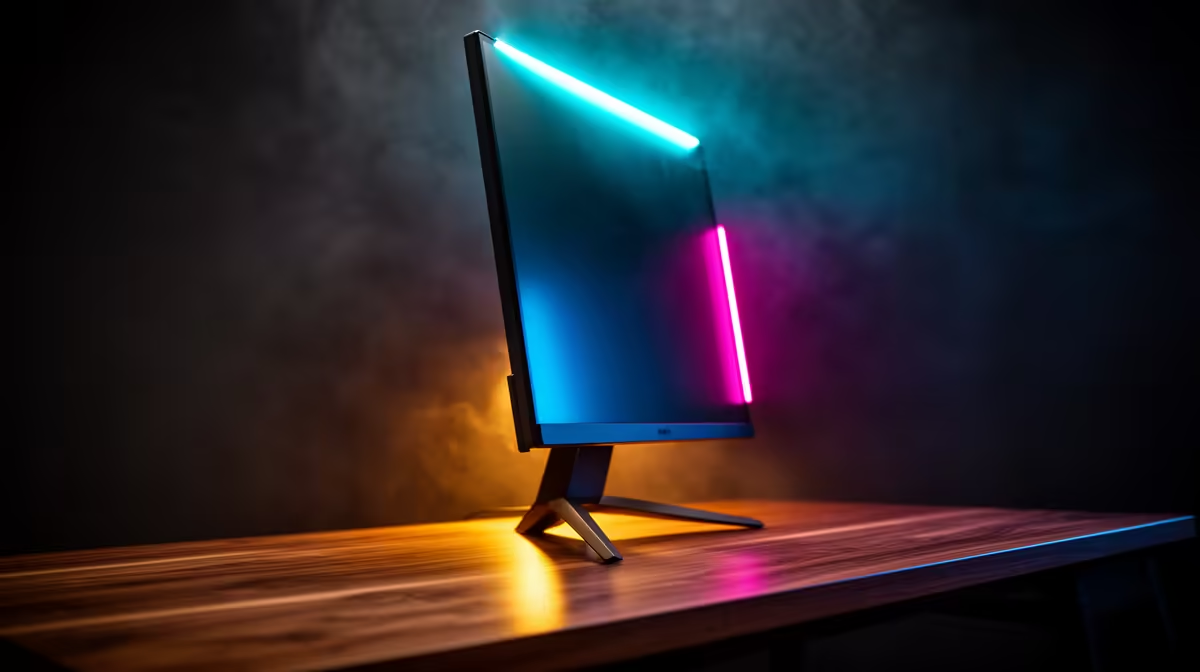
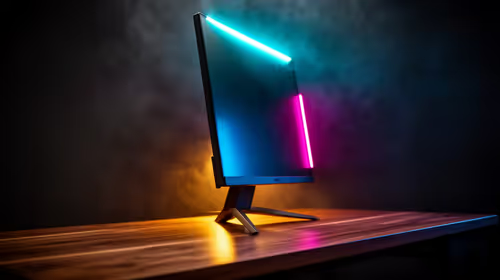
Five hundred refreshes each second matter only when the PC and game can feed them with consistency. A 500Hz monitor is a specialised esports tool whose motion gain should be compared with resolution, panel quality and total system cost.
Quick Answer
A 500Hz monitor is worth it when competitive play is your main use, your PC delivers very high and stable frame rates, and you can perceive the motion or latency gain over 240Hz or 360Hz. It is not reserved for paid professionals, but the benefit is narrow. Frame rate does not need to sit at exactly 500 for every moment, though low and uneven delivery wastes much of the panel's advantage. Most mixed-use players gain more from resolution, contrast or a strong 240Hz display. Test the complete monitor, because refresh rate cannot guarantee fast pixels or clean overdrive.
The time step becomes very small
At 500Hz, a refresh begins every 2ms. At 240Hz, the interval is about 4.17ms. That can improve motion sampling and reduce the wait for a newly rendered frame, but the total response still includes input, game, CPU, GPU, display scanout and pixel transition.
Moving from 240Hz to 500Hz trims a little over two milliseconds from the refresh interval. The first jump away from 60Hz removes far more time, so this later step needs the games, vision and training to expose it.
Frame-time lows matter most
Competitive titles at reduced settings are the natural fit. Measure a busy match, smoke, utility and player-heavy scenes. An average above 500 can hide drops that disturb motion.
CPU speed, memory behaviour and game engine can set the limit before the GPU. Use a sensible frame cap when it improves consistency, and check VRR range plus game latency settings.
Pixel response must keep up
A 500Hz input cannot produce 500 clear images when transitions remain incomplete. Read measured response across the refresh range, overshoot and inverse ghosting. One aggressive overdrive mode may work at maximum refresh and look poor when frame rate falls.
Check blur-reduction modes separately. They can reduce brightness, disable VRR or work only in a refresh range.
Resolution and ownership are trade-offs
Many ultra-high-refresh monitors focus on 1080p or another competitive resolution. That can suit esports and look cramped for creation or detailed single-player games. Measure viewing distance and text needs.
Confirm the graphics connection, cable, colour depth and refresh combination. Browse gaming monitors and monitor best sellers for exact current specifications.
Use a blind motion test when possible
Ask someone to switch between correctly configured refresh modes without telling you which is active. Run the same tracking drill and record hits, target loss and comfort. Repeat on another day. If your result and preference stay the same, the specification is not earning its cost.
Keep resolution and image settings matched. A lower-resolution 500Hz mode against a sharper 240Hz image creates two changes at once.
FAQ
Must a game stay above 500 FPS?
No, but high stable frame delivery helps use the refresh headroom. Large drops reduce the benefit.
Is 500Hz clearer than every 240Hz OLED?
No. Refresh, pixel response, overshoot and persistence all shape motion. Compare measured complete displays.
Does 500Hz help single-player games?
It can improve motion, but resolution, HDR and contrast may offer a larger visible gain for that use.
Compare 500Hz monitors with 240Hz and 360Hz options using your real frame-time lows and motion test.