Controller polling figures become easier to judge once they are translated into time. The difference between 1000Hz and 250Hz polling is a nominal report interval of about 1ms versus 4ms, leaving roughly 3ms between the two rates before the rest of the system is considered.
Quick Answer
1000Hz reports four times as often as 250Hz, reducing the nominal interval from about 4ms to 1ms. The R729 GameSir Nova 2 Lite lists 1000Hz polling, though the supported connection, platform, game, frame delivery, display, and player sensitivity decide how much of that gap is noticeable.
⏱️ Read frequency as an interval
Hertz describes events per second. A 250Hz controller can report at nominal four-millisecond intervals, while 1000Hz corresponds to about one millisecond. The subtraction is simple, but it does not mean the complete input chain becomes exactly three milliseconds faster in every action.
The controller is only one stage. Its connection carries the report to a host, the platform and game process the input, a frame is produced, and the display presents it. Timing at those stages can hide, reduce, or vary the advantage that exists on paper.
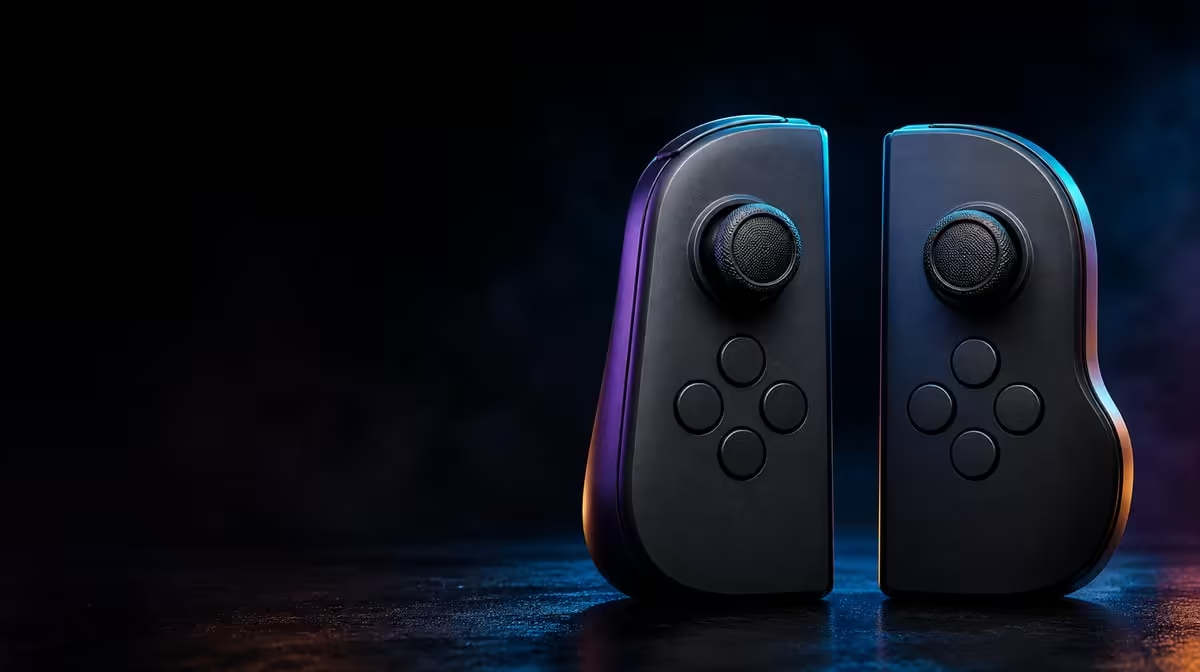
Evetech's gaming controller category is a practical place to compare rates alongside the features around them. At R729, the Nova 2 Lite combines its 1000Hz figure with Hall sticks and precision Hall triggers.
🧪 Test without changing the whole setup
Choose a repeatable local scene and keep the display, game settings, sensitivity, and connection route unchanged. Perform the same movement several times at the available configuration, then compare consistency. A single attempt is too noisy; a small set of repeated inputs exposes whether the higher report frequency supports your play.
Avoid using an online match as the first test. Network latency belongs to a different path and can dominate what you feel after pressing a control. An offline training action, fixed camera movement, or menu sequence gives the controller and display a cleaner stage.
Hall sensing does not make polling irrelevant. Hall sticks determine position magnetically, while polling determines how often the state is reported. A stable sensor reading can complement frequent reports, but each feature answers a separate question.
🎮 Decide whether the gap matters to you
Fast games can expose timing differences more clearly because actions happen frequently, yet not every player will perceive or use the change in the same way. Frame timing, display behaviour, connection support, and personal consistency all influence the result. Judge repeated performance rather than the expectation created by a larger number.
The Nova 2 Lite's tri-mode connectivity offers multiple routes, but do not assume every route exposes identical polling behaviour on every platform. Check the intended host and use the supported path that gives a reliable result. The gaming accessories section helps put that connection choice within a broader setup.
Current buying context can also be found through Evetech's accessory best sellers. A good R729 decision weighs the 1000Hz rate together with the Hall controls, app profiles, dual asymmetric motors, and exact compatibility you need.
Consider the size of the timing change beside the consistency of the test. A nominal three-millisecond interval difference is small enough that random variation in a single movement can overwhelm it. Use batches of the same action and look for a repeatable shift in control, not a perfect ability to identify each rate blindly.
The comparison also needs a stable frame path. If the game changes frame behaviour between runs, the visible result can move even while controller reporting stays unchanged. Preserve the scene and display conditions, then let several repetitions decide whether the higher rate contributes in your setup. That method respects both the arithmetic and the limits of perception.
Price the interval as part of the package. The R729 Nova includes magnetic sticks and triggers, alternate connection routes, motor feedback, and app profiles around its 1000Hz rate. Even when the timing difference is subtle, those surrounding features can still decide the purchase.
Frequently Asked Questions
Is the nominal three-millisecond gap always delivered to the screen?
No. It describes the difference between report intervals, while other stages add their own processing and timing.
Can 250Hz still feel responsive?
It can, depending on the game, display, platform, connection, and player. Test the complete system instead of rating one number alone.
Does online ping fall when controller polling rises?
Controller polling changes local input reporting. It does not shorten the network journey to an online server.
What should remain fixed during comparison?
Keep the game scene, display mode, connection route, profile, and sensitivity constant so the polling change is not mixed with another variable.
Ready to put polling numbers into proper context?
Compare Evetech's current gaming controller options and choose the response rate that fits your platform, display, and favourite games.