



Memory Supply Squeeze: Should South Africans Buy RAM Now?
Memory supply is expected to stay tight into 2027. South African builders with a near-term project should price the correct RAM now instead of waiting for an assumed drop.
Read moreAMD's Q2 results show weaker gaming revenue but stronger Ryzen-led client sales. South African buyers should judge today's CPU value by platform cost, not the headline alone.

AMD's latest results tell two different consumer stories. AMD Q2 2026 gaming revenue fell while Ryzen-led client sales grew, but neither line tells a South African buyer that a CPU or graphics card price is about to change. The useful response is to separate company performance from the platform cost visible on today's shelf.
AMD reported Q2 revenue of $11.5 billion, with gaming revenue at $779 million, down 31% year over year, while client revenue grew 23%. A live Evetech check on 5 August found 13 AMD desktop processors from R1,499 to R17,999. Practical upgrade points included the Ryzen 7 5700 at R2,999, Ryzen 5 9600X at R4,699 and Ryzen 7 9700X at R6,699.
AMD's gaming segment is broader than desktop Radeon cards. It also includes semi-custom products used in consoles, so a decline in segment revenue cannot be translated directly into weaker demand for one retail graphics card family. The result says what AMD earned across that reporting group, not what a South African distributor will charge next week.
The client segment is closer to the processor discussion. Its growth was led by Ryzen demand, showing that PC makers and buyers continued taking AMD client products. Even here, stronger revenue does not mean every Ryzen model will become more expensive. Product generation, inventory, competition and channel decisions still shape individual prices.
For buyers, earnings are context. They can identify where demand is strong and where a company is concentrating, but they should not replace a current product comparison.
The live AMD processor category contained 13 products during the check. The R1,499 entry was a Ryzen 5 3400G, an older AM4 processor with integrated graphics. Its low price is relevant only for a compatible budget system, not as a direct substitute for current AM5 hardware.
At R2,999, the Ryzen 7 5700 offered eight cores and 16 threads for an existing AM4 desktop that already has a suitable motherboard and discrete graphics card. That can be a focused upgrade because it avoids a new board and DDR5 memory, provided the board BIOS supports the processor.
The Ryzen 5 9600X was R4,699 and moves the decision to AM5. The Ryzen 7 9700X was R6,699 for eight cores and 16 threads on the newer platform. Neither price is the whole bill: an AM5 move also needs a compatible motherboard and DDR5 memory, and the checked processors do not all include a cooler.
Complete AMD Ryzen PC deals provide another reference because a finished system prices the processor alongside graphics, memory, storage, cooling and power delivery.
An AM4 owner should start with the existing motherboard. If a supported processor such as the Ryzen 7 5700 removes the measured bottleneck, R2,999 can buy more useful life without replacing the platform. Check BIOS support before ordering and remember that this processor needs a discrete graphics card.
A fresh build has a different calculation. AM5 costs more at the processor, motherboard and memory level, but it offers a newer upgrade path. Current AMD B650 motherboards are one part of that total. Add the chosen DDR5 kit and cooler before comparing the result with an AM4 upgrade or complete PC.
Core count alone should not settle the choice. Gaming performance also depends on architecture, cache, clock behaviour and the graphics card. Creation, compilation and heavy multitasking can reward more cores differently. Match the processor to the workload and the monitor resolution, then spend the remaining budget where it removes the biggest limit.
Watch live local price gaps, not a single quarterly percentage. If the Ryzen 7 5700 stays far below the full cost of an AM5 change, it remains an attractive extension for the right AM4 system. If a CPU, B650 board and DDR5 combination closes the gap, the newer platform becomes easier to justify.
Also watch availability around the exact model. A category can have plenty of processors while the one that fits your budget or BIOS disappears. Recheck stock and the full component basket when you are ready to order.
AMD's results support one durable conclusion: Ryzen demand remains healthy even while the reported gaming segment weakened. They do not create a reason to rush or wait on their own. The local platform maths should make that decision.
Yes. AMD reported $779 million in gaming revenue, down 31% from the same quarter a year earlier.
No. The gaming segment includes more than retail graphics cards, and company revenue does not set local shelf prices.
The live category started at R1,499, but that entry was an older Ryzen 5 3400G for compatible AM4 systems.
It can be at R2,999 for a supported AM4 board when eight cores solve a real bottleneck and a discrete graphics card is already present.
It adds a newer platform and upgrade path, but also the cost of a compatible motherboard, DDR5 memory and possibly a cooler.
Ready to compare the full Ryzen platform cost? Price the processor together with its motherboard, memory and cooling at Evetech, then choose the route that improves your actual workload.
Yes. AMD reported gaming revenue of $779 million, down 31% year over year, while its client segment grew.
No. The segment also includes semi-custom products, and a revenue result does not set South African retail prices.
The checked AMD CPU category started at R1,499 on 5 August 2026, with 13 live products.
The Ryzen 7 5700 was R2,999, while the newer AM5 Ryzen 7 9700X was R6,699 in the live check.
Only if the performance and upgrade path justify a new motherboard and DDR5 memory. A CPU price alone understates the move.
No. They show business demand trends, while local prices also depend on inventory, distribution and exchange-rate conditions.
Memory supply is expected to stay tight into 2027. South African builders with a near-term project should price the correct RAM now instead of waiting for an assumed drop.
Read more
Steam's July 2026 survey puts 16GB VRAM and 8-core CPUs at the top of their categories. South African buyers can reach both from about R12,998 before the rest of the build.
Read more
Fresh reports warn of 20% to 40% GPU order increases in Japan, but no matching South African rise is confirmed. The checked local 16GB shelf still starts at R9,999.
Read more
Black Friday Gaming PC Wait can help if your PC need is flexible. On a R8,000 SA budget, compare deal risk, component balance, warranty, and timing before waiting.
Is the vertical mouse vs horizontal mouse needs a workload-first comparison. For SA buyers, judge real performance, platform fit, warranty path, power needs, and upgrade timing before choosing either side.
An alternative to the RTX 5090 for 1080p gaming should match your screen, not chase excess headroom. Compare SA-friendly GPU classes, monitor needs, and upgrade priorities before choosing a balanced card for your rig. Keep heat and fit in view.
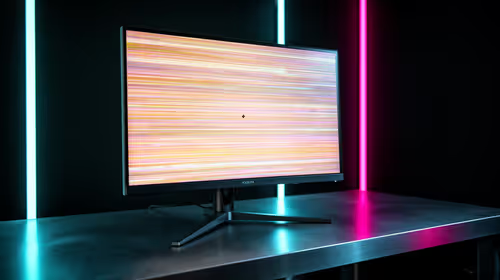
Windows 11 gaming PC dead pixel checks start with a pixel test and display isolation. This how to fix dead pixel windows 11 gaming pc guide helps SA gamers test cables, settings, monitor behaviour, and warranty-safe next steps.
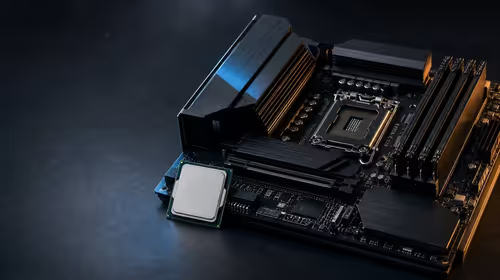
This high-end AMD kit combines the platform parts that define CPU performance, memory and cooling, while the remaining PC still needs support hardware. Its 9950X3D sits on the Dark Hero board, with 48GB KLEVV memory and an LQ360 completing the package.
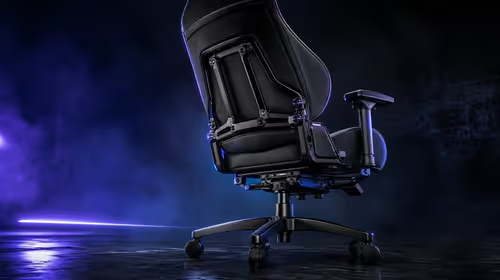
A gaming chair frame transfers seated and movement forces through the structure, making it more consequential than surface styling. The HERO uses a robust steel frame and is designed for users up to 150kg, though those facts cannot establish an exact lifespan.
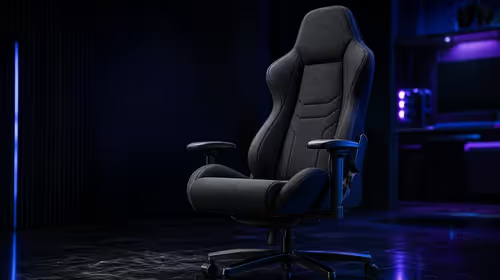
Gaming chair material affects more than appearance: upholstery shapes feel while foam manages pressure beneath it. The HERO TX combines premium TX fabric with cold-foam, then uses enlarged 4D armrests and a memory headrest to refine upper-body contact.
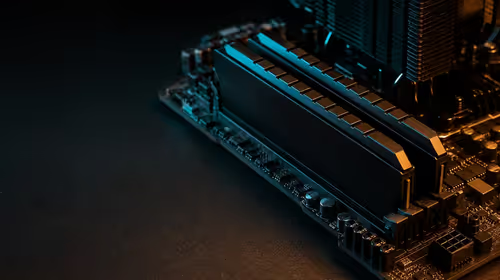
Faster memory can increase data bandwidth for workloads that respond to it, while sufficient capacity prevents concurrent tasks from exhausting the available pool. This kit's 48GB DDR5-7200 configuration targets both needs for gaming, streaming and creative work.
Memory supply is expected to stay tight into 2027. South African builders with a near-term project should price the correct RAM now instead of waiting for an assumed drop.

AMD's Q2 results show weaker gaming revenue but stronger Ryzen-led client sales. South African buyers should judge today's CPU value by platform cost, not the headline alone.
Steam's July 2026 survey puts 16GB VRAM and 8-core CPUs at the top of their categories. South African buyers can reach both from about R12,998 before the rest of the build.
Fresh reports warn of 20% to 40% GPU order increases in Japan, but no matching South African rise is confirmed. The checked local 16GB shelf still starts at R9,999.