Large graphics memory is valuable when a known workload uses it, not because the buyer lives in a particular market. What South African buyers should know about 32GB GDDR7 GPUs is how capacity, price and full-build requirements fit their real games, AI models or creative projects.
Quick Answer
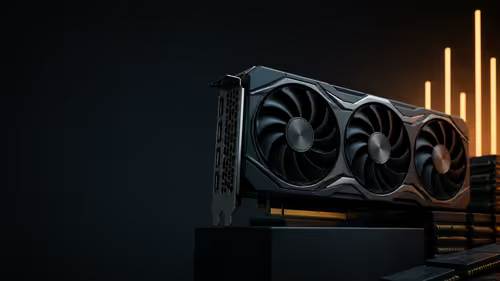
At R73,599, the ASUS TUF RTX 5090 needs a demanding, repeated use case. Its 32GB pool can hold substantial compatible data, while 3352 AI TOPs handles supported processing; compare those resources separately and include every required system change.
🧠 Prove the need for 32GB
Choose the largest ordinary game, creator file or AI model. Record application version, resolution or output settings and current graphics-memory behaviour.
Look for an observable constraint: reduced quality, a project that will not fit, disrupted responsiveness or repeated data movement. A high allocation reading without a practical consequence is weaker evidence.
Test an ordinary project and the largest credible one. Daily work shows routine value; the second reveals whether headroom prevents a meaningful edge-case compromise. Do not build an artificial file solely to fill the memory.
GDDR7 names the memory generation; 32GB is the capacity. The full GPU and software determine performance, so do not compare cards by gigabytes alone.
For AI work, check application support and precision. The 3352 AI TOPs figure cannot replace model fit, and memory capacity cannot accelerate an unsupported feature.
Record system memory, CPU and storage behaviour during the same run. A model that fits in VRAM can still wait for host-side preparation, making another component the better first purchase.
Start with Evetech's ASUS graphics-card range once the memory threshold is documented.
💰 Price the complete South African build
Place R73,599 beside a less expensive GPU and another system upgrade. Storage, system memory, processor or display investment may solve a more frequent constraint.
Date the comparison and keep the GPU ceiling visible. Prices can change, but the workload and affordability test should remain consistent rather than expanding to follow a preferred model.
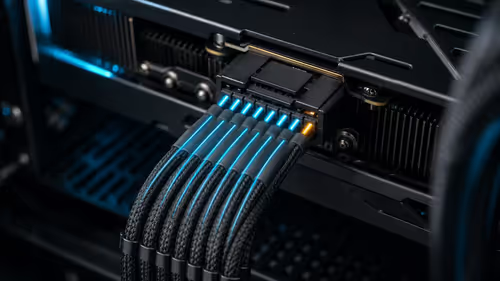
Confirm chassis clearance, power requirements and motherboard support from the product and component guidance. Any required case, power or platform change belongs in the total.
The card uses PCIe 5.0, the card's vapor chamber and axial-tech fan array. Those are relevant platform and cooling details, but the chassis still needs a clean airflow route.
Measure the case with installed fans or radiators and plan safe cable space. Premium cooling cannot help a card that is squeezed into an unsuitable enclosure.
Its five outputs - two HDMI 2.1b links alongside three DisplayPort 2.1b sockets - can support a creator workstation. Map actual screens and modes rather than treating unused sockets as value.
Compare complete candidates via Evetech's NVIDIA graphics-card category.
📊 Make the premium measurable
Save one workload before purchase and define the desired improvement. After installation, repeat it with the same software, inputs and settings.
Include a failure condition. If the project shows no useful improvement or another bottleneck still controls the outcome, the evidence should say so instead of awarding automatic credit to 32GB.
Record output quality, frame-time or completion, memory use and the wider system. A fast GPU can still wait for the CPU, storage or host memory.
Weight frequency. A daily production model supports the premium differently from occasional experimentation, while a frequently played game deserves more influence than a showcase title.
Review the result after several weeks. Real client files and long gaming sessions may reveal usage that a first-day benchmark misses, while consistently unused capacity informs the next upgrade.
Use Evetech's GPU best-seller collection for a final current comparison and check availability when ready to choose.
Frequently Asked Questions
How can a South African buyer tell whether 32GB is useful?
Test the largest real workload and look for a repeatable limitation associated with a smaller graphics-memory pool.
What does the R73,599 price demand from the workload?
It calls for frequent, meaningful use that a less expensive complete configuration cannot serve as well.
Should GDDR7 generation decide the purchase on its own?
No. Capacity, full GPU design, software behaviour and total system cost all matter.
Which AI users have a clearer reason to consider 32GB?
Those running supported models or projects whose working data demonstrably benefits from the room.
What installation details need confirmation before purchase?
Check case clearance, documented power needs, motherboard layout, safe cabling and chassis airflow.
How can five display outputs add local workstation value?
They can connect several purposeful screens when the intended modes and simultaneous arrangement are supported.
Why compare the GPU with another system upgrade?
The same money may solve a more frequent bottleneck in the processor, storage, system memory or display.
Assessing 32GB against a real South African budget?
Measure the project that needs it, total the supporting build and compare Evetech graphics cards by the improvement you can demonstrate.