Fresh testing puts the Intel Core Ultra 7 270K Plus and AMD Ryzen 7 7700X3D in a useful dead heat. AMD leads the tested gaming average and efficiency results. Intel wins heavily threaded productivity work by a wide margin. For a South African buyer, the right answer depends on workload, complete platform cost and current availability.
Quick Answer
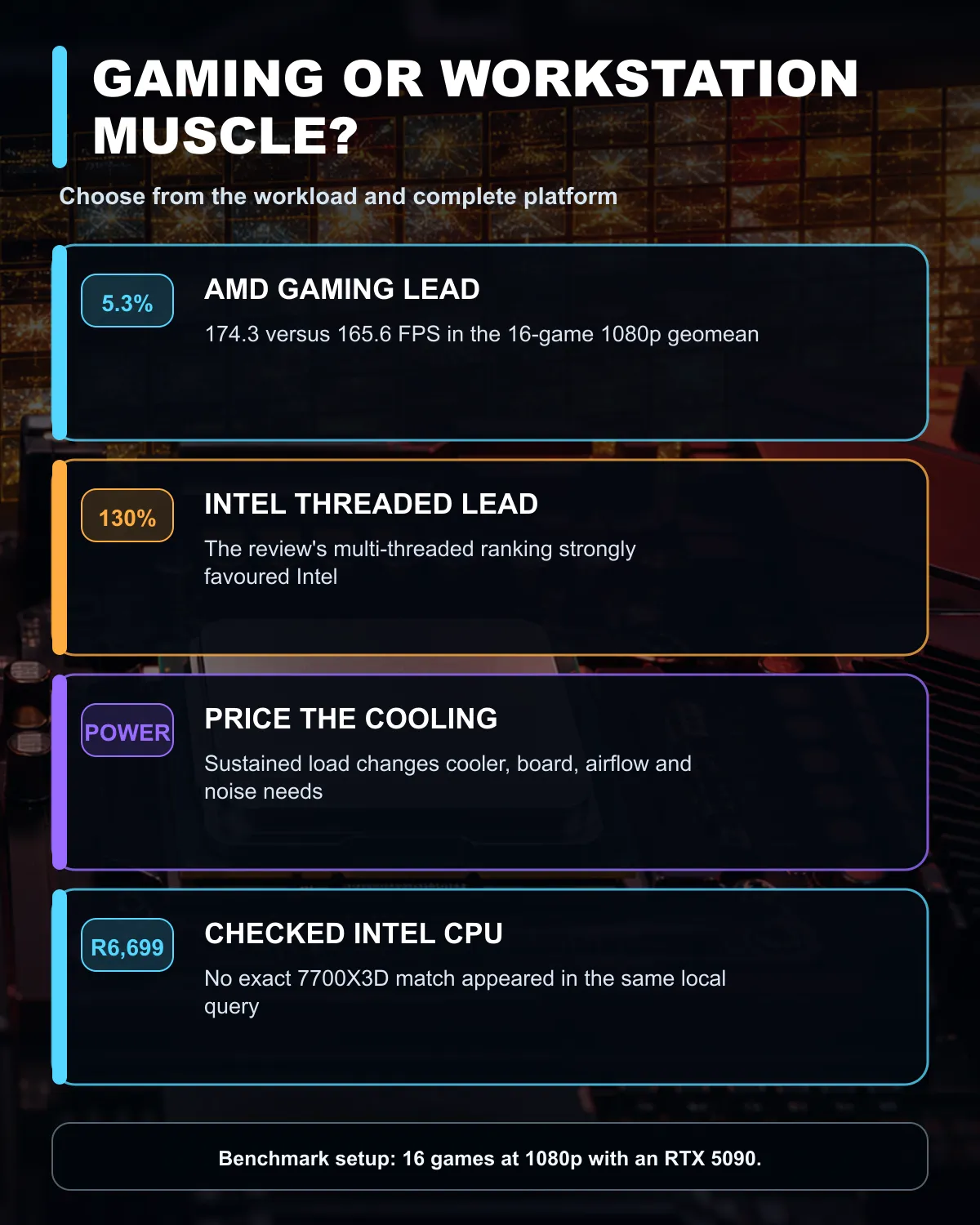
Choose the Ryzen 7 7700X3D for a gaming-first PC when the chip and a suitable AM5 platform are available at a sensible total price. Choose the Core Ultra 7 270K Plus when video work, rendering, compiling or other heavily threaded tasks share the machine with gaming. The 10 August catalogue check found the Intel processor in stock at R6,699, but no exact Ryzen 7 7700X3D match, so compare a real purchasable build rather than benchmark winners in isolation.
What the new comparison found
The gaming test used 16 titles at 1080p with an RTX 5090 to reduce the graphics card as a limiting factor. Across that geomean, the Ryzen 7 7700X3D averaged 174.3 FPS and the Core Ultra 7 270K Plus averaged 165.6 FPS. That gives AMD a 5.3% lead in this specific test setup.
The result does not mean every game, resolution or graphics card will show the same gap. At 1440p or 4K, a slower GPU can become the main limit and reduce the visible CPU difference. Competitive players chasing very high frame rates are more likely to notice a CPU gap than someone playing a graphically demanding title at 4K.
Productivity reverses the decision. In the same review's multi-threaded ranking, Intel scored 626 against AMD's 272, a reported 130% lead. The Intel chip also led the single-threaded geomean by 42.5%. Those numbers matter for sustained creation and development workloads, but they do not turn a web browser or ordinary office work into a reason to buy 24 cores.
Two very different processor designs
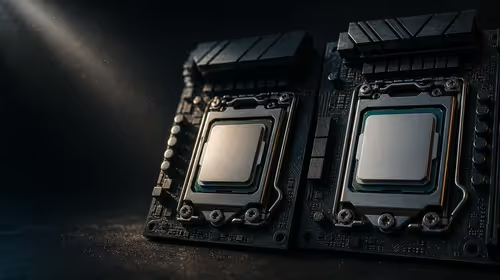
Intel's Core Ultra 7 270K Plus has 24 cores and 24 threads: eight performance cores and 16 efficient cores. It boosts to 5.5GHz, carries 36MB of Smart Cache and uses the LGA1851 socket. Intel lists 125W base power and 250W maximum turbo power.
AMD's Ryzen 7 7700X3D has eight Zen 4 cores and 16 threads, boosts to 4.5GHz and carries 96MB of L3 cache through 3D V-Cache. It uses socket AM5 and has a 120W default TDP. The cache-heavy design targets gaming rather than maximum multi-threaded throughput.
Neither boxed specification includes the complete thermal or platform bill. Both need an appropriate cooler, motherboard and DDR5 memory. The Intel power ceiling makes cooler and motherboard power delivery especially important during sustained all-core work. AMD recommends liquid cooling for optimal performance on its product page, so a buyer should not treat lower measured power as permission to ignore cooling.
The South African availability check
The live snapshot found the Core Ultra 7 270K Plus processor at R6,699. It also found three in-stock upgrade kits from R14,499 and several complete gaming PCs using the chip. The exact Ryzen 7 7700X3D produced no match in the same query.
That is a snapshot, not a permanent availability verdict. It means today's direct comparison is asymmetrical: Intel has a verified local purchase path, while an AMD build needs a fresh stock and price check before checkout. Do not substitute another X3D processor and assume it will reproduce the same benchmark or cost.
Start on the processor shelf, then compare Intel motherboards and AMD processors as complete platform choices rather than isolated chips.
Gaming-first buyers
The 7700X3D's tested 5.3% lead is useful when the target is CPU-sensitive gaming, but first verify the rest of the system. A midrange graphics card at 1440p may erase much of the difference. Spending the platform gap on a faster GPU, more suitable monitor or enough memory can improve the final experience more than choosing the nominally faster gaming CPU.
Platform life also matters. AM5 supports a wide family of current boards, and the processor page lists A620 through X870-class chipsets. The exact motherboard still needs BIOS support, adequate power delivery and the ports required by the build. A socket label alone is not a compatibility guarantee.
Work-and-play buyers
The 270K Plus makes a stronger case when time spent rendering, encoding or compiling has real value. Its 24-core layout delivered much higher throughput in the tested productivity suite. Power is the trade-off. One HandBrake workload in the review measured 226W for Intel against 72W for AMD.
That difference affects cooler size, case airflow, noise and electricity use during sustained loads. A creator should price the cooler and motherboard at the same time as the CPU. A gaming-only buyer should not pay for throughput that sits idle.
A practical decision rule
Build the choice around four checks: primary workload, target frame rate and graphics card, complete platform cost, and exact availability.
A clear answer on those checks resolves the choice. Otherwise, choose the better complete build rather than chasing a five-percent result from a test system unlike your own.
Frequently Asked Questions
Which CPU was faster in the 16-game test?
The Ryzen 7 7700X3D averaged 174.3 FPS versus 165.6 FPS for the Core Ultra 7 270K Plus, a 5.3% lead in that setup.
Which CPU was faster for multi-threaded work?
The Core Ultra 7 270K Plus led the review's multi-threaded ranking by 130%.
What was the checked local Intel price?
The Core Ultra 7 270K Plus processor was in stock at R6,699 on 10 August 2026.
Was the Ryzen 7 7700X3D in the checked catalogue?
No exact match appeared in the 10 August query, so a current local price was not established.
Do both processors use the same motherboard?
No. Intel uses LGA1851 while AMD uses AM5, so they require different motherboards.
Should a 4K gamer choose from this CPU result alone?
No. At higher resolutions the graphics card often becomes the stronger limit, reducing the practical CPU gap.
Choosing a CPU for one PC that must game and work? Price the processor, motherboard, DDR5 memory and cooling as one platform, then match the benchmark strength to the workload you run most.