Microsoft Project Zenith Windows is a proposed ready-to-code PC experience for developers. It joins a high unified-memory hardware tier with prepared tools and settings, aiming to reduce the hours normally spent turning a fresh machine into a useful development environment.
Quick Answer
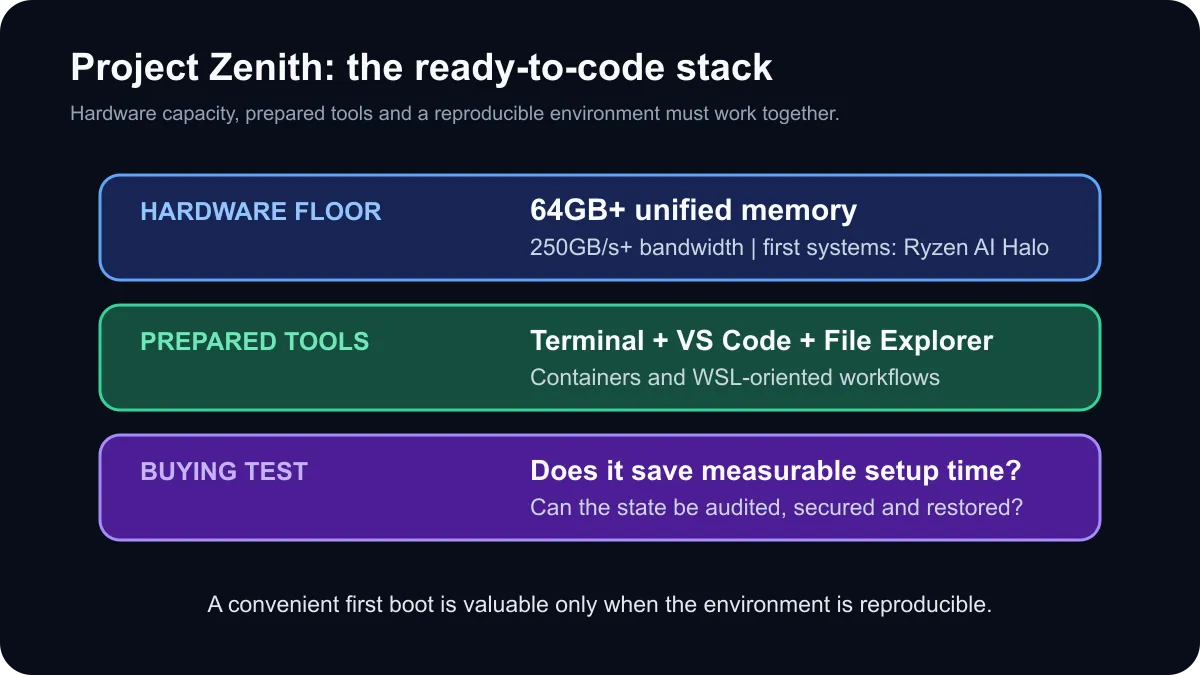
Project Zenith targets Windows PCs with at least 64GB of unified memory and at least 250GB per second of memory bandwidth. The first systems are planned around AMD Ryzen AI Halo processors. Windows Terminal and Visual Studio Code are pinned, while File Explorer, containers and WSL-oriented settings are prepared for development. South African models, prices and support terms are not confirmed, so the decision is whether that integration solves a real workflow problem better than a current workstation.
🧰 What ready to code should save
A normal new-PC setup can involve removing unwanted software, enabling developer settings, installing a terminal, configuring version control, adding language runtimes and setting up containers or a Linux environment. None of those steps is impossible, but repeating them across a team wastes time and creates differences between machines.
Project Zenith attempts to make the starting state intentional. The visible tool choices include Windows Terminal and Visual Studio Code, with File Explorer adjusted for technical work. Container and WSL workflows also form part of the proposal. The value is not that these tools are new. It is that the machine should arrive in a consistent state that a developer can understand and audit.
Consistency still needs documentation. Teams should ask which tool versions ship, how updates are controlled, which security policies are active and whether the configuration can be reproduced after a clean reinstall. A convenient first boot is not enough if the prepared state cannot be restored later.
🧠 Unified memory changes local AI planning
The minimum 64GB unified-memory target and 250GB per second bandwidth figure place these machines above ordinary office laptops. Unified memory can let the processor and integrated accelerator work from the same pool, reducing copies and making a larger share of system memory available to local models.
Microsoft positions the class for models above 30 billion parameters. That does not mean every model of that size will be fast, or that 64GB is always enough. Quantisation, context length, framework overhead and other applications affect capacity. Developers should test the exact model format and workload rather than buying against parameter count alone.
The first hardware is planned around AMD Ryzen AI Halo, with more details still to come. That makes Project Zenith a platform direction rather than a complete South African buying list today. Compare it with available workstation PCs and decide whether a discrete GPU, expandable memory or stronger local service matters more than a unified design.
🇿🇦 Wait only for a measurable advantage
South African pricing, launch timing and support were not confirmed in the announcement. Waiting makes sense when the prepared environment removes a known setup burden, the unified-memory pool enables a specific local model, or the power and size fit a constrained workspace.
Current mini PC options may be easier to deploy where compact size matters. Conventional towers offer more upgrade paths and can be repaired with familiar parts. The new class may win on memory architecture and a coordinated software experience, but those benefits need to survive real benchmarks and local support questions.
Also price the operating system and management model. Review current Windows options, then confirm the edition, recovery process, encryption defaults and business-management support included with any future Zenith machine. A developer computer is part of a security boundary, so a cleaner setup should also be transparent and reproducible.
Frequently Asked Questions
What is Microsoft Project Zenith?
It is a proposed ready-to-code Windows PC experience that combines selected hardware with preconfigured developer tools and settings.
What hardware does Project Zenith target?
Microsoft describes systems with at least 64GB of unified memory and at least 250GB per second of memory bandwidth.
Which processors will appear first?
The first systems are planned around AMD Ryzen AI Halo processors, with more hardware details still to come.
Which developer tools are included?
The preview shows Windows Terminal and Visual Studio Code pinned, plus prepared File Explorer, container and WSL workflows.
Can it run local AI models?
The class is aimed at models above 30 billion parameters, but practical speed and capacity depend on model format, context and available memory.
Should a South African developer wait for it?
Wait only when the memory architecture or prepared setup solves a measured need. Current workstations remain easier to price and support locally.
Buy for the workflow, not the platform label.
Compare current workstations and mini PCs, then wait for Project Zenith only if its memory architecture and prepared environment save measurable time.