


Marvel Rivals Cuts 40GB: Do You Still Need a Bigger SSD?
Marvel Rivals Season 9.5 will cut roughly 40GB from the PC install through texture compression. South African players should clear patch space before buying more storage.
Read moreThe RTX 5090's 32GB and higher bandwidth handle full-quality video models the 4090's 24GB cannot load unquantised, while the 4090 stays strong for 720p Wan and tiled 4K image work. Those extra 8GB unlock simultaneous FP16 Flux and Wan 2.2 14B without model swapping.
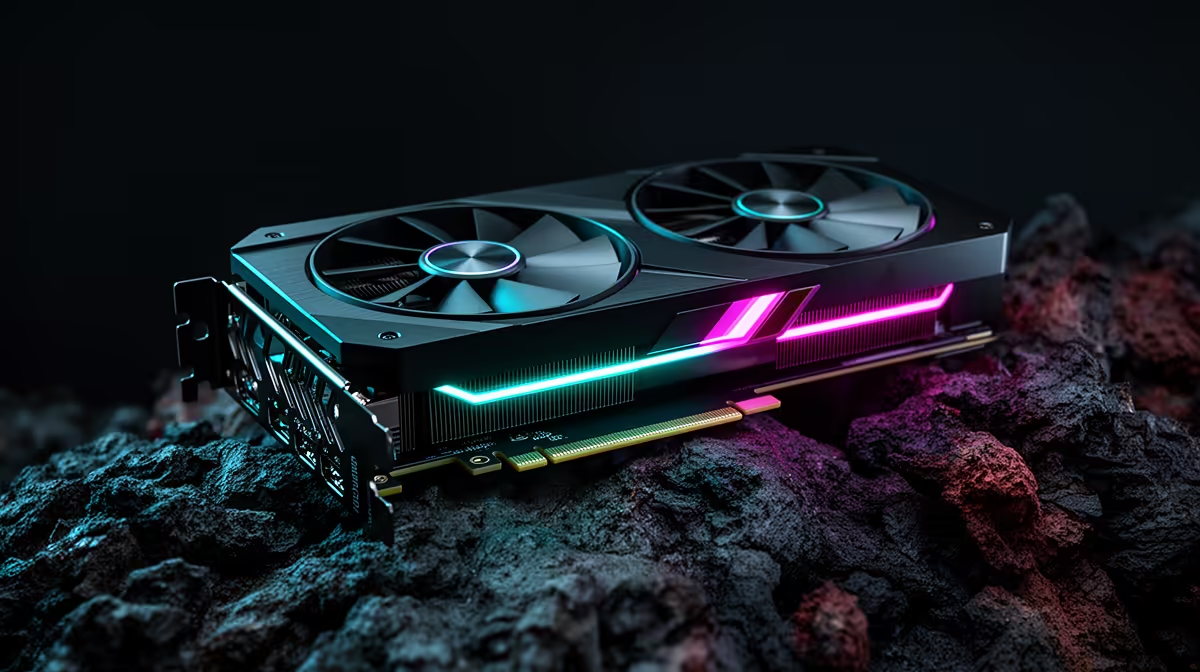
Eight gigabytes does not sound like much of a gap until a video model needs exactly those eight to load without being cut down. The RTX 5090 with 32GB against the RTX 4090 with 24GB is, for diffusion work, mostly a story about what those extra gigabytes and the faster memory let you do. The 5090 loads full-quality video models the 4090 cannot fit unquantised, while the 4090 stays a strong, sensible card for image work and lighter video.
The RTX 5090's 32GB and much higher memory bandwidth let it run full-precision FP16 Flux and large video models like Wan 2.2 14B without quantising or offloading, which the 4090's 24GB cannot do unaided. The 4090 remains capable for 720p Wan, tiled 4K image work and FP8 Flux. If you generate video locally, the extra 8GB is the deciding factor; for pure image work, the 4090 still holds up.
VRAM is a hard wall in diffusion: a model either fits or it does not. The 5090's 32GB is a third more than the 4090's 24GB, and that headroom is exactly what large video pipelines need. The 5090 can hold FP16 Flux and a 14B video model without dropping to lower precision or spilling into system RAM, so it runs them at full quality and keeps everything resident at once.
The 4090, by contrast, must lean on memory-efficient attention to keep FP16 Flux inside 24GB and may run out of room on the heaviest video models without quantising them first. It still works, it just works with more compromises on the largest jobs.
Capacity is only half of it. The 5090's memory bandwidth is dramatically higher than the 4090's, which speeds up the constant shuffling of data during generation, especially on large models and video sequences where memory traffic is heavy. The practical result is faster batch turnaround on big jobs, on top of simply being able to fit them. If your bottleneck is how long a queue of renders takes rather than cost per image, that combination of more VRAM and more bandwidth is what shortens the wait.
The 4090 is far from obsolete for AI art. For image generation, including tiled 4K work, FP8 Flux, and SDXL, it is quick and capable, and for 720p video with models that fit its 24GB it handles the load well. It is the right card for someone focused on images and lighter video who does not need to run the very largest models at full precision. The decision comes down to your workload, not bragging rights.
If your work is video and large-model diffusion, the RTX 5090 graphics cards at Evetech are the match, and complete builds tuned for this sit on the AI PCs range.
If you run large video models or want FP16 Flux and a 14B video model loaded at full quality without quantising, yes, the 32GB and higher bandwidth justify it. For mainly image work, the 4090's 24GB still does the job and the upgrade is harder to justify.
It can, but tightly: it needs memory-efficient attention to stay inside 24GB and has little spare room. The 5090 runs FP16 Flux comfortably with headroom to spare, so the 4090 is workable here while the 5090 is relaxed.
Yes, for 720p Wan and other video models that fit within 24GB, often after quantisation for the larger ones. The 5090's extra VRAM matters most when you want longer sequences, higher resolution, or the biggest models at full precision.
It speeds the heavy data movement during generation, so big jobs and video sequences process faster on the 5090 beyond just fitting in memory. If your concern is total render time on large queues, that bandwidth shortens it noticeably.
Deciding between 24GB and 32GB for your diffusion workflow? Compare current cards on the Evetech GPU best sellers and pick the VRAM that matches whether you generate images or full-quality local video.
If you run large video models or want FP16 Flux and a 14B video model loaded at full quality without quantising, yes, the 32GB and higher bandwidth justify it. For mainly image work, the 4090's 24GB still does the job and the upgrade is harder to justify.
It can, but tightly: it needs memory-efficient attention to stay inside 24GB and has little spare room. The 5090 runs FP16 Flux comfortably with headroom to spare, so the 4090 is workable here while the 5090 is relaxed.
Yes, for 720p Wan and other video models that fit within 24GB, often after quantisation for the larger ones. The 5090's extra VRAM matters most when you want longer sequences, higher resolution, or the biggest models at full precision.
It speeds the heavy data movement during generation, so big jobs and video sequences process faster on the 5090 beyond just fitting in memory. If your concern is total render time on large queues, that bandwidth shortens it noticeably.
Marvel Rivals Season 9.5 will cut roughly 40GB from the PC install through texture compression. South African players should clear patch space before buying more storage.
Read more
Leaked documents point to selected Xbox 360 games coming to PC and Project Helix with publisher approval. South African gamers should treat it as a roadmap, not a buying promise.
Read more
Memory supply is expected to stay tight into 2027. South African builders with a near-term project should price the correct RAM now instead of waiting for an assumed drop.

AMD's Q2 results show weaker gaming revenue but stronger Ryzen-led client sales. South African buyers should judge today's CPU value by platform cost, not the headline alone.

SpaceX is exploring a terrestrial mobile network, but that does not change Starlink's South African licensing position. Local buyers should wait for formal authorisation and launch terms.
Black Friday Gaming PC Wait can help if your PC need is flexible. On a R8,000 SA budget, compare deal risk, component balance, warranty, and timing before waiting.
Memory supply is expected to stay tight into 2027. South African builders with a near-term project should price the correct RAM now instead of waiting for an assumed drop.
AMD's Q2 results show weaker gaming revenue but stronger Ryzen-led client sales. South African buyers should judge today's CPU value by platform cost, not the headline alone.

Steam's July 2026 survey puts 16GB VRAM and 8-core CPUs at the top of their categories. South African buyers can reach both from about R12,998 before the rest of the build.
Fresh reports warn of 20% to 40% GPU order increases in Japan, but no matching South African rise is confirmed. The checked local 16GB shelf still starts at R9,999.
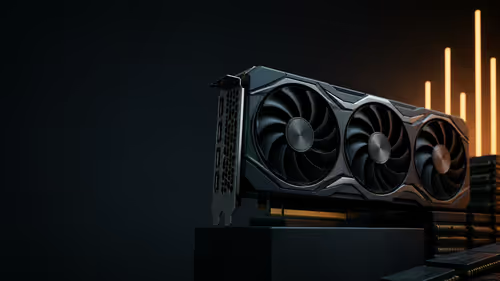
MSI has joined a new wave of overseas graphics-card price increases. South African buyers should compare the card they need against live local options rather than panic-buy.
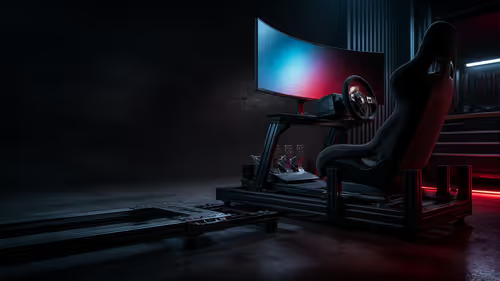
Corsair has acquired Trak Racer's assets and will place the cockpit specialist alongside Fanatec. South African sim racers should focus on compatibility, support and full-rig cost.
Marvel Rivals Season 9.5 will cut roughly 40GB from the PC install through texture compression. South African players should clear patch space before buying more storage.
Leaked documents point to selected Xbox 360 games coming to PC and Project Helix with publisher approval. South African gamers should treat it as a roadmap, not a buying promise.