



Smart Monitor Ads and Tracking: The SA Buyer's Privacy Check
Smart monitors can add apps and convenience, but they also add privacy settings and unwanted-software risk. SA buyers should audit the operating system before paying for extras.
Read moreRX 7800 XT Doom The Dark Ages Ultra Settings. Real-world benchmark data, FPS numbers & performance analysis. What SA gamers can actually expect.
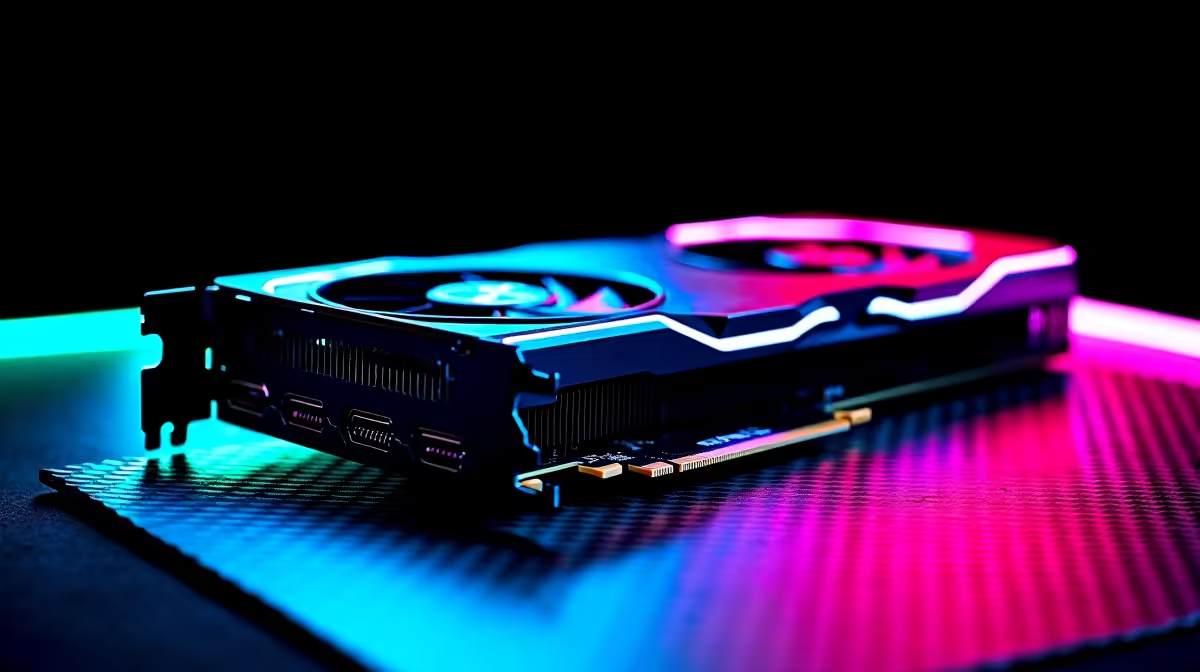
The AMD RX 7800 XT delivers playable but inconsistent performance in Doom: The Dark Ages at 4K ultra settings in 2026. Expect average framerates in the 45-58 FPS range, with drops during heavy particle and lighting effects. Enabling FSR 3 with frame generation brings the experience closer to a smooth 60 FPS threshold.
Doom: The Dark Ages is a visually aggressive title built on id Software's latest engine iteration, and pushing it to 4K ultra is a significant ask for any GPU in the RX 7800 XT's class. The card carries 16GB of GDDR6 VRAM, which is genuinely strong for 4K texture work and means VRAM is not the limiting factor here. The bottleneck is raw shader throughput at native 4K resolution.
In GPU-heavy sequences like the large-scale siege battles with dense particle effects, demon hordes, and dynamic lighting interacting simultaneously, the RX 7800 XT can dip below 45 FPS. In more linear combat corridors the card holds closer to 55-60 FPS. The variance depends heavily on the scene complexity id Software built into each encounter.
For South African gamers running the RX 7800 XT, the 4K ultra experience is achievable but benefits substantially from FSR 3 assistance.
To get the most out of the RX 7800 XT in Doom: The Dark Ages at 4K, a targeted settings approach works better than dropping the entire preset:
With FSR 3 Quality enabled and RT set to medium, the RX 7800 XT turns the 4K ultra experience from marginal to genuinely enjoyable.
At its current price point in the South African market, the RX 7800 XT sits in a competitive spot for 1440p gaming and can stretch to 4K with assist from FSR 3. For native 4K without upscaling, cards with higher compute units are needed.
If your primary gaming resolution is 4K and Doom: The Dark Ages is representative of what you play (fast, visually dense shooters), the RX 7800 XT is a capable but not ideal native 4K card. At 1440p, it excels. At 4K with FSR 3, it delivers a worthwhile experience. The 16GB VRAM means it will not be VRAM-starved by future titles either, which matters for longevity in the SA market where GPU upgrade cycles tend to stretch longer than in Europe or the US.
Yes. FSR 3 frame generation runs on any AMD GPU with FSR support, including the RX 7800 XT. It works at the driver level rather than requiring specific hardware, unlike NVIDIA's DLSS Frame Generation.
The RX 7800 XT is primarily optimised for 1440p gaming where it typically achieves 90-120 FPS on ultra settings in demanding titles. 4K is achievable with upscaling assist.
At native 4K ultra without upscaling, cards with larger compute budgets pull ahead meaningfully. The RX 7800 XT's 4K performance with FSR 3 Quality is competitive with native 4K on slightly more powerful cards.
Ready to Find Your Perfect Match? View current RX 7800 XT availability and pricing for South African gamers. Shop Graphics Cards at Evetech
RX 7800 XT Doom The Dark Ages Ultra Sett available at Evetech.co.za with local warranty and fast delivery.
RX 7800 XT Doom The Dark Ages Ultra Sett - check Evetech for latest stock and SA pricing.
Depends on your use case. RX 7800 XT Doom The Dark Ages offers good value at current Rand pricing.
Smart monitors can add apps and convenience, but they also add privacy settings and unwanted-software risk. SA buyers should audit the operating system before paying for extras.
Read more
Pre-Black Friday Ultrawide Monitor Buying Advice for SA in needs cautious deal planning. Set spec targets and budget limits first, then verify live pricing and availability close to purchase instead of trusting early deal claims.
Read more
Cursor 3 goes agent-first with its Agents Window, launched 2 April 2026 under codename Glass and not derived from VS Code, running multiple parallel agents on cloud models like Composer 2 so the heavy inference lives server-side. For SA developers, this means Cursor 3.
Read more
The M5 MacBook Air's Liquid Retina display does not include ProMotion, so it runs at a fixed 60 Hz refresh rate despite the M5 chip upgrade. ProMotion with adaptive 120 Hz remains exclusive to the MacBook Pro line in Apple's current laptop range.
Read more
2026 brings a wave of new 5G CPEs built on next-generation modem chipsets from Qualcomm and MediaTek, including RedCap-ready platforms designed for mass-market fixed-wireless access. For SA buyers, the features that matter most are band-locking capability, external SMA
Read more
O-Week runs largely off your phone, but registration and essays still demand a real keyboard, and 78.9% of SA students browse mobile-first. The Vivobook Go 15 at R7,999 or the IdeaPad Slim 3 at R10,499 both clear the 16GB, 512GB Windows 11 floor.
Read more
A fake 113GB GTA VI ISO reportedly used empty padding around a small malware payload. SA gamers should delete unofficial builds, keep Windows security active and wait for official channels.

Wi-Fi 6E vs Wi-Fi 6 matters for 4K video editing when files move across a network. The real-world difference between Wi-Fi 6E and Wi-Fi 6 for video editing in 4K depends on NAS access, cloud uploads, router range, and SA creator workflows.

The difference between PCIe 5.0 and PCIe 4.0 for SA gamers is mostly bandwidth headroom. Compare GPU slot needs, NVMe speed, motherboard support, and upgrade timing before paying extra for a newer platform.

Gaming PC stuck pixel checks in South Africa should confirm the monitor fault first. Use colour tests, screenshot comparison, cable swaps, display menu checks, and clear photos before deciding on support.

Shokz OpenFit Air 2 earbuds weigh 7.2g each and use a redesigned dual-driver open-ear layout. SA buyers should choose them for comfort and awareness, not maximum isolation.

AMD's current driver now lists a Radeon RX 9050 4GB, while product coverage details a narrowed memory system. SA buyers should weigh the low VRAM ceiling against current local Radeon options.

Samsung Display has demonstrated a 16-inch 2.5K OLED laptop panel running at 300Hz. SA buyers should wait for a named notebook, full panel specifications and a local price before planning an upgrade.

Microsoft says some Windows 11 game crashes after recent updates are linked to RGB-related drivers. Affected SA gamers should confirm the update and driver before using the published registry workaround.

Minisforum's M2 Pro pairs Core Ultra X7, Arc B390 graphics and 32GB onboard memory in 1.8 litres. SA buyers should weigh its fixed memory and $1,439 launch offer against local mini PCs.
Smart monitors can add apps and convenience, but they also add privacy settings and unwanted-software risk. SA buyers should audit the operating system before paying for extras.

Lenovo says Legion Go failures linked to BIOS N3CN42WW are not user error. Affected SA owners should stop retrying the update, preserve proof and open a support case.
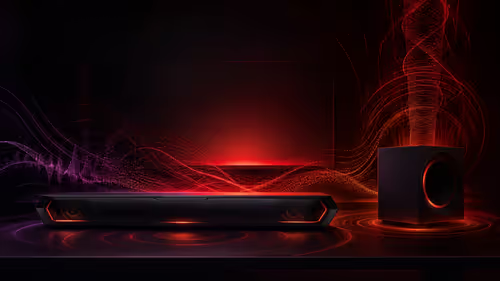
The ROG Gjallar gaming soundbar is now listed in the US at $599.99. SA buyers should compare its 2.1.2 audio, wireless bass and built-in chat controls with simpler local options.