


PCIe 5.0 vs PCIe 4.0 for Video editing in 4k in SA
PCIe 5.0 vs PCIe 4.0 for video editing in 4k is mainly about fit, features, compatibility, cost, and upgrade path, not one automatic winner. SA buyers should match the choice to the setup.
Read moreA 140-degree recline measures the chair's maximum back angle, while controls and usable positions vary by mechanism. The E3 Air reaches 140 degrees and pairs reclining with auto-wrap lumbar, a 4D headrest and omni-motion armrests.

Maximum recline is only the visible part of a chair's motion story. A 140-degree recline mechanism must also be understood through its controls, usable task positions and room clearance. The E3 Air supplies the 140-degree endpoint at R7,399, while buyers still need to learn how their chair moves in practice.
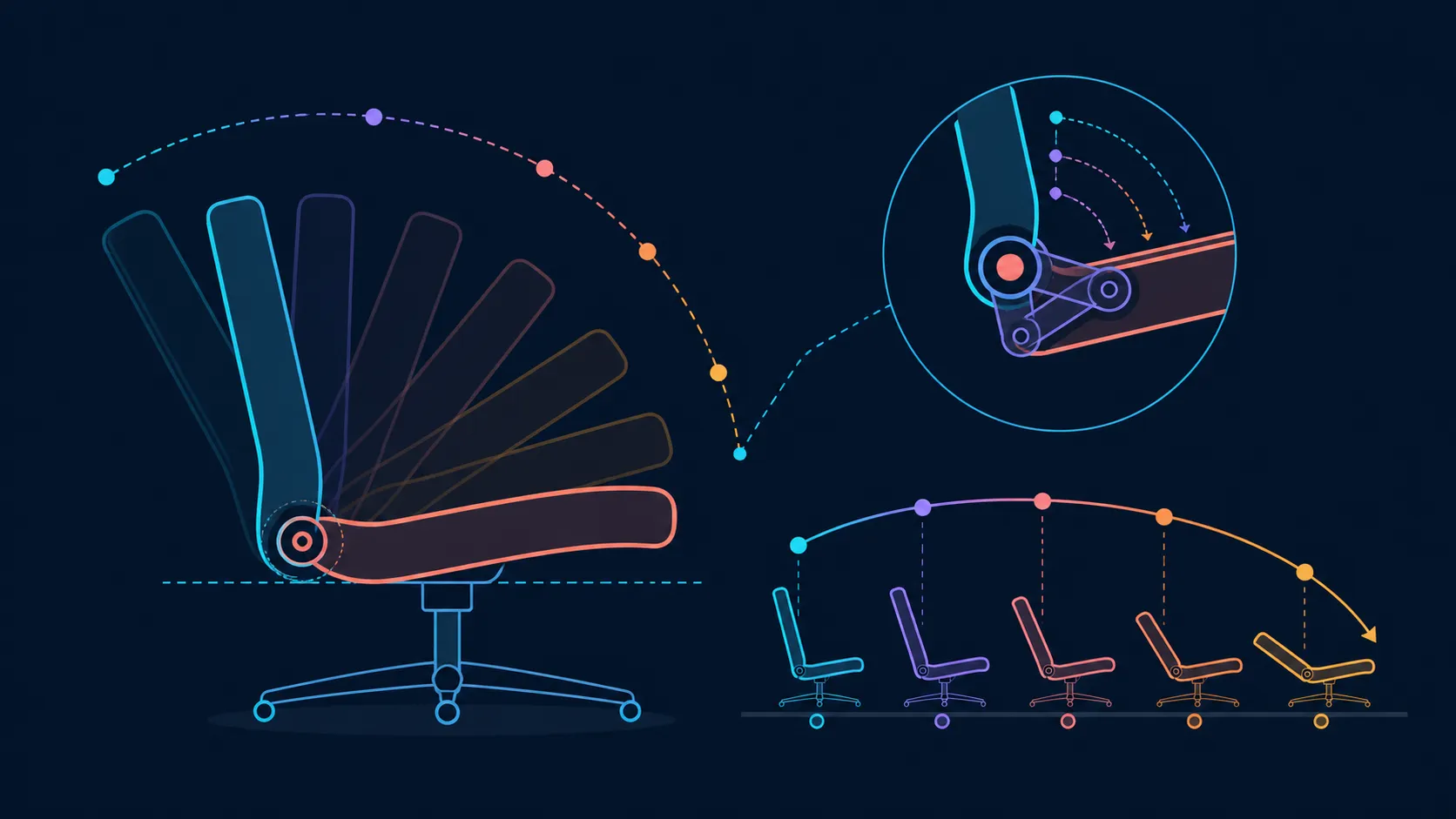
The E3 Air uses defined recline zones: 105-115 degrees for focused work, 115-125 degrees for an adaptive flow posture and 140 degrees for power naps.
A 140-degree figure measures the maximum back angle. Tension, locking positions and the path between upright and the endpoint remain separate mechanism checks. The R7,399 E3 Air reaches 140 degrees and combines that movement with three-zone auto-wrap lumbar plus adjustable head and arm supports. Evaluate angle, operation and task suitability independently.
Two chairs with the same maximum can feel and operate differently. The number states where movement ends, whereas the mechanism determines how the user gets there and returns. Controls, resistance and intermediate positions must be checked on the actual candidate rather than predicted from 140 degrees.
Before the first test, identify the control used for recline and make sure the area around the chair is clear. Move slowly while seated securely. Do not copy an operating sequence from another model, even if its headline angle matches. A familiar lever shape does not prove identical behaviour.
Record three observations: how the movement starts, whether the intended activity can be performed at the chosen angle, and how easily the working position returns. This turns an impressive endpoint into evidence about everyday use.
Run the sequence twice. The first pass teaches the controls; the second shows whether that learning is repeatable. If a household member will also use the chair, let that person learn from the chair's guidance rather than inheriting a verbal shortcut that may omit a necessary step.
Avoid judging smoothness from speed. A controlled, predictable transition is more useful than moving quickly toward the maximum. Stop the test when the user cannot explain what the next control action will do.
Review HBADA office chairs at Evetech with those three mechanism questions alongside the maximum figure.
The E3 Air has three lumbar zones covering an 80-degree auto-wrap area. As the backrest moves, the user's relationship with that support can change. Notice contact through the transition and check any lumbar movement directly on the chair.
At the changed angle, inspect the headrest separately; it provides 4D adjustment across two axes. Set the screen and task first, then look for upper contact without forcing the viewing direction. If the activity still uses inputs, position the mechanical arm supports through their 360 degrees of omni-motion afterward.
Support that works upright is not automatically correct at maximum recline. Equally, a break posture does not need to preserve an input arrangement meant for active desk work. Define what the user will do before deciding whether the configuration succeeds.
For a reading trial, place the material and viewing target before reclining. For a listening break, remove the expectation of keyboard access. Naming the activity prevents the chair from being marked down for a relationship that the chosen posture was never meant to support.
Then observe the return journey. Head and lumbar contact should be reassessed after the backrest comes forward because a support may have shifted or the user may settle differently. The mechanism test is complete only when the desk baseline is restored.
Test the chair where it will live. The backrest needs space to move, while the steel five-star base must remain free of furniture, cables and traffic. Measure the candidate's external dimensions and the available room instead of estimating space from its 140-degree endpoint.
Check access as well as motion. A reclined chair should not block a doorway or create an unexpected obstacle in a shared home office. Marking the working base position can help the user restore a safe relationship with the desk after a break.
Include cables in the clearance map. A routed power lead, headset cable or nearby charger can be harmless upright but enter the base path as the chair moves. Secure the room layout before relying on a repeated recline routine.
If the chair is used on a surface where its base position changes easily, repeat the envelope check from the actual resting point each day. The maximum back angle cannot compensate for an inconsistent floor relationship.
Capacity supplies another boundary rather than an assumption. E3 Air users may weigh up to 150kg, but staying below that limit says nothing about room fit, mechanism feel or personal comfort.
Choose an upright activity and one plausible reclined activity. Keep their duration modest and their purpose clear. Note screen visibility, lumbar and head contact, arm position and ease of return. Repeat on another day before deciding that novelty is genuine versatility.
Use plain outcomes: practical, distracting or not applicable. A numerical comfort score can imply precision the test does not have. A short reason beside each outcome gives the buyer something concrete to compare when another chair reaches a similar angle.
Finally, decide whether the maximum itself matters. Many routines may use only a smaller change, while another buyer may value a clearly different reading position. The appropriate endpoint comes from activity and room fit, not from pursuing the largest available number.
The seat's high-density mesh carries a cloud-like description and should be judged across both configurations without assuming guaranteed comfort. Apply the same task pair across Evetech's wider office-chair category. At R7,399, ask whether the available movement supports activities that actually occur rather than whether the E3 Air reaches a large number.
Its Auto-Wrap lumbar and arm synchro-tilt move with the body, helping support remain aligned through the transition. Learn each band before using the deepest position, and keep the rear travel area clear.
Recline mechanics are most useful when each range has a task. The focus band keeps the user closer to inputs, the flow band supports reading or media, and the 140-degree cradle suits a short rest. Synchro-tilt arms and adaptive lumbar should remain supportive through every transition, not only at the endpoint.
The backrest reaches 140 degrees. This endpoint enables an angle comparison, while operating controls, intermediate positions and resistance need independent assessment.
The same maximum can be reached through different mechanisms. Safe, useful operation depends on learning the exact chair rather than transferring instructions from a similar model.
Watch how movement begins, how support contact changes, whether the intended activity remains practical and how reliably the working posture can be restored.
Lumbar contact, headrest placement and arm position may all change. Assess the E3 Air's wrap-around lower support, dual-axis 4D headrest and omni-motion arms in separate passes.
No. A listening or reading break may tolerate a different input relationship than sustained typing. Select an angle only after naming the task it should serve.
The seating surface is high-density mesh with a cloud-like form. Assess it upright and at the changed angle; comfort remains an individual result.
Ready to test recline as movement, support and space together? Browse Evetech office seating with a clearance map and two real activities prepared for comparison.
The backrest reaches 140 degrees. This endpoint enables an angle comparison, while operating controls, intermediate positions and resistance need independent assessment.
The same maximum can be reached through different mechanisms. Safe, useful operation depends on learning the exact chair rather than transferring instructions from a similar model.
Watch how movement begins, how support contact changes, whether the intended activity remains practical and how reliably the working posture can be restored.
Lumbar contact, headrest placement and arm position may all change. Assess the E3 Air's wrap-around lower support, dual-axis 4D headrest and omni-motion arms in separate passes.
No. A listening or reading break may tolerate a different input relationship than sustained typing. Select an angle only after naming the task it should serve.
The seating surface is high-density mesh with a cloud-like form. Assess it upright and at the changed angle; comfort remains an individual result.
PCIe 5.0 vs PCIe 4.0 for video editing in 4k is mainly about fit, features, compatibility, cost, and upgrade path, not one automatic winner. SA buyers should match the choice to the setup.
Read more
Wi-Fi 7 vs Wi-Fi 6e for competitive esports comes down to router support, latency goals, device compatibility, and coverage. SA buyers should match the choice to the real network setup.
Read more
ATX 3.1 vs ATX 3.0 for mMO and live-service games buyers - what changes is mostly about compatibility, budget, upgrade path, and setup fit. SA buyers should check device support and real needs before expecting a clear win from either option.
Read more
LGA 1851 vs LGA 1700 can affect Twitch and YouTube streaming when gaming and encoding share CPU resources. For SA creators, the real-world difference depends on encoder choice, memory support, motherboard cost, thermals, and upgrade plans.
Read more
X870E vs X670E for aaa single-player gaming is mainly about fit, features, compatibility, cost, and upgrade path, not one automatic winner. SA buyers should match the choice to the setup.
Read more
Hall Effect switches vs Mechanical switches for mMO and live-service games is mostly about compatibility, budget, upgrade path, and setup fit. SA buyers should check device support and real needs before expecting a clear win from either option.
Read more
A fake 113GB GTA VI ISO reportedly used empty padding around a small malware payload. SA gamers should delete unofficial builds, keep Windows security active and wait for official channels.

Wi-Fi 6E vs Wi-Fi 6 matters for 4K video editing when files move across a network. The real-world difference between Wi-Fi 6E and Wi-Fi 6 for video editing in 4K depends on NAS access, cloud uploads, router range, and SA creator workflows.

The difference between PCIe 5.0 and PCIe 4.0 for SA gamers is mostly bandwidth headroom. Compare GPU slot needs, NVMe speed, motherboard support, and upgrade timing before paying extra for a newer platform.

Gaming PC stuck pixel checks in South Africa should confirm the monitor fault first. Use colour tests, screenshot comparison, cable swaps, display menu checks, and clear photos before deciding on support.

Shokz OpenFit Air 2 earbuds weigh 7.2g each and use a redesigned dual-driver open-ear layout. SA buyers should choose them for comfort and awareness, not maximum isolation.

AMD's current driver now lists a Radeon RX 9050 4GB, while product coverage details a narrowed memory system. SA buyers should weigh the low VRAM ceiling against current local Radeon options.

Samsung Display has demonstrated a 16-inch 2.5K OLED laptop panel running at 300Hz. SA buyers should wait for a named notebook, full panel specifications and a local price before planning an upgrade.

Microsoft says some Windows 11 game crashes after recent updates are linked to RGB-related drivers. Affected SA gamers should confirm the update and driver before using the published registry workaround.
Shokz OpenFit Air 2 earbuds weigh 7.2g each and use a redesigned dual-driver open-ear layout. SA buyers should choose them for comfort and awareness, not maximum isolation.
A fake 113GB GTA VI ISO reportedly used empty padding around a small malware payload. SA gamers should delete unofficial builds, keep Windows security active and wait for official channels.

The ROG Flux Charger Dock combines 260W total output, 140W laptop charging and HDMI 2.1. SA buyers should check laptop USB-C limits, display needs and local warranty first.

ASRock's Rock 360 Digital AIO adds a 1.05-inch CPU temperature display, 360mm radiator and simplified wiring. SA builders should check case fit, socket support and local warranty.