


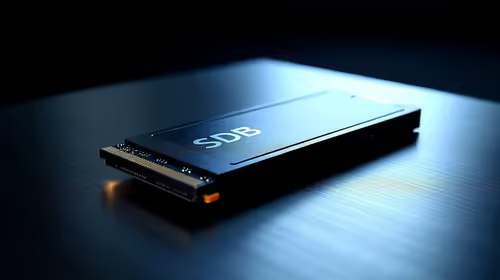
PCIe 5.0 vs PCIe 4.0 for Video editing in 4k in SA
PCIe 5.0 vs PCIe 4.0 for video editing in 4k is mainly about fit, features, compatibility, cost, and upgrade path, not one automatic winner. SA buyers should match the choice to the setup.
Read moreThe J314 combines a 2160x1440 2K QHD resolution with a 14-inch IPS panel and 1500:1 contrast ratio. Resolution defines the pixel grid, IPS identifies the panel technology, and contrast compares its darkest and brightest levels as a ratio.

Resolution, panel type and contrast describe different parts of a picture. This 2K QHD IPS and 1500:1 contrast guide separates pixel count, physical size, panel technology and tonal range so a buyer can test the J314 without collapsing them into one quality label.
The J314's 2160x1440 IPS panel supplies 185 PPI, while 1500:1 describes its white-to-black contrast relationship rather than resolution.
For R1,799, the UPERFECT UBegin J314 combines a 14-inch IPS panel with 2160x1440 QHD resolution and a 1500:1 contrast ratio. Those details define useful comparison points, but they do not establish screen brightness, colour accuracy, numeric viewing angles or gaming suitability.
The resolution contains 2160 pixels across and 1440 vertically. That pixel grid can present fine interface and image detail when the source outputs a compatible signal.
Physical screen area remains 14 inches diagonally. More pixels do not enlarge the panel, so operating-system scaling and application layout determine how much information is comfortable to view. Test text size and window arrangement at the normal distance.
The source matters. A laptop, phone or console must support the selected output through Type-C or Mini HDMI. The monitor cannot create source detail that was not sent to it.
Compare QHD options within Evetech's portable monitor category after defining the required workspace and source output.
IPS identifies the panel technology, not the pixel dimensions. Two screens can share 2160x1440 resolution while differing in other behaviour, just as two IPS panels can use different resolutions.
Do not attach an unmeasured viewing-angle degree or colour-accuracy result to the IPS label. If several people will view the display from the side, reproduce that seating arrangement. If visual work needs measured colour, use an appropriate requirement and test.
The J314's 30ms response is another independent display characteristic. It concerns pixel transition behaviour rather than resolution or panel size.
A 1500:1 contrast ratio expresses the relationship between brighter and darker output under a measurement method. It does not provide a brightness value and should not stand in for every aspect of image quality.
Use familiar content containing shadow detail, bright regions, text and mid-tones. Keep the source, room and settings consistent when comparing screens.
Contrast preferences can differ between document work, photographs and entertainment. A ratio that looks acceptable for one activity does not automatically settle another.
Dual stereo speakers with 360-degree sound sit outside the image equation. They can support entertainment, while loudness and sound quality require their own listening assessment.
Open the actual work or media at 2160x1440, choose comfortable scaling and observe the panel from the positions people will use. Then test motion relevant to the task and inspect darker material for the role contrast plays.
Keep connection and power questions visible. Type-C and Mini HDMI are available inputs, but the complete source route must be compatible. Select cables through the Evetech monitor accessories selection after identifying both ends and functions.
The display weighs 1.4kg, which matters when QHD workspace must travel. Add power and protection to the complete kit rather than judging portability from screen size.
At R1,799, the J314 has a 2160x1440 pixel grid and 1500:1 contrast ratio. It is the right comparison point when those figures solve the intended workspace and viewing needs under a proven connection.
Build a viewing matrix with three content types: text and interface detail, photographs or video, and darker entertainment scenes. Keep the source, room and scaling steady while noting what resolution, IPS and contrast contribute to each row.
Use the matrix from the normal seat first, then repeat at any shared viewing positions. This provides practical evidence without assigning a numeric angle the exact panel has not measured for the comparison.
For colour-sensitive work, define a measurable target before testing. Visual preference can still guide ordinary media use, but professional colour requirements need more than the IPS name or a favourable-looking sample.
Include connection limits in the record. If a source cannot output 2160x1440 through the chosen route, the panel test is not equivalent to a working QHD setup. Resolve source capability before judging fine detail.
The finished decision should state which image properties passed and which remain open. That distinction makes the R1,799 choice explainable without turning three different specifications into one broad quality claim.
Add a scaling row for every source. The same 2160x1440 panel can present different interface sizes when operating systems or applications apply their own defaults, so the working result must be judged per device.
Use several viewing distances if the screen moves between desk work and entertainment. Fine detail that is helpful close up can become irrelevant farther away, while contrast preferences may change with room light.
Record which setting was altered during each trial. Changing brightness, application colour controls and source output together makes it impossible to tell whether the panel or software created the difference.
For shared viewing, invite the actual second viewer rather than estimating their position. Note whether content remains useful from that seat without converting the observation into a universal degree claim.
Include a motion sample even though this guide centres on static image properties. The 30ms response can affect how moving content feels, while resolution and contrast cannot answer that question.
Finally, compare the image benefit with the mobile cost. A 1.4kg screen may be worthwhile for detailed work at multiple locations, or unnecessary when the content is consumed briefly on the move. Keep portability beside, not inside, the picture score.
Ask the buyer to describe the winning image without using IPS, QHD or contrast terminology. If the answer names readable detail, useful dark-scene separation or comfortable shared viewing, the specifications have been connected to a real outcome.
Save the source mode and room conditions beside that outcome. A later test can then reproduce the viewing case instead of relying on memory.
Brightness is rated at 300 nits, colour coverage reaches 100% sRGB and HDR support extends the entertainment feature set. The 178-degree view aims to hold image quality from wide positions. These specifications complement each other: pixel density sharpens text and fine detail, contrast separates light from dark, and colour coverage defines the gamut. No one figure can substitute for the complete picture.
The 3:2 ratio changes how those pixels are used. Compared with a wider shape, more of the 2160x1440 grid appears vertically, helping reading, coding and spreadsheet rows. Set scaling from the normal seat, then use reference photos and dark scenes to assess colour and contrast. Resolution, ratio, gamut and tonal separation should each be credited for their own visible contribution.

It is the panel's pixel resolution. Scaling and the 14-inch physical area determine how that grid becomes a usable workspace.
No. IPS identifies panel technology, while 2160x1440 counts pixels across and down the image.
It is a contrast ratio between bright and dark output under a measurement method, not a brightness or colour-accuracy rating.
No. Resolution is only one part of a game setup; response behaviour, input timing, source performance and user expectations also matter.
The J314 applies them to a 14-inch IPS panel that weighs 1.4kg as part of the portable setup.
Want to compare resolution, IPS and contrast without mixing their roles? Run one controlled viewing test, then explore portable monitors and the connection accessories needed through Evetech.
It is the panel's pixel resolution. Scaling and the 14-inch physical area determine how that grid becomes a usable workspace.
No. IPS identifies panel technology, while 2160x1440 counts pixels across and down the image.
It is a contrast ratio between bright and dark output under a measurement method, not a brightness or colour-accuracy rating.
No. Resolution is only one part of a game setup; response behaviour, input timing, source performance and user expectations also matter.
The J314 applies them to a 14-inch IPS panel that weighs 1.4kg as part of the portable setup. {{PRODUCTS: { facets: { query: "portable monitor" }, limit: 6, title: "Portable IPS Comparisons", style: "4" } }}
PCIe 5.0 vs PCIe 4.0 for video editing in 4k is mainly about fit, features, compatibility, cost, and upgrade path, not one automatic winner. SA buyers should match the choice to the setup.
Read more
Wi-Fi 7 vs Wi-Fi 6e for competitive esports comes down to router support, latency goals, device compatibility, and coverage. SA buyers should match the choice to the real network setup.
Read more
ATX 3.1 vs ATX 3.0 for mMO and live-service games buyers - what changes is mostly about compatibility, budget, upgrade path, and setup fit. SA buyers should check device support and real needs before expecting a clear win from either option.
Read more
LGA 1851 vs LGA 1700 can affect Twitch and YouTube streaming when gaming and encoding share CPU resources. For SA creators, the real-world difference depends on encoder choice, memory support, motherboard cost, thermals, and upgrade plans.
Read more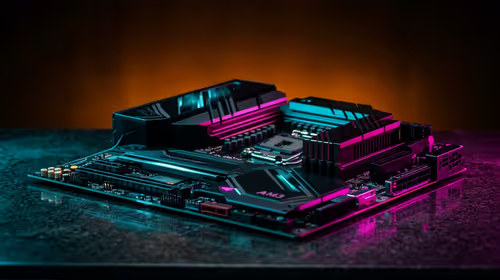
X870E vs X670E for aaa single-player gaming is mainly about fit, features, compatibility, cost, and upgrade path, not one automatic winner. SA buyers should match the choice to the setup.
Read more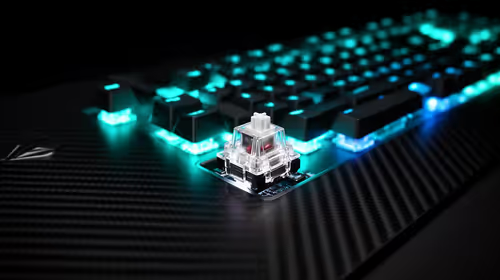
Hall Effect switches vs Mechanical switches for mMO and live-service games is mostly about compatibility, budget, upgrade path, and setup fit. SA buyers should check device support and real needs before expecting a clear win from either option.
Read more
A fake 113GB GTA VI ISO reportedly used empty padding around a small malware payload. SA gamers should delete unofficial builds, keep Windows security active and wait for official channels.

Wi-Fi 6E vs Wi-Fi 6 matters for 4K video editing when files move across a network. The real-world difference between Wi-Fi 6E and Wi-Fi 6 for video editing in 4K depends on NAS access, cloud uploads, router range, and SA creator workflows.

The difference between PCIe 5.0 and PCIe 4.0 for SA gamers is mostly bandwidth headroom. Compare GPU slot needs, NVMe speed, motherboard support, and upgrade timing before paying extra for a newer platform.

Gaming PC stuck pixel checks in South Africa should confirm the monitor fault first. Use colour tests, screenshot comparison, cable swaps, display menu checks, and clear photos before deciding on support.

Shokz OpenFit Air 2 earbuds weigh 7.2g each and use a redesigned dual-driver open-ear layout. SA buyers should choose them for comfort and awareness, not maximum isolation.

AMD's current driver now lists a Radeon RX 9050 4GB, while product coverage details a narrowed memory system. SA buyers should weigh the low VRAM ceiling against current local Radeon options.

Samsung Display has demonstrated a 16-inch 2.5K OLED laptop panel running at 300Hz. SA buyers should wait for a named notebook, full panel specifications and a local price before planning an upgrade.

Microsoft says some Windows 11 game crashes after recent updates are linked to RGB-related drivers. Affected SA gamers should confirm the update and driver before using the published registry workaround.

Minisforum's M2 Pro pairs Core Ultra X7, Arc B390 graphics and 32GB onboard memory in 1.8 litres. SA buyers should weigh its fixed memory and $1,439 launch offer against local mini PCs.

Smart monitors can add apps and convenience, but they also add privacy settings and unwanted-software risk. SA buyers should audit the operating system before paying for extras.
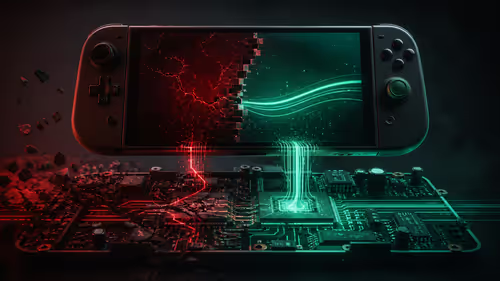
Lenovo says Legion Go failures linked to BIOS N3CN42WW are not user error. Affected SA owners should stop retrying the update, preserve proof and open a support case.
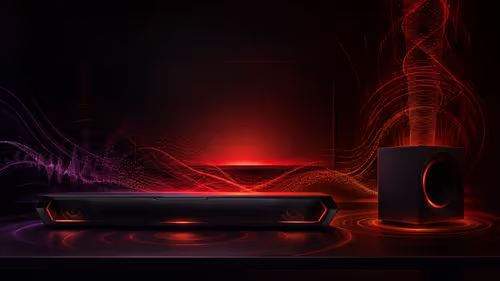
The ROG Gjallar gaming soundbar is now listed in the US at $599.99. SA buyers should compare its 2.1.2 audio, wireless bass and built-in chat controls with simpler local options.