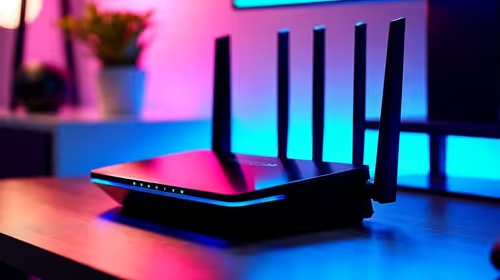
A letdown when it comes to signal strength? You're not alone. In South Africa, getting that fast 4G connection is only half the battle. The other half is pushing that signal to every corner of your home, from the gaming den to the home office. Weak 4G CAT6 router WiFi coverage can mean lag, buffering, and frustrating dead zones. Let's fix that. 🚀
Understanding Your 4G CAT6 Router's WiFi Coverage
Before we dive into the fixes, it's crucial to understand what we're dealing with. Your 4G router handles two different signals:
- The 4G/LTE Signal: This is the mobile data signal it receives from a nearby cell tower (like from Vodacom, MTN, or Telkom).
- The WiFi Signal: This is the signal the router broadcasts inside your home, connecting your laptop, console, and phone to the internet.
This guide focuses on boosting that second signal—the WiFi—to ensure your entire home gets the performance you're paying for. Improving your home signal often comes down to a few simple, strategic changes.
Quick Wins: Optimise Your Router Placement
Where you place your router has the biggest impact on your 4G CAT6 router WiFi coverage. Moving it just a few metres can make a massive difference. Think of WiFi like a lightbulb; you want to place it where the light can reach everywhere with minimal obstruction.
Find the Sweet Spot 📍
The ideal spot is central, elevated, and in the open. Avoid tucking it away in a cabinet or behind the TV. Thick walls, especially in older South African homes, are WiFi killers. Metal objects and even large bodies of water (like a fish tank) can also block or reflect signals.
Get it Up High
Don't leave your router on the floor. Placing it on a shelf or mounting it on a wall helps the signal travel further and over furniture. For multi-story homes, placing it high up on the ground floor is often a good compromise to cover both levels.
Signal Strength Pro Tip ⚡
Use a free mobile app like "WiFi Analyzer" to walk around your home and see the signal strength (measured in dBm) in real-time. A reading closer to -30 dBm is excellent, while anything below -70 dBm will feel slow and unreliable. This helps you find dead zones instantly.
Point Your Antennas Correctly
If your router has external antennas, their orientation matters. The signal broadcasts outwards from the antenna in a doughnut shape.
- Single-story home: Point the antennas straight up for the best horizontal coverage.
- Multi-story home: Position one antenna vertically and one horizontally to spread the signal both across the floor and up to the next level.
For a brand that offers reliable hardware with these flexible features, check out the range from reputable brands like Cudy South Africa.
Advanced Tweaks for a Stronger Home Signal
If placement alone doesn't solve your signal woes, it's time to look at your router's settings. These tweaks are simple and can significantly reduce interference from your neighbours' networks.
Change Your WiFi Channel
Your router's WiFi operates on specific channels. The 2.4GHz band (which has a longer range) is often crowded. By logging into your router's admin panel, you can manually select a less congested channel (typically 1, 6, or 11). The 5GHz band is much faster and less crowded but has a shorter range, making it perfect for devices in the same room as the router, like your gaming PC or console.
Keep Your Firmware Updated
Manufacturers regularly release firmware updates that can improve performance, patch security holes, and even enhance signal stability. It’s a simple step that many people overlook. Check your router's admin page for an "update" option.
Sometimes, however, the hardware itself is the limitation. If you're using an older router, it might not have the power or technology to cover your whole home effectively. Upgrading can provide a massive boost. For instance, a powerful option like the Cudy LT700 AC1200 4G CAT6 Router offers strong dual-band WiFi and advanced CAT6 technology, ensuring you get the best possible speed and coverage from your 4G SIM. ✨
Ready to Banish Lag for Good?
A weak WiFi signal can ruin a gaming session or a work-from-home day. Stop struggling with dead zones and unlock the full potential of your internet connection. Explore our range of high-performance 4G routers and find the perfect upgrade for your home.