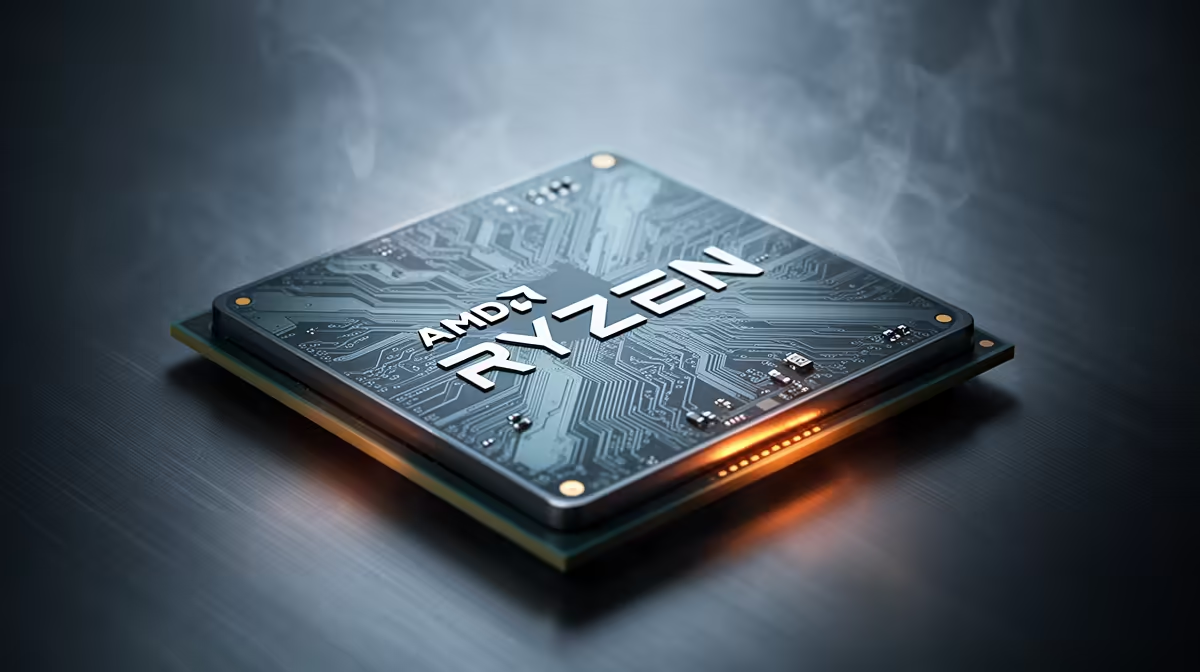
The 9800X3D wins the specification contest against the 7800X3D. Your gaming experience may tell a quieter story. Once resolution, graphics settings and GPU load enter the room, the faster CPU can spend much of its time waiting for the graphics card. The premium earns its place in narrower, CPU-heavy conditions.
Quick Answer
Buy the 9800X3D for a new top-end gaming build, very high competitive frame rates or games that lean hard on the CPU. Choose the 7800X3D when it costs enough less and your main target is 1440p or 4K with a powerful GPU. Existing 7800X3D owners should hold unless testing shows a CPU limit they care about.
Resolution changes what you can see
At 1080p with low visual settings, the graphics card can finish frames quickly and ask the processor for more. That is where a faster gaming CPU can stretch its legs. Review charts built around a flagship GPU often use this setup to reveal the maximum difference between processors.
Move to 1440p, raise image quality and the GPU takes longer to draw each frame. At 4K, the effect grows. The CPU still handles game logic, simulation and frame preparation, but the final rate can be governed by graphics performance. A large CPU lead in an artificial low-resolution test may shrink in the settings you use.
This does not make CPU testing useless. It tells you to match the test to your monitor. If you own a 240Hz 1440p display and play competitive games, look for results at that resolution and a realistic settings mix. If you enjoy cinematic 4K games at high detail, place more weight on GPU-limited testing and low-frame consistency.
Check the current AMD processor shelf before reducing the choice to two chips. The Intel catalogue adds a platform reference. July 2026 put the named AM5 Ryzen 5 9600X at R4,499, showing how far below X3D the price ladder begins.
Games that reward the faster chip
Competitive titles can turn processor headroom into higher frame rates and stronger lows. The benefit matters when your monitor and GPU can use it. A jump from 180fps to 240fps has a job on a 240Hz screen; the same gain is harder to value on a 144Hz panel.
Simulation and strategy games create another test. Large crowds, physics, AI and late-game calculations can keep the CPU busy even when graphics settings stay modest. Look for benchmarks that use mature saves or crowded scenes, since an empty opening map tells you little.
Some games respond more to stacked cache than others. Averages across a broad suite can hide a title you play every night. Build a personal shortlist and compare those results. Two useful games beat a dozen benchmarks from genres you never touch.
Streaming and background tasks can influence the choice, though capture settings and GPU encoding also matter. If the PC earns money through creation work, add application tests. A gaming champion is not guaranteed to lead every render, compile or encode.
The premium belongs in a complete build
For a new PC, calculate what the CPU premium removes from the rest of the machine. If it pushes you down a graphics tier, the cheaper 7800X3D build may produce more frames at 1440p or 4K. If the system already has the GPU, monitor, storage and power supply you want, the 9800X3D becomes easier to justify.
Motherboard cost can distort the comparison. Both chips use AM5, and neither needs an extravagant board to become fast. Choose for the required CPU support, storage slots, networking and rear connections. Confirm the BIOS version for the 9800X3D before assembly.
Both platforms use DDR5. Capacity and stability matter more than a tiny memory timing advantage. A sound matched kit and current firmware give you a reliable baseline. Reuse a good kit when upgrading from the 7800X3D unless a workload needs more capacity.
Cooling and case airflow belong in the budget too. Check the cooler maker's support and the processor's needs, then judge noise as well as temperature. A premium gaming PC should stay comfortable in the room where you use it.
Existing owners have a different calculation
A 7800X3D owner already possesses much of the gaming experience the 9800X3D sells. The upgrade cost is the processor price, installation time and the value lost when selling the old chip. Measure the problem before spending.
Use a repeatable game scene. Record GPU use and frame times, lower resolution, then test again. If performance barely changes when the GPU load falls, the CPU may be the ceiling. If frame rate climbs with the lower graphics load, the GPU remains the larger constraint.
Set a threshold. Perhaps you want the slowest competitive moments above 200fps, or a simulation turn to complete faster. Find comparable results that meet it. If the 9800X3D cannot deliver a noticeable change in that exact use, keep the 7800X3D and wait for a larger step.
New builders can buy the faster foundation without paying for two CPUs. Existing owners should demand more. That difference is why both answers can be right in 2026.
Keep the comparison repeatable
Save one benchmark replay or game save before changing CPUs. Record the resolution, preset, memory profile and background applications. After the swap, use the same scene and look for stronger lows as well as the average. This prevents a driver update or changed setting from receiving credit for the processor.
Let the new thermal paste settle through several normal heat cycles before judging fan noise. Compare both processors with the same case airflow, room conditions and fan curve.
Frequently Asked Questions
How big is the real-world gap?
It varies by title, GPU, resolution and settings. CPU-bound 1080p tests show more separation than demanding 4K play.
Is the 7800X3D still a strong gaming CPU?
Yes. It remains powerful enough for high-end gaming and can be the better value at the right price.
Who should choose the 9800X3D?
New top-end builders, high-refresh competitive players and users with measured CPU-heavy workloads gain the clearest case.
Do both chips use AM5?
Yes. A compatible board may support either chip, though the 9800X3D can require a BIOS update.
Does resolution affect the gap?
Yes. Higher resolution tends to increase GPU load and can reduce the visible CPU difference.
Compare X3D CPUs against your monitor, graphics card and favourite games before paying for benchmark headroom.