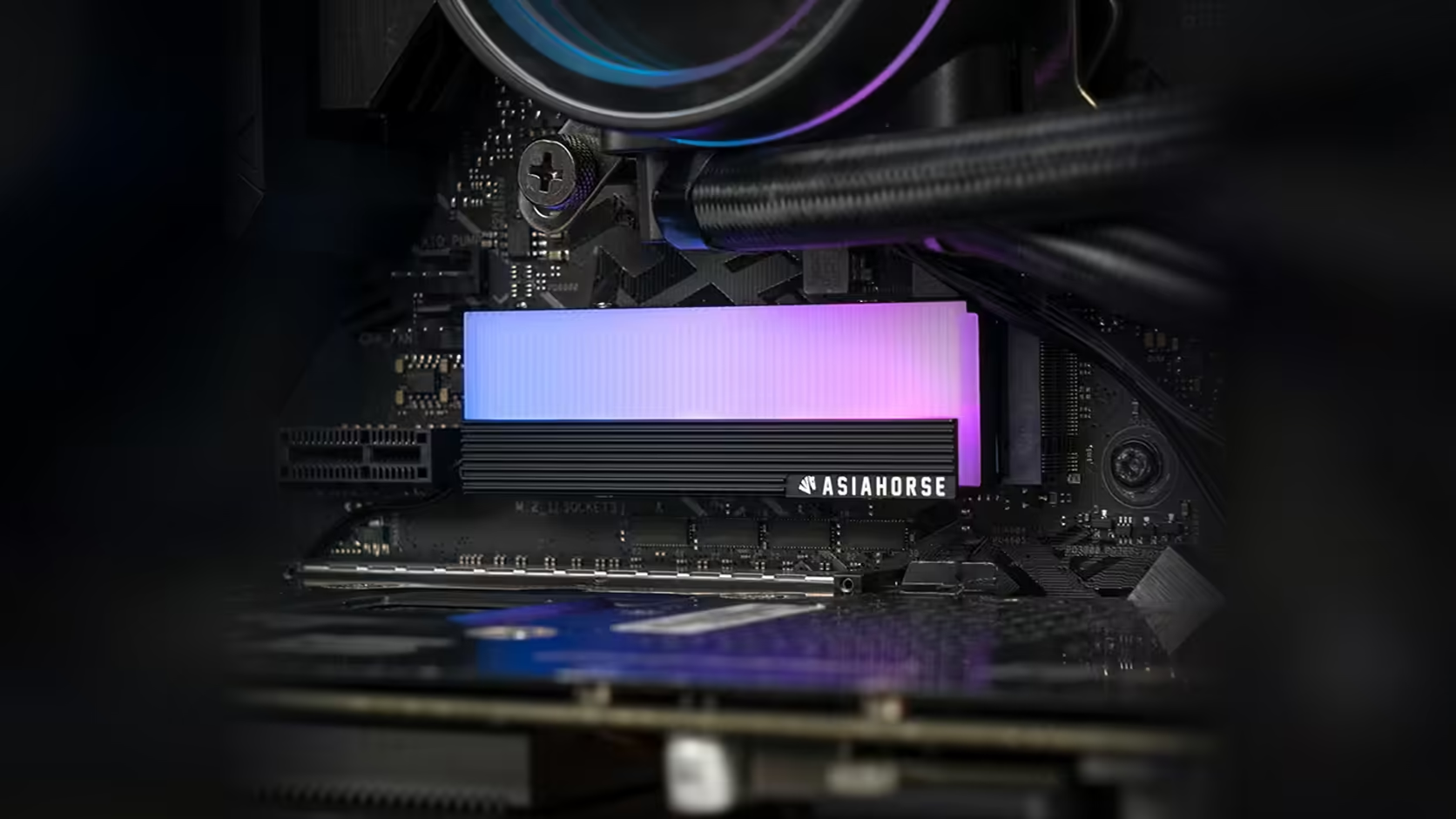
There is a specific kind of assumption that trips up builders around M.2 covers, and it is worth naming directly: seeing "2280 supported" on a listing and reading it as a size guarantee for the whole part. The 2280 format describes what fits inside the AsiaHorse aluminium heatsink. It says nothing about how much room the cover itself takes up once it is fitted, and confusing the two is exactly how a R199 accessory turns into a fitment problem in a build that otherwise went smoothly.
Quick Answer
"2280" on the AsiaHorse M.2 heatsink's listing tells you which drive length the cover is built to accept, not how large the assembled cover becomes once fitted. No body dimensions are published for the outer shell at all, so the drive's format and the cover's actual footprint are two separate figures, and only one of them is available to check before you buy at R199, a VAT-included price Evetech can still adjust.
📐 Two different measurements hiding behind one number
It is easy to see a spec like "M.2 2280" and assume it tells you everything you need about size. In reality it is describing the internal compatibility of the cover, the drive length it is shaped to accept, and that is a completely separate figure from the cover's external dimensions once assembled. A drive's format tells you what goes in. It does not tell you how far the cover reaches out, up, or sideways once it is closed around that drive.
Why manufacturers separate these figures at all
A cover has to be large enough to enclose a 2280 drive plus a thermal pad plus its own aluminium walls, which inevitably makes the outer shell noticeably bigger than the drive alone. Every M.2 heatsink on the market works this way to some degree. What varies is whether the manufacturer publishes the resulting outer dimensions or leaves them out, and for this particular AsiaHorse cover, they are left out entirely.
🔍 What "no dimensions published" actually means in practice
For this cover, our verified product data carries the drive format it supports, the lighting specification, the mounting method and the warranty terms, but no height, length or width for the assembled shell itself. That is a real gap for anyone planning a build around a graphics card that overhangs the top M.2 slot, since height is precisely the figure that would settle whether the two components can coexist.
It is worth being clear that this is not a case of the dimensions being buried somewhere less obvious. They are simply not part of the published specification for this product, which means the usual approach of hunting through a longer spec sheet will not turn anything up here.
The practical consequence for build planning
Where a cover does publish its outer height, a builder can compare that figure directly against the measured gap under their graphics card and know the answer before ordering anything. Without that figure, the comparison has to happen the other way around: measure the gap first, then compare it against the physical cover once you have it in hand, rather than working from a spec sheet in advance.
🎯 Why clearance depends on the cover's size, not the drive's format
This is the part that most often gets confused during a build. A tight fit under a graphics card is a question about the cover's outer height, full stop. It has nothing to do with whether the drive inside is 2280, 2260, or any other length, because the drive's format only ever determines what the cover can accept internally, not how the finished assembly sits in the case once fitted.
Put differently: knowing your drive is correctly 2280-length tells you the cover will accept it. It tells you nothing about whether that assembled cover then clears the graphics card sitting above the slot, which is a completely separate question with a completely separate answer.
🧰 What actually answers the clearance question
With no published outer dimensions to consult, the only reliable route is a physical one. Measure the gap between your board's top M.2 slot and the underside of your installed graphics card, then compare that figure against the cover itself once it arrives, ideally before final assembly rather than after. If the fit looks marginal, moving to a lower M.2 slot that sits clear of the card sidesteps the whole question, provided your board manual confirms that slot carries the same bandwidth. Two Evetech sections are worth having open while you plan this: case accessories for the fit itself, and the solid state drive range for whichever drive ends up under the cover.
🔩 Does the mounting method hint at size?
It is tempting to look at the four-screw mount and assume it tells you something about the overall dimensions, but it does not. A screw mount describes how the cover attaches to the drive assembly, not how large the assembled part becomes. Two covers could share an identical four-screw method while differing considerably in outer height, so this detail, useful as it is for planning your fit sequence, does not answer the clearance question either.
🧪 What other covers on the market do differently
Some M.2 heatsinks on the broader market do publish full outer dimensions precisely because builders run into exactly this confusion often enough that manufacturers have started closing the gap. Where clearance under a graphics card is genuinely tight, a cover that states its own height in millimetres removes the guesswork this AsiaHorse listing leaves in place. That is worth keeping in mind if your build's clearance margin is close to zero rather than comfortable.
Frequently Asked Questions
What does the 2280 specification actually describe?
The drive's own physical dimensions, 22mm wide and 80mm long, which determines what length of drive the cover is shaped to accept internally.
Does knowing the drive format tell me the cover's outer size?
No. The cover surrounds the drive and is necessarily larger than it, and that external size is a separate specification the listing does not include.
Are the cover's outer dimensions published anywhere in the product data?
No body dimensions appear in our verified product data for this cover, so outer size has to be judged from the physical part rather than a spec sheet.
Why does the difference between format and size matter practically?
Because clearance under a graphics card depends entirely on the cover's outer height, not on the length of the drive fitted inside it.
What is the most reliable way to plan around this gap in information?
Measure the physical space available in your case and compare it directly against the cover once you have it, rather than trying to calculate clearance from the listing alone.
Does the four-screw mounting method reveal anything about the cover's size?
No. It describes how the cover attaches to the drive, which is unrelated to how large the assembled cover ends up being.
Would a different cover on the market solve this uncertainty?
Some competing heatsinks do publish full outer dimensions, which is worth seeking out specifically if your build's clearance margin is tight rather than generous.
Weighing up format against actual fit before you buy?
Explore Evetech's solid state drive range and measure your own board's clearance before adding a cover to the cart.