Quick Answer
Real-time music sync in gaming room lighting works by sampling audio through a microphone built into the light controller, analysing the frequency spectrum and beat intensity, then translating those values into colour changes and brightness pulses at update rates typically between 30 and 60 times per second.
How the Audio Analysis Pipeline Works 🎵
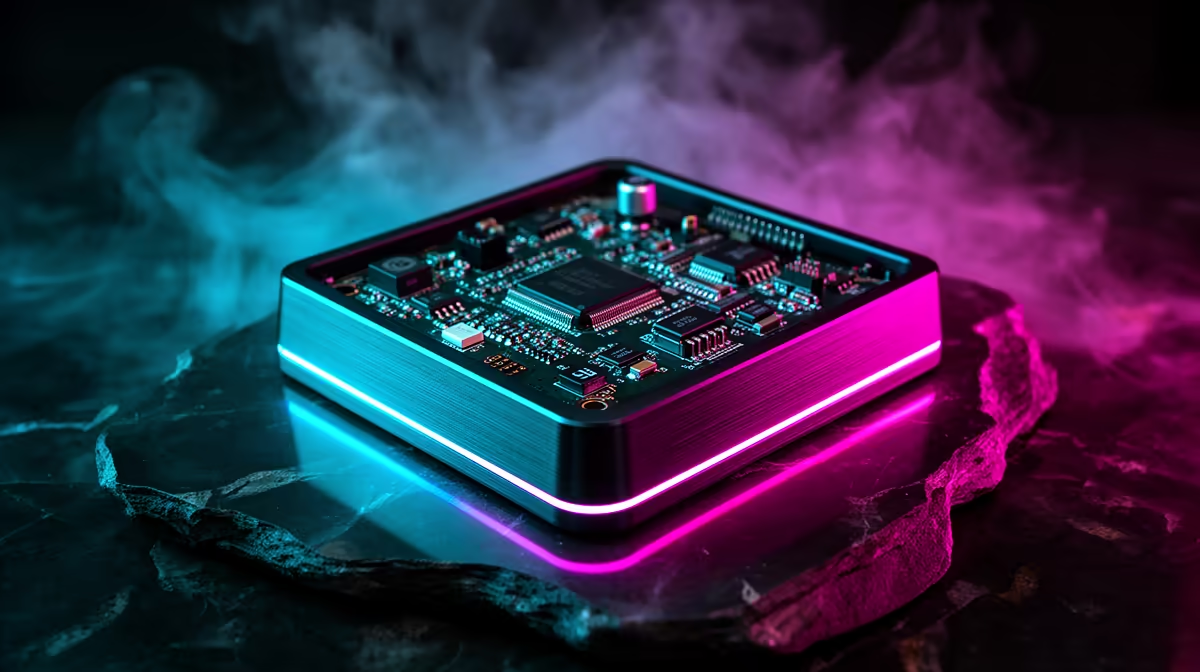
The microphone on a Cololight controller continuously samples ambient sound. The controller's onboard DSP runs a fast Fourier transform to split audio into frequency bands: sub-bass below 80Hz drives deep red or orange pulses, midrange from 250Hz to 2kHz drives green and blue shifts, and high frequencies above 4kHz trigger white or cyan flashes. The speed of colour transitions ties to a BPM detection algorithm tracking kick drum transients. On Cololight hardware, microphone sensitivity is adjustable in the app from level 1 (responds only to loud beats) to level 10 (reacts to near-whispers), allowing calibration for a quiet SA home office or a loud LAN party.
Latency and Synchronisation Accuracy 🕹️
The gap between an audio event and the corresponding light change is sync latency. In well-designed systems it sits between 20ms and 80ms. Human perception of audio-visual mismatches becomes noticeable above roughly 100ms. Locally processed systems like Cololight's onboard DSP skip the cloud step entirely, keeping latency under 50ms regardless of internet quality, a meaningful advantage for SA households in areas with variable Openserve or Frogfoot fibre uptime.
Calibrating Music Sync for Different Scenarios 🎮
FPS gaming produces sporadic audio transients from gunshots rather than a consistent beat. Music sync in this context creates chaotic lighting many players find distracting. Reserve music sync for music sessions or rhythm games. For Amapiano or house music with consistent 120 to 130 BPM kick patterns, set sensitivity to level 6 and select Rhythm mode: panels pulse on every downbeat while smoothly shifting hue between beats.
Position the Mic Away From Speakers ⚡
The built-in microphone picks up room audio, not a line-in signal. Placing the controller closer than 40cm to your PC speakers causes clipping, where the mic is constantly overloaded and the light effects become a frantic strobe. Mount the controller at least 60cm from any speaker driver for accurate sync.
FAQ
Does music sync work with audio played through headphones only?
If audio plays exclusively through headphones, the microphone picks up nothing and the lights do not react. Standalone smart panels require audible room sound to activate music sync.
Can I run music sync and a scheduled scene at the same time?
No. Music sync mode overrides any active scheduled scene for the duration it is enabled. Turning off music sync returns panels to the most recently active scene.
Does the microphone record and store audio data?
No. The onboard DSP processes audio locally in real time and discards the signal immediately. No audio data is transmitted to servers or stored.
Bring your music to life on the walls?
Evetech stocks Cololight Smart Modular Panels with built-in music sync, available for local delivery across South Africa with manufacturer warranty included.