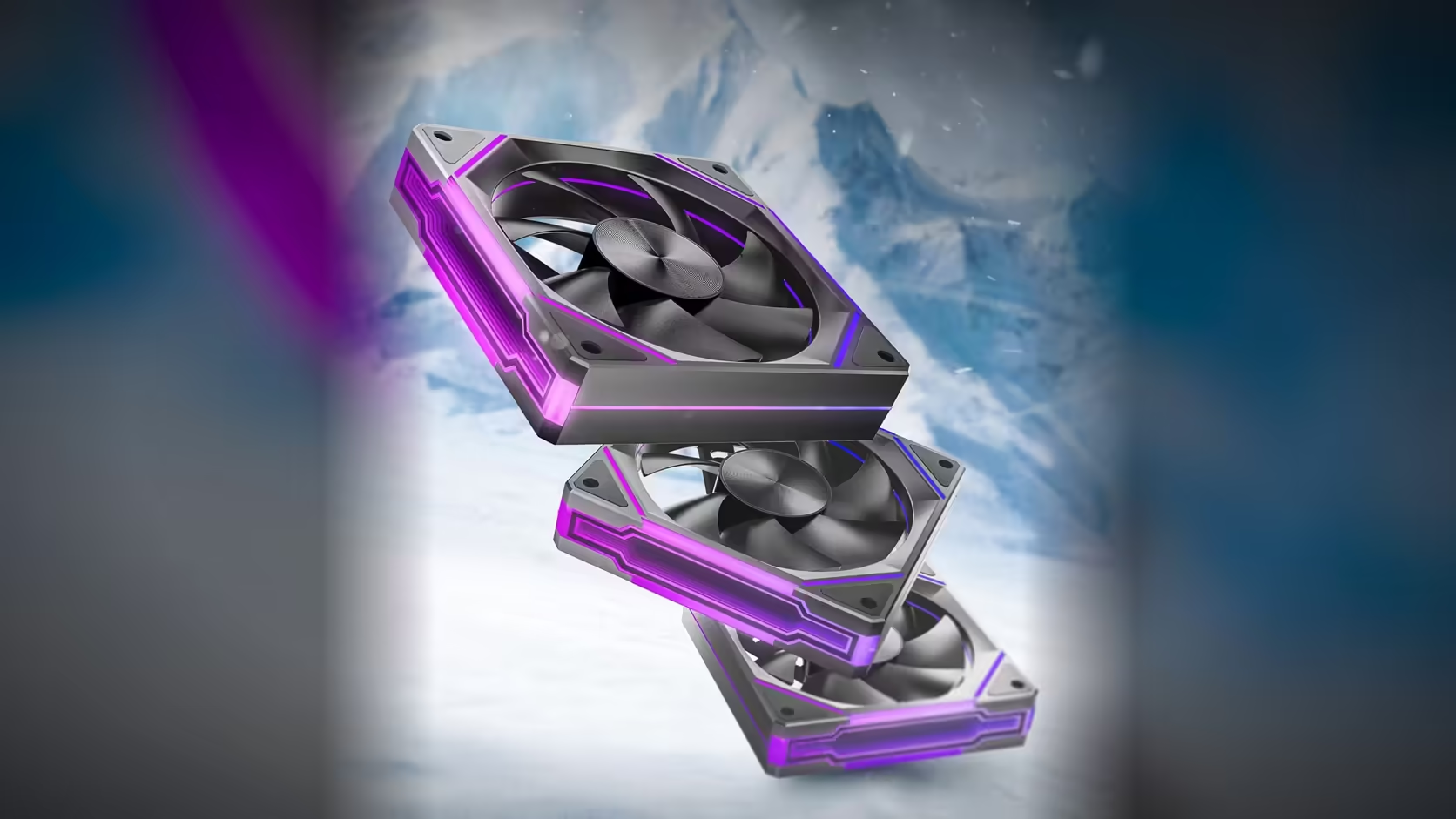
Two very different pieces of hardware can chase the same lighting goal. A trio of Amici Pro fans puts glowing rings exactly where a build already needs airflow, while an ARGB light strip puts glow wherever you choose to stick it - along an edge, behind a panel, around a window frame. They are not interchangeable, and knowing which one actually solves your layout problem saves a wasted purchase.
Quick Answer
Three Amici Pro fans cost R399 (VAT-inclusive, prices move), each spinning up to 1800 RPM and moving up to 61.5 CFM under 30 dBA. A light strip solves a different problem: it lights a surface, not a fan position, and the two are best chosen based on what your case actually needs lit.
🌀 What a lit fan ring actually gives you
Fan positions are fixed by the case - front, top, rear, wherever the manufacturer put mounting holes. Light the fans there and the glow follows the airflow path itself, outlining exactly where air enters and exits the build. That is a very different visual statement to lighting an edge or a flat panel that has nothing to do with cooling.
The Amici Pro specifically
Each fan in the pack lights only its infinity mirror ring; the blades stay dark by design. Up to 61.5 CFM at under 30 dBA on a hydro-dynamic bearing means the fans are doing real cooling work while they light, not just sitting there as decoration. Standard forward blades suit either intake or exhaust mounting, so the same three fans can serve either role depending on where the airflow plan needs them.
📏 What a light strip gives you instead
A strip attaches wherever you decide - along a case edge, behind a motherboard tray, around the inside of a window. It has no cooling function at all; its entire job is to be seen. That flexibility is the strip's real advantage: it is not constrained to fan positions, so it can outline the case itself rather than the components inside it.
Where the two overlap
Both an Amici Pro pack and most ARGB strips connect over a 5V 3-pin addressable header, meaning they compete for the same motherboard headers and can, in principle, run the same lighting scheme through one piece of RGB software. A build with limited headers may need to choose which gets priority, or use a hub to run both.
🔍 Choosing between them for your build
Ask what the build actually needs first. If the goal is to mark where airflow moves through the case - and get real cooling in the process - three Amici Pro fans do that job while a strip cannot, since a strip adds no airflow at all. If the goal is to outline a specific case feature that has nothing to do with a fan position, a strip reaches places fans simply cannot go.
Nothing stops a build from using both, subject to available headers, though it is worth deciding which element is meant to lead the overall look rather than adding both without a plan. A case with three fan positions already accounted for by the airflow design gains cooling and a lighting statement from one purchase; a case that already has enough fans but wants a highlighted edge is better served by a strip alone.
Browse the case fans range to see the Amici Pro alongside other fan options, and check case accessories for hubs, extension cables, and mounting hardware that make running both elements together easier.
🛡️ Bearings and warranty are part of the decision too
A hydro-dynamic bearing is built for continuous running, which matters because a case fan spins for as long as the machine is powered - unlike a strip's LEDs, the Amici Pro's motor and bearing are the parts most likely to show wear over years of daily use. All 75 SKUs across the AsiaHorse case fan lineup, this one included, carry a 1 Year Local Warranty, so a genuine fan failure inside that period is handled locally rather than through an overseas return process. A light strip fails differently: individual LEDs can dim gradually rather than cutting out entirely, and since a strip has no moving parts, there is nothing analogous to bearing wear to plan around.
Header budget matters before either purchase lands
A 5V 3-pin addressable header is a genuinely limited resource on most motherboards, typically two or three before a hub becomes necessary for a larger build. Three Amici Pro fans daisy-chained correctly can often run from a single header, which leaves headers spare for a strip or other addressable components placed elsewhere. Working out header count before ordering either product avoids discovering mid-install that a splitter or hub needs adding to the order after the fact.
Checking stock before you commit to a plan
This particular fan's page stays hidden while it waits on trial-order stock, and no date has been confirmed for when that arrives, so it is not something to treat as buyable today. A light strip, being a smaller and more commonly stocked catalogue item, may already be available while the fan trio is still pending - worth checking both before finalising a combined lighting plan that leans on a pack you cannot yet order.
Frequently Asked Questions
What does a lit fan ring give a build that a strip cannot?
Cooling. The fan is doing airflow work at the same time as it lights, where a strip contributes no airflow at all.
Can a strip do the same job as three fan rings?
Not really - their positions differ fundamentally, so the finished shape of the lighting in the case looks quite different.
Do fans and strips draw from the same header type?
Both typically use a 5V 3-pin addressable connection, so they compete for the same motherboard headers in a build.
Is one option cheaper than the other?
Pricing depends on the specific strip length and fan pack chosen, so it is worth comparing the actual products rather than assuming.
Can I run both an Amici Pro pack and a light strip together?
Yes, subject to header availability on your motherboard, and a hub can help if you run short of connections.
Which is easier to install?
A strip is generally more flexible on placement since it does not need a fan mounting position, while fans have to go where the case allows.
Does adding a strip void the fan warranty?
No, the two are separate products entirely, and the Amici Pro's 1 Year Local Warranty applies regardless of what else is connected.
Planning the lighting layout for your next build?
Browse Evetech's case fan range to see how Amici Pro and other options fit your airflow plan.