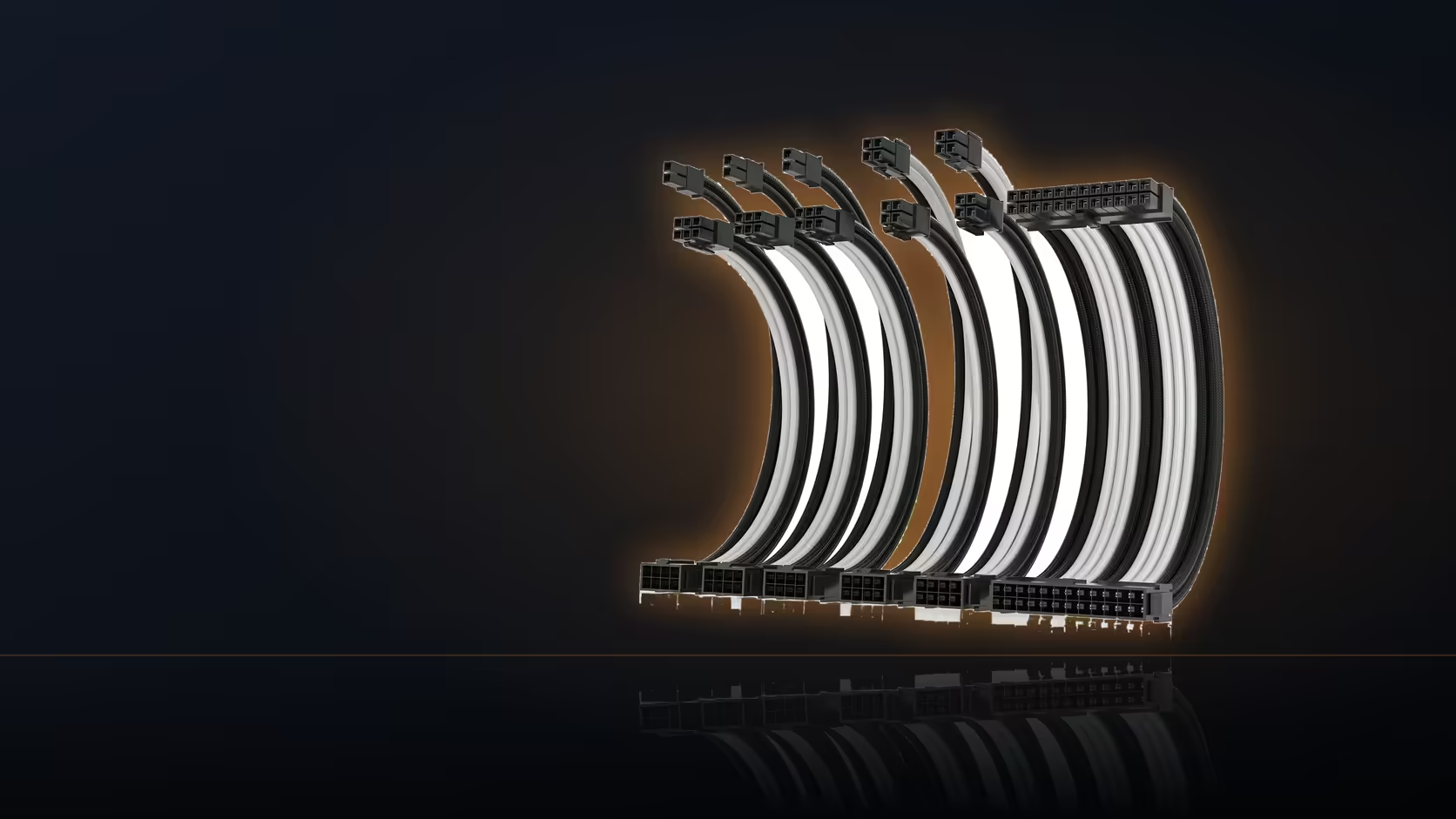
R799 against R549 is a R250 gap that only makes sense once you have actually counted what your build exposes. The six-piece set and the four-piece kit are not simply bigger and smaller versions of the same product - they answer to genuinely different socket layouts.
Quick Answer
Six leads cost R799 and four cost R549. Match that against the sockets your board and card present, counted with the panel off. A kit that dresses every visible run beats a cheaper one that leaves two of them plain.
🕳️ What the smaller kit simply cannot reach
The four-piece kit's contents stop at one 24-pin lead, one processor lead and two card leads - full stop. A second processor power socket and a third card socket both fall entirely outside what it supplies, no matter how the rest of the purchase is justified. If your build uses either of those additional connections, those specific runs stay in their original factory finish regardless of how carefully everything else gets dressed, because the four-piece kit has no piece capable of covering them.
There is no workaround for this within the smaller kit either - no spare piece to repurpose, no alternate wiring trick that turns one extension into two. If a build genuinely presents six connectors that need dressing, the four-piece set was never going to be the right purchase regardless of price, and recognising that early avoids buying the wrong kit twice.
💭 Weighing appearance against the actual price gap
R250 is a meaningful amount of money on top of a purchase already sitting comfortably under R1,000, and it is fair to ask whether the visual improvement on a dual-input board genuinely justifies it. For most builders the answer comes down to how visible the build actually is day to day - a machine that sits under a desk out of sight tolerates a mismatched lead far better than one that anchors a living room setup on permanent display through a large glass panel. There is no universally correct answer here, only a judgement call that depends entirely on how much of the build's interior actually gets looked at once the desk lamp is on and the machine is running through a normal day. Ask yourself honestly how often you actually glance at the open side of the case during a typical week, rather than how often you imagine you will when the build is freshly finished and still novel - that honest answer, more than any spec sheet, is what should settle a R250 decision like this one.
👀 Why one plain lead stands out among five dressed ones
On a dual-input board where only one of the two processor leads gets the sleeved treatment, the visual result is often worse than leaving everything plain would have been - a single undressed factory-grey lead sitting beside five carefully finished sleeved runs draws far more attention than a uniformly plain interior ever would. That asymmetry is usually what tips the R250 price gap in the six-piece kit's favour on a board that genuinely needs it: the eye picks up the one thing that does not match faster than it appreciates the five things that do.
🔗 What both kits actually share
Both sizes are built from the identical connector families - a 24-pin board lead, 4+4 processor leads and 6+2 card leads throughout - so quantity and conductor gauge are genuinely the only things separating them, not the underlying connector technology. That shared foundation means neither kit is a compromise on build quality; the choice is purely about matching the count to your board and card.
🎯 Matching the kit to the build in front of you
Most mainstream gaming builds run a single processor socket paired with a card drawing through one or two plugs, a configuration the four-piece kit covers completely without any gaps. The six-piece kit earns its clearest advantage on a board carrying two power inputs paired with a card pulling through three sockets, where it dresses every single visible run and the smaller kit simply cannot follow. Buying the larger kit purely as future-proofing is a weaker argument than it sounds - a single extension bought later, when an actual upgrade calls for it, is usually the cheaper route to the same eventual coverage. Combining both kits on one build is technically possible but wasteful, since it duplicates the board lead and pays twice for coverage the smaller purchase already provided. Every finish in the family is laid out together at cable solutions, worth weighing against what individually sleeved premium cables charges for a loom built from nothing.
🧮 Doing the sums before you order
Lay the two prices side by side against what your own build actually needs dressed, and the decision tends to settle itself quickly. R549 for four leads that cover everything, or R799 for six leads where two sit permanently boxed, is not a close call once the sockets are counted honestly rather than assumed.
Frequently Asked Questions
What does the four-piece kit leave out?
A second processor lead and a third card lead. If your build uses either, those runs stay in their factory finish.
Is the price gap worth it for one extra run?
On a dual-input board, usually yes, because a single plain lead beside five dressed ones is exactly what the eye picks up.
Do both kits share the same connector types?
Both use a 24-pin board lead, 4+4 processor leads and 6+2 card leads. Quantity and conductor size are where they part company.
Which kit suits a mainstream gaming build?
Most mainstream builds run one processor socket and a card with one or two plugs, which the four-piece set covers completely.
Where does the six-piece kit clearly win?
On a board with two power inputs paired with a card drawing through three sockets, where it dresses every run and the smaller kit cannot.
Does buying the larger kit future-proof anything?
It gives you spare leads for a later upgrade, though a single extension bought when needed is usually the cheaper route to the same place.
Can the two kits be combined?
Nothing stops it, but you would duplicate the board lead and pay twice for coverage you already have.
Matching a kit size to your exact socket count?
See Evetech's power supply range and count every processor and card socket before choosing between the two sizes.