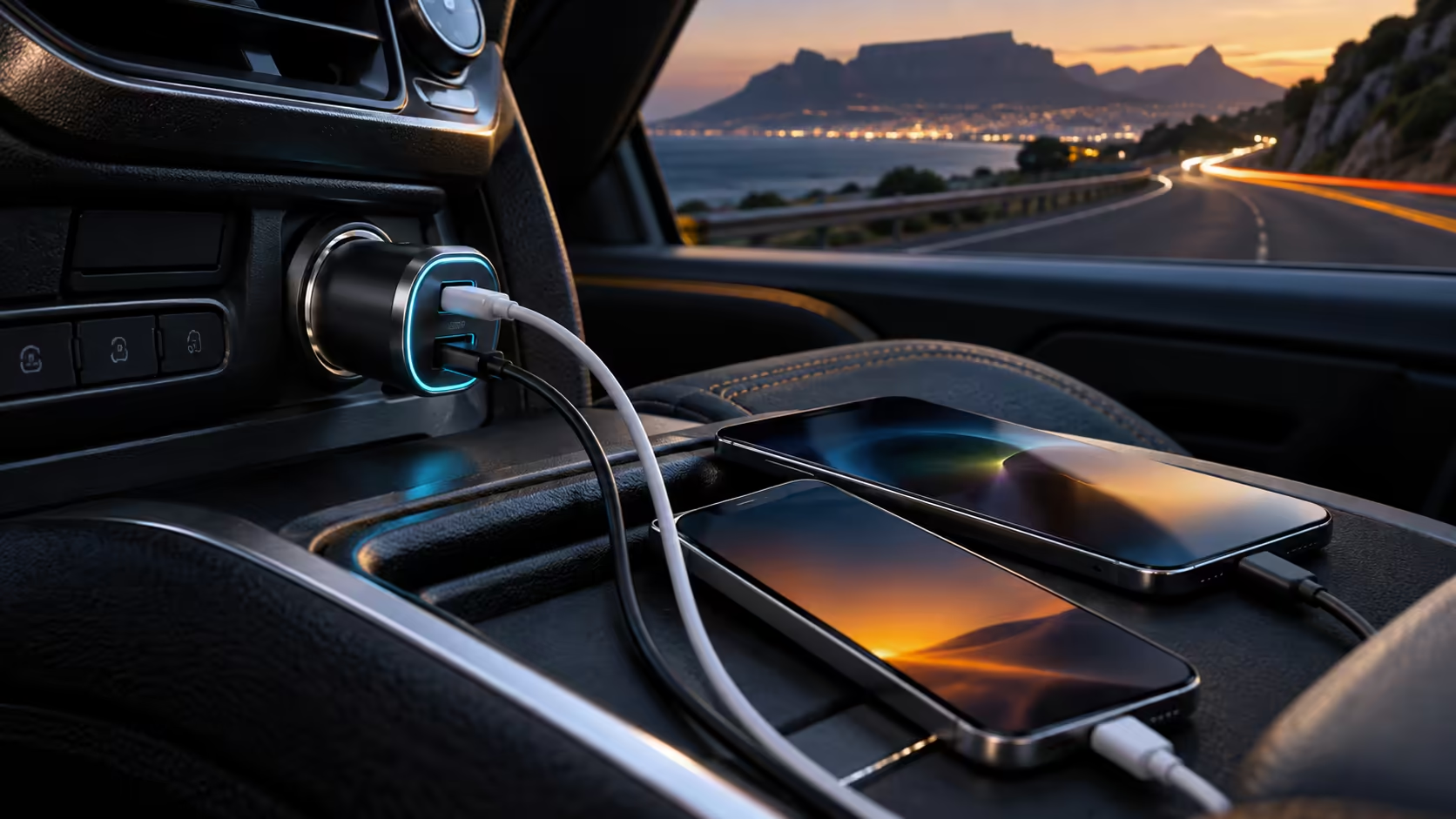
Safe dual-port phone charging in a South African car means two separate checks done properly: what happens if the electrical system misbehaves, and what happens the moment a second device joins the first on the same charger. Most buying advice covers only one of the two.
Quick Answer
Look for stated protection against over-voltage, over-current and heat, given how much more a vehicle's 12V supply moves around compared with a steady wall outlet. Then check how power actually splits once both ports are busy, because the two headline wattage figures on the box are solo numbers, not a combined guarantee. Anker's own page states that MultiProtect, on its 30W two-port charger, guards against all three at once, over-voltage, over-current and overheating, and pairs that USB-C output with 22.5W USB-A, at R349.
⚡ The electrical side: why cars are rougher on chargers
A car's electrical system is a noisier environment than a wall socket, because the same 12V rail feeding a charger also carries the starter motor's demands and the alternator's output at different moments of a single trip. Cranking the engine briefly drags the whole system well below its resting voltage, and a healthy alternator afterwards pushes it back up above resting voltage again while it tops up the battery.
A well-built charger generally needs three separate watch-points to cover that swing. One guards the top end against an alternator or wiring fault pushing voltage too high. Another limits how much current any port will actually hand out if a fault downstream asks for more than it should. The third keeps an eye on the charger's own internal temperature, which becomes the more pressing of the three in a hot, sun-soaked cabin common across much of South Africa for a large part of the year. Anker's two-port charger states that its own MultiProtect feature covers exactly these three, over-voltage, over-current and overheating.
🔌 The power-sharing side: what two ports really give you
A dual-port charger runs one internal converter feeding both outputs, not two independent supplies. Each port reaches its full solo figure, 30W or 22.5W here, only when it is the sole device drawing from that converter. The moment both are active, they settle at a lower shared figure, 12W each on this unit, because the converter is dividing a single budget rather than doubling its output to match two claims at once.
That distinction matters for safety as much as for speed. A charger correctly limiting its combined output to what its internal components can safely sustain is doing exactly what good design should, even though the resulting per-device figure looks smaller than the two numbers printed on the box.
🌡️ Putting both together for a South African summer
Heat compounds both risks at once. A charger already working harder because both ports are active, inside a cabin that has spent an afternoon in direct sun, is closer to the point where thermal protection needs to step in than either factor would be alone.
Checking that a charger states temperature protection explicitly, not just over-voltage and over-current, is worth the extra minute before buying, especially for anyone in a warmer part of the country where a parked car regularly gets hot enough to matter. A cable in good condition rounds out the picture, since a worn lead adds its own resistance and heat near the connector regardless of how well the charger itself is protected.
🔍 A short pre-trip check worth adopting
Before a long drive, or simply once a month for a daily commuter car, a 60-second visual check of the charger and socket catches most problems before they become an inconvenience on the road. Look for a plug that seats fully home without wobbling, a cable free of cracks or exposed strands near either end, and a charger body that feels no warmer than expected after normal use.
None of this takes more than a minute, and it is the same habit that catches a socket working loose from dust or wear long before it becomes a genuinely dangerous connection, rather than after a phone has already dropped out mid-navigation on a trip that mattered.
🛒 What to look for on the listing itself
A listing worth trusting states the safety protections by name rather than folding them into a vague "safe charging" claim, and separates each port's solo rating from the combined figure when both are busy. Household mains here runs at a steady 230V AC; a car's 12V DC supply swings around far more than that, so protections genuinely built for a vehicle are worth more than a generic line borrowed from a wall-charger listing.
🧭 Where to look if something still feels off
If a phone rated for 25W or more is still only pulling a trickle despite a charger that ticks every box on this list, work through the variables in order rather than assuming the charger itself is at fault. Check the cable first, then the socket's physical condition, then whether a second device is quietly sharing the same converter, before concluding the charger needs replacing.
Frequently Asked Questions
Does a car really put more electrical stress on a charger than a wall socket?
Yes. The 12V rail swings noticeably during engine cranking and while the alternator charges, a wider range than regulated household mains ever presents.
If both ports are protected individually, is that enough?
Mostly, though it is also worth checking the combined, shared-power figure, since that is the number that applies whenever both ports are genuinely busy at once.
Does South African summer heat actually affect charger safety?
It can. A cabin left in direct sun adds thermal stress on top of whatever the charger and its cable are already generating internally, which is exactly what temperature protection exists to manage.
Is MultiProtect the same thing as power sharing?
No. MultiProtect is the charger's own safety circuitry; power sharing describes how the converter divides its output between two active ports. Both matter, separately.
How often should I actually check the charger and cable?
Once a month for a daily commuter car is a reasonable habit, and always before a long trip where a fault would be far more inconvenient than it would be on a short local errand.
Does a more expensive charger automatically mean better protection?
Not automatically. Price correlates loosely with build quality, but the only reliable way to know for certain is checking that the listing actually names the specific protections rather than assuming a higher number on the box implies safer internals underneath, since a badge alone proves nothing.
Ready to charge two phones safely on the road?
Browse the car charger range and check both the protections and the shared power figure before buying.