Sixty-four gigabytes rarely makes a gaming-only PC faster than a healthy 32GB setup. It earns its place when the machine does more than run the game: high-resolution editing, virtual machines, large software builds, simulation, local AI, huge mod lists or several heavy applications at once. The proof is sustained memory pressure in the real workload.
Quick Answer
Buy a matched 2x32GB kit when your normal committed memory approaches or exceeds 32GB, paging hurts the workload or a professional application recommends the capacity for the project size. Keep 32GB for a gaming-focused build with headroom. Do not choose 64GB from a future-proof label while cutting the GPU, storage or monitor that affects daily use.
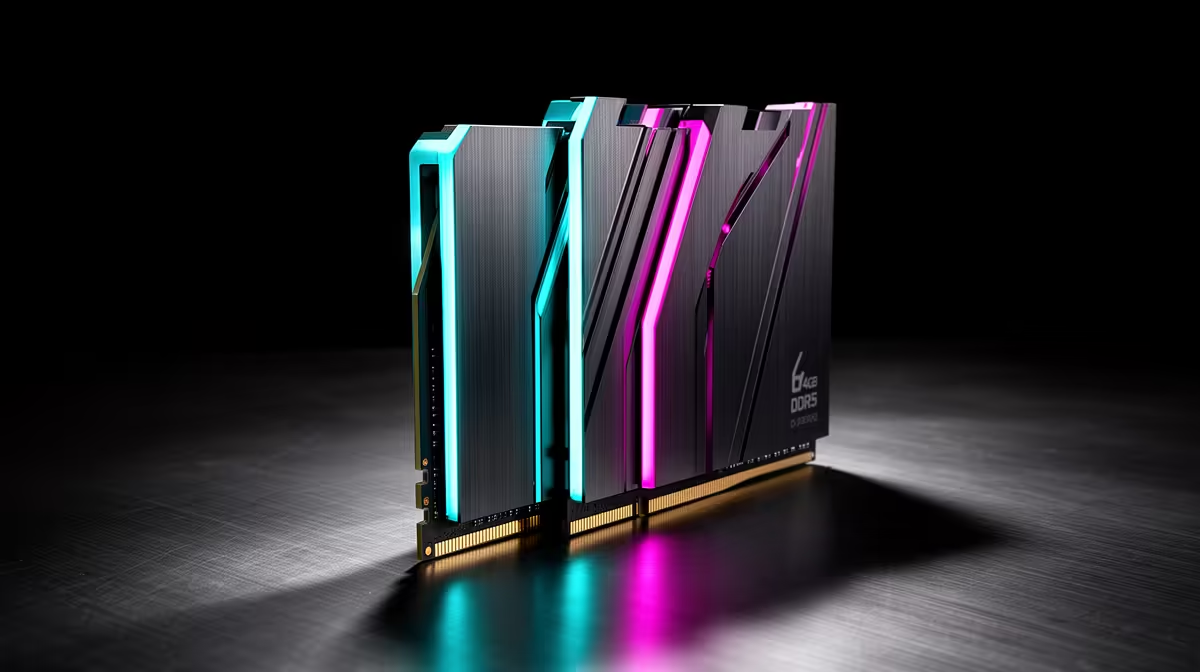
Evetech's DDR5 memory range lets you compare high-capacity matched kits by speed and timings. The memory best sellers provide a current local view without inventing a price for a generic capacity.
Gaming Alone Usually Stops at Headroom
A game, Windows, launcher and voice chat can fit comfortably in 32GB. Once the session has free memory and avoids paging, another 32GB does not feed the CPU or GPU faster by capacity alone.
Some titles allocate large caches when memory exists. Allocation is not the same as need. Compare frame time and page-file activity rather than the biggest In use number.
Heavy mods, simulation and user-created assets can change the result. Test the exact mod pack and save, not the unmodified game's store requirement.
Measure Committed and Available Memory
Open Task Manager, Performance, Memory during the busiest workload. Record In use, Available and Committed. Commit describes memory Windows has promised across RAM and the page file.
Low available memory, commit near its limit and storage activity during stalls indicate pressure. Close a heavy application and repeat. If the symptom clears, capacity is part of the diagnosis.
Keep the page file system-managed on a healthy SSD. Disabling it can crash an application and hides nothing about the real requirement.
Video Editing and Motion Work
High-resolution footage, large timelines, effects and background applications can push beyond 32GB. Editors use RAM for decoded frames, caches and application state.
Measure the largest normal project during playback and export. A 64GB kit can reduce paging and make task switching smoother. It will not repair a weak codec engine, slow source drive or GPU effect.
For enormous projects, 96GB or 128GB can be the proper target. Capacity tiers should follow project evidence, not gaming labels.
Virtual Machines and Development
Each virtual machine reserves or consumes memory beside the host. Two development VMs, containers, an IDE and browser can fill 32GB before a game opens.
Write down the assigned memory and peak host use. Leave enough for Windows and avoid overcommitting merely because the hypervisor allows it.
Large compiles can benefit from file cache and parallel work, though CPU core count and storage remain important.
Local AI and Data Work
Local models can use system RAM for weights, context, offload and data preparation. The requirement depends on model format, quantisation, context and whether a GPU carries part of the workload.
Measure the model and tool you use. Sixty-four gigabytes can be a practical entry point for some workflows and inadequate for others.
Do not assume more system RAM becomes graphics memory at equal speed. PCIe offload is much slower than data held in dedicated GPU memory.
Large Photo, CAD and Simulation Projects
Panoramas, layered photos, CAD assemblies, scientific datasets and simulation can consume memory with project complexity. Application recommendations often separate minimum, recommended and high-end project sizes.
Watch the real project and cache settings. A 64GB kit can keep working data resident, while a slow scratch disk or CPU can still limit the task.
Save the peak use across a week rather than one empty-project screen.
Prefer 2x32GB on a Dual-Channel Desktop
Two 32GB modules populate both channels and leave two slots free on a common four-slot board. That is often easier for the memory controller than four 16GB modules at the same total.
Check module rank, motherboard support and the CPU's memory specification. A 64GB profile can need a lower stable speed than a 32GB kit, especially on older BIOS versions.
Install in the recommended A2 and B2-type slots named by the manual. Labels differ by board.
Four DIMMs Can Change the Speed
Adding another 2x16GB kit fills all slots and combines separately validated sets. Even matching part numbers can use different DRAM revisions.
The platform may train only at a lower transfer rate or need relaxed timings. That is normal electrical load behaviour, not proof the board is broken.
When 64GB is known from the start, one matched 2x32GB kit is the cleaner route.
Check Cooler and Case Clearance
Tall heat spreaders can interfere with large air-cooler front fans. A 2x32GB kit still uses the same slot positions as a smaller pair, but module height varies by model.
Check the cooler diagram and case width. Do not choose a taller module for decoration and then raise the fan into the side panel.
Plain low-profile memory can offer the same capacity and electrical performance.
Use Current Price Evidence Correctly
Compare named 2x32GB kits from the approved July 2026 price pack when making a rand claim. Include speed, timings, voltage and warranty. A bare category minimum is not a 64GB price.
Then compare 2x24GB, 2x32GB and 2x48GB totals for the workload. A 48GB kit can be enough; a 96GB kit can offer cleaner growth.
Do not calculate value per gigabyte until module count and specification match.
Test the Upgrade
Boot at JEDEC defaults, confirm 64GB and run full memory passes. Enable XMP or EXPO after the baseline is clean and repeat testing.
Use an in-Windows memory stress tool and the original workstation project. Watch WHEA events, application errors and idle-to-load transitions.
The upgrade succeeds when paging falls and the project remains stable. A benchmark screenshot without error testing is incomplete.
FAQ
Does 64GB improve FPS over 32GB?
Usually no when 32GB has headroom. It helps when the full gaming session or mods exceed 32GB and cause paging.
Which workloads justify 64GB?
Large editing projects, virtual machines, software builds, CAD, simulation, data work and some local AI workflows.
Should I add another 2x16GB kit?
It can work, but four DIMMs and separate kits may need lower settings. A matched 2x32GB kit is the cleaner planned route.
Log peak committed memory in the real project, then choose a matched 2x32GB kit only when 32GB pressure is already visible.